L'arbre généalogique galactique : quand la chimie des étoiles raconte leur histoire express
Une étoile hérite de la composition chimique du nuage de gaz qui l'a vue naître, tout comme un enfant hérite des gènes de ses parents. Les astronomes ont transformé cela en méthode : en mesurant la proportion de carbone et d'autres éléments grâce à la spectroscopie (la décomposition de la lumière en couleurs), ils reconstituent les arbres généalogiques des étoiles de la galaxie. C'est comme une généalogie, mais au lieu de l'ADN, c'est la chimie qui sert de fil conducteur.
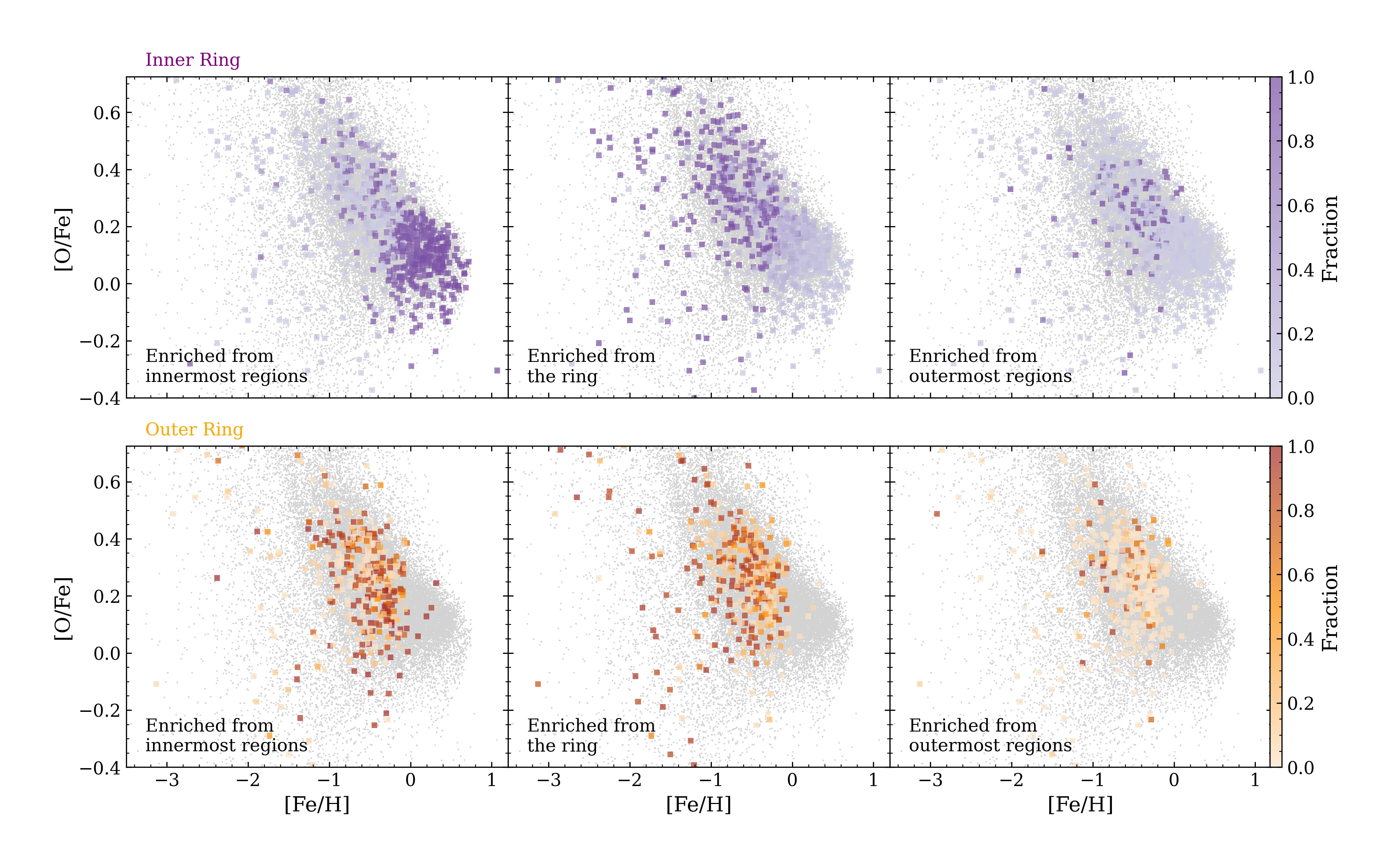
Au centre de la Voie lactée, le gaz s'est accumulé en flux tumultueux, les étoiles sont nées rapidement, s'enrichissant des explosions de supernovae. Leur arbre est un buisson emmêlé aux branches courtes et épaisses. En périphérie, sous l'effet des bras spiraux, le processus s'est déroulé en douceur : l'arbre a poussé avec des branches fines, longues et symétriques.
Cette lignée chimique est une machine à remonter le temps pour les galaxies. Grâce à ces « fossiles », nous lisons l'histoire des éruptions et des vents stellaires, reconstituant la croissance de notre propre Galaxie.
Résumé original
tel que rédigé par les auteurs, en anglais arXiv:2604.11974
Phylogenetic methods, traditionally used in biology to trace the evolutionary relationships among species, are emerging as a powerful framework to reconstruct evolutionary processes in galaxies from chemical information. We apply galactic phylogenetics to study the chemical evolution of stellar populations in distinct regions of a simulated disc galaxy, assessing its capability to unveil assembly histories. We used a high-resolution simulation that follows the chemical enrichment of an isolated disc galaxy, by different stellar progenitors. We track gas particles as they turn into stars and inherit their parent gas chemical composition. Target particles are selected to store the chemical history of each chemical element considered in the simulation. Two regions were analysed: an inner ring, influenced by early bar-driven inflows, and an outer ring, shaped by spiral arms. We built phylogenetic trees for stellar populations in each region and quantified their structure using the Corrected Colless index, a standard metric of tree balance used in biology. The inner ring tree reveals a compact clade of old stars enriched by rapid SNII feedback, followed by a hierarchical sequence with increasing SNIa and AGB contributions. In contrast, the outer ring exhibits more symmetric, caterpillar-like trees with smoother abundance gradients, consistent with more prolonged star formation and efficient local mixing. Chemical enrichment rates corroborate these trends, showing fast early enrichment in the inner ring and gradual, spatially extended enrichment in the outer disc. The structural indices differ significantly between the two regions and converge robustly even for modest stellar samples (NSSP = 100). Galactic phylogenetics provides a novel and complementary tool to decode the fossil record of galaxies.
Certaines des étoiles les plus anciennes de la Voie lactée contiennent à peine d'éléments lourds, comme si elles étaient restées figées à l'époque de l'univers primordial.