Le trou noir flipper : quand la rotation engendre la matière noire express
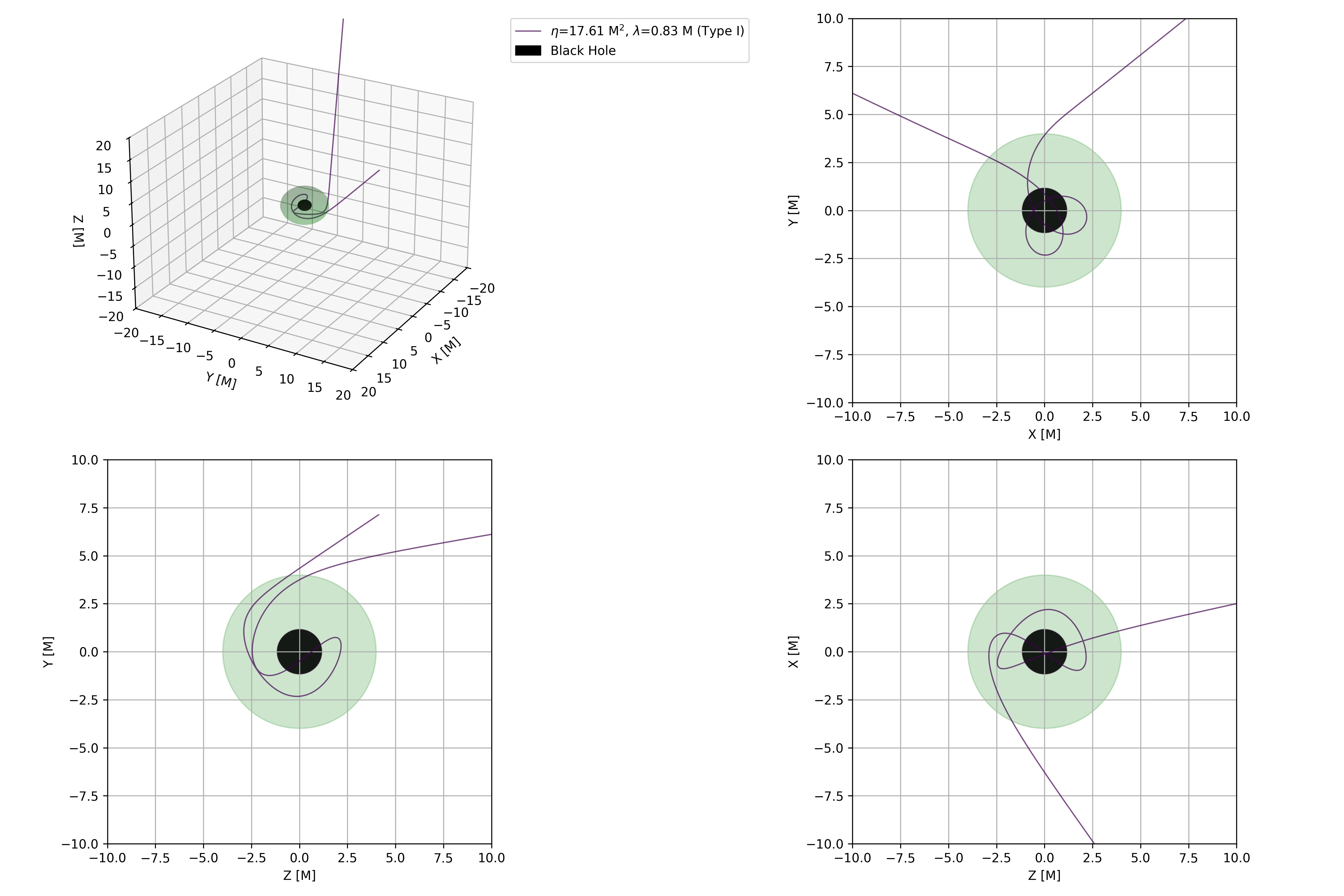
Lorsque la lumière passe à proximité d'un trou noir, elle tombe dans un piège gravitationnel : sa trajectoire est courbée et la particule tourne sur une orbite presque fermée, comme une bille de flipper. Plus cette course dure longtemps, plus grandes sont les chances qu'un photon, sous les secousses des champs magnétiques, se transforme en axion — une particule invisible qui constitue probablement la matière noire. Cette possibilité a été prédite par Frank Wilczek.
Si, pour les trous noirs actifs, la lumière de haute énergie s'affaiblit plus que prévu, cela signifie qu'une partie s'est transformée en axions. Ainsi, le flipper cosmique devient un laboratoire économique pour la recherche de la matière noire, remplaçant les expériences au sol.
Résumé original
tel que rédigé par les auteurs, en anglais arXiv:2605.22696
We investigate photon-axion conversion in the vicinity of rotating Kerr black holes where strong gravity traps photons on near-circular trajectories, effectively enhancing the path length. We explore the observable signatures of such a conversion near the photon region. The process, driven by ambient magnetic fields, is significantly more efficient around supermassive black holes such as M87*, since the luminosity of photons increases with the mass of the BH. By numerically evaluating photon path lengths (on which the conversion depends), we analyze how key parameters-photon frequency, axion mass, photon-axion coupling, magnetic field strength, plasma density, and black hole spin-affect the conversion probability and the resultant dimming of photon spectral luminosity. We find that the conversion is most efficient at high frequencies (X-rays and gamma rays), while the frequency window associated with efficient conversion widens with an increase in the photon-axion coupling and a decrease in the electron density and the axion mass. The magnitude of dimming of the photon spectral luminosity depends primarily on the magnetic field, the photon-axion coupling and the BH spin. Our study reveals that rotating black holes generally exhibit enhanced dimming compared to static ones. Thus, if future telescopes achieving a resolution $$\sim 10^{-5}$$ arcsec in the X-ray/gamma-ray band detect a dimming of the photon spectral luminosity, then they can provide interesting constraints on the axion mass and its coupling with photons.
Dans un flipper, la bille peut tourner pendant plusieurs secondes ; pour le trou noir M87*, la lumière n'est retardée que d'une milliseconde, mais pendant ce temps elle parcourt des dizaines de milliers de kilomètres — et cet instant suffit pour qu'un axion naisse, qui traversera ensuite sans encombre une planète entière.