Le télescope Webb découvre un moulin à poussière cosmique express
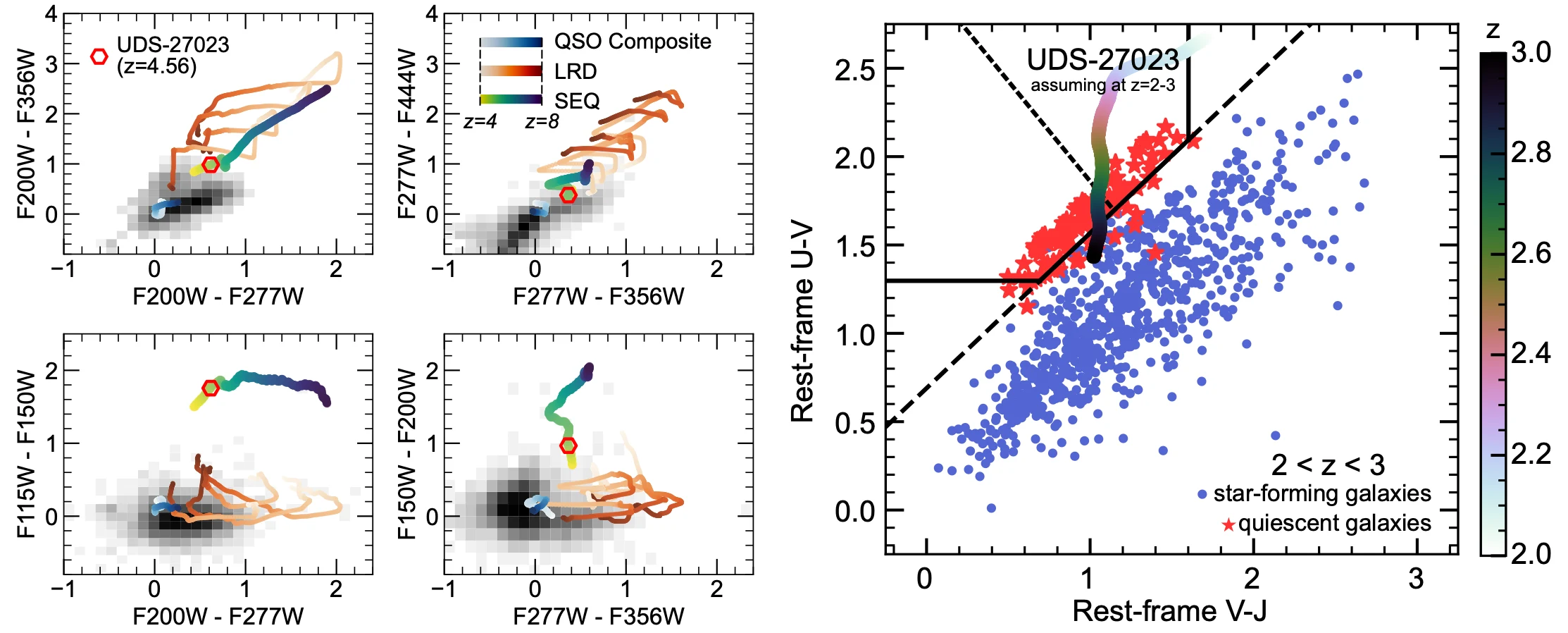
Grâce au télescope James Webb, des astronomes ont plongé leur regard dans un ancien quasar — le cœur éblouissant d'une galaxie où un trou noir géant aspire la matière. Il s'avère que ce dernier ne fait pas que détruire, il crée aussi : ses puissants jets et ondes de choc agissent comme un véritable moulin cosmique. Ils broient les particules de poussière cosmique en une poudre très fine — la même que le sable ordinaire, mais réduite à des dimensions microscopiques.
Et voici le rebondissement : le télescope n'a pas détecté la caractéristique spectrale qui trahit la poussière carbonée — pourtant quasi omniprésente. On dirait que ce moulin est sélectif : il ne traite que les silicates, ignorant le carbone.
Résumé original
tel que rédigé par les auteurs, en anglais arXiv:2606.02685
The rapid accumulation of massive dust reservoirs in the early Universe remains a major challenge in astrophysics. While core-collapse supernovae can inject large dust grains ($$a \gtrsim 0.1\,\mu{\rm m}$$) on short timescales, explaining the total dust budgets in the early Universe likely requires efficient grain growth in the interstellar medium (ISM). Such growth depends critically on an abundant population of small grains, which maximize the surface area available for accretion and may be generated by rapid dust-processing or dust-formation channels. Here, we report the discovery of a QSO UDS-27023 at $$z=4.556\pm0.003$$, identified using JWST/NIRSpec spectroscopy. By quantitatively comparing the spectra to QSO composite templates, we find that UDS-27023 displays an exceptionally steep far-UV extinction curve ($$A_{1500}/A_V \approx 8$$) but notably lacks the 2175 Angstrom bump, indicating a dominance of small silicate dust grains. We interpret this phenomenology as evidence for active small-grain production and processing in the QSO environment. Mechanical shattering of pre-existing large grains by QSO-driven shocks and outflows provides one natural pathway, while in-situ condensation of silicate grains inside dense QSO-driven winds may offer an additional route. Such a population of steep-extinction QSOs (SEQs) may therefore reveal a short-lived phase in which luminous AGN generate, process, and redistribute small grains, potentially facilitating rapid ISM grain growth and enriching the circumgalactic medium.
La lumière de ce quasar a voyagé 12,5 milliards d'années avant d'atteindre le télescope. Nous le voyons tel qu'il était seulement 1,3 milliard d'années après le Big Bang.