Xiaojing Lin

5 articles · 30 co-authors · latest: 2026-09-08
438 citations · h-index 11 · 72 papersData: Semantic Scholar

We have retold 5 papers by this author. 2 of them with a full read. most often about: microlensing, dark matter, exoplanet atmosphere. 30 co-authors across our retellings.

Links in the knowledge graph
Instrumentation2026-02-192 minarXiv:2602.17205express
How to See the Invisible in Space
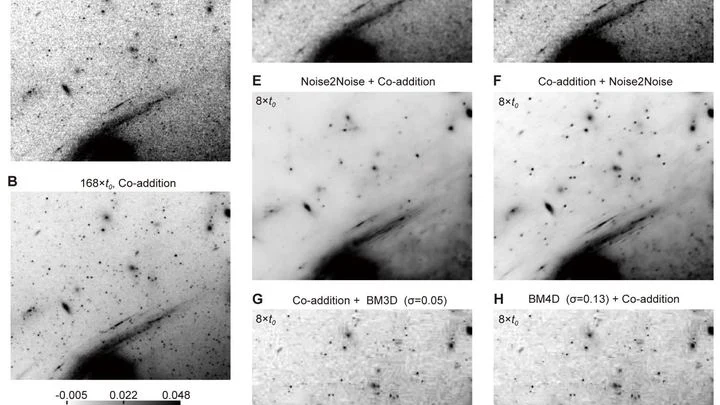
The night sky in a telescope image looks like a photo taken through a fogged-up window: bright stars are visible, but everything faint drowns in a murky haze. That haze is noise — random interference from electronics, heat, and the atmosphere itself.
Galaxies2026-04-242 minarXiv:2604.22702express
More Than a Hundred Distant Stars in a Single Galaxy
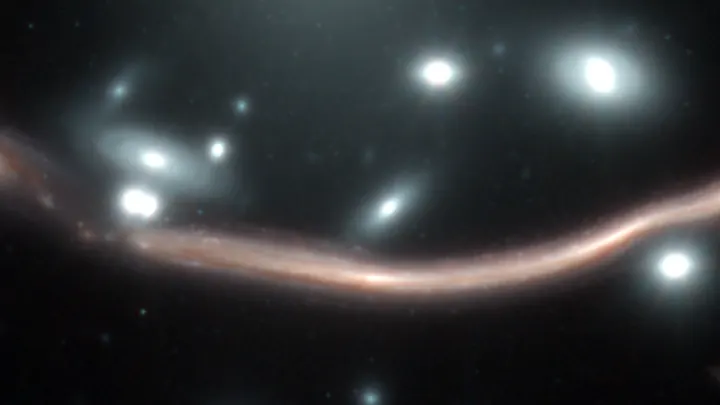
Light from the distant Dragon Galaxy has been traveling toward us for more than seven billion years. On its way, it passes by a huge galaxy cluster whose gravity bends the path of light like a lens. As a result, the galaxy appears brighter and larger than it really is, just as a magnifying glass enlarges fine print.
Galaxies2026-06-011 minarXiv:2606.02685express
Webb Telescope Discovered a Cosmic Dust Mill
Using the James Webb telescope, astronomers peered into an ancient quasar — the dazzling heart of a galaxy where a giant black hole sucks in matter. It turns out it doesn't just destroy, but also creates: its powerful outflows and shock waves act like a true cosmic mill.
Galaxies2026-06-232 minarXiv:2606.25022
Galaxies2026-09-083 minarXiv:2609.08264
Galaxy Blows Metals into the Early Universe
In a village smithy, the blacksmith pumps the bellows, and sparks fly into the darkness. So too in the galaxy AEON-z5, an active nucleus, like a red-hot forge, hurls metal-enriched material far beyond the stellar disk. The James Webb Space Telescope caught this process just a billion years after the Big Bang, when the universe was still in its infancy.