Zheng Cai

6 articles · 30 co-authors · latest: 2026-09-08
35 citations · h-index 2 · 6 papersData: Semantic Scholar

We have retold 6 papers by this author. 4 of them with a full read. most often about: microlensing, dark matter, exoplanet atmosphere. 30 co-authors across our retellings.

Links in the knowledge graph
Instrumentation2026-02-192 minarXiv:2602.17205express
How to See the Invisible in Space
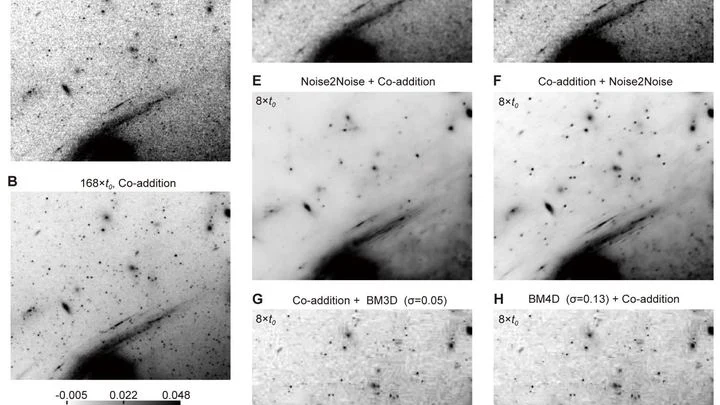
The night sky in a telescope image looks like a photo taken through a fogged-up window: bright stars are visible, but everything faint drowns in a murky haze. That haze is noise — random interference from electronics, heat, and the atmosphere itself.

Galaxies2026-06-011 minarXiv:2606.02685express
Webb Telescope Discovered a Cosmic Dust Mill
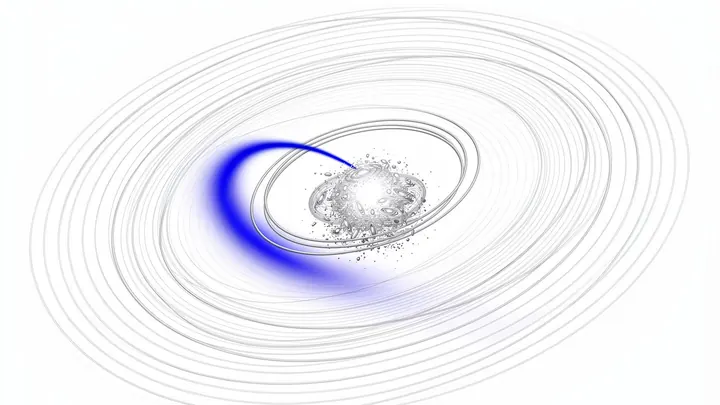
Using the James Webb telescope, astronomers peered into an ancient quasar — the dazzling heart of a galaxy where a giant black hole sucks in matter. It turns out it doesn't just destroy, but also creates: its powerful outflows and shock waves act like a true cosmic mill.
Galaxies2026-06-223 minarXiv:2606.23869
Gravitational Lens Catches Light of First Stars at z≈10
The giant galaxy cluster Abell S1063, lying 4 billion light-years away, works not just as a lens but as a gravitational well of time. Its mass bends space so sharply that photons from an era when the Universe was just 500 million years old slide along curved paths, like rays in slow motion, and converge on us magnified forty-three times.
Galaxies2026-06-232 minarXiv:2606.25022
An Orchestra Without a Conductor: How Collective Light Measurement Lifts the Curse of Incompatibility
At night on a volcano summit, six telescopes stare at the same speck of light. Each catches its own copy of the wave, and if you combine their signals, you get an image that no single instrument could produce alone. But there's a catch: light captured by different stations cannot simply be added like photographs.
Galaxies2026-09-083 minarXiv:2609.08264
Galaxy Blows Metals into the Early Universe
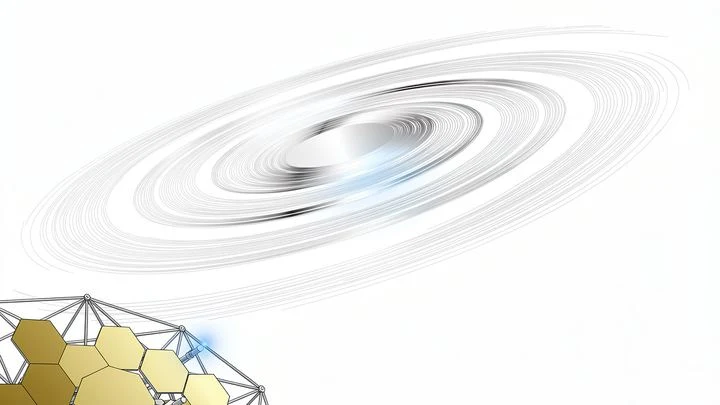
In a village smithy, the blacksmith pumps the bellows, and sparks fly into the darkness. So too in the galaxy AEON-z5, an active nucleus, like a red-hot forge, hurls metal-enriched material far beyond the stellar disk. The James Webb Space Telescope caught this process just a billion years after the Big Bang, when the universe was still in its infancy.