Quand le milieu perd sa stabilité express
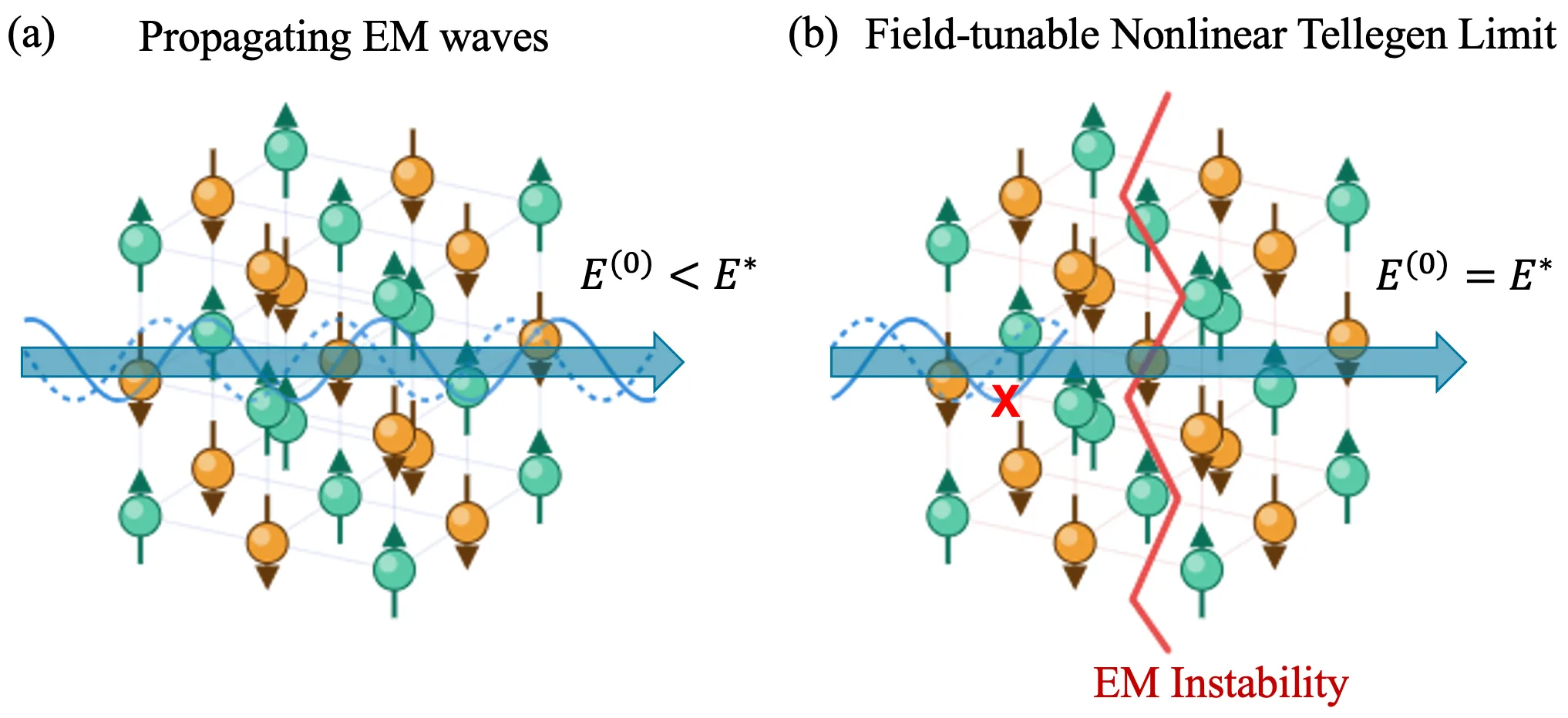
La bobine de Tesla crépite, et un faisceau lumineux commence à tourner autour d'elle. Le milieu qu'il traverse est encore stable — mais le champ augmente, et la rotation s'intensifie. Ce n'est pas un tour de magie, mais le comportement de matériaux particuliers : ils couplent électricité et magnétisme. Pour ce couplage, il existe une limite fondamentale — la limite de Tellegen. Si on la franchit, le milieu perd sa stabilité électromagnétique.
On pensait auparavant que cette limite était rigidement fixée par les propriétés du matériau lui-même. Les auteurs montrent désormais que dans les milieux non linéaires, elle devient ajustable par le champ. Appliquez un champ statique — et le système se dirige vers l'instabilité. Le point critique dépend de la symétrie de la structure magnétique du cristal. Dans ce travail, cela a été vérifié sur deux matériaux : un antiferromagnétique alternant à onde d et un ferrite hexagonal de type M. Leur symétrie dicte la forme du tenseur magnétoélectrique non linéaire et le chemin vers la rupture.
En pratique, cela signifie qu'en modifiant le champ externe, on peut contrôler progressivement la réponse optique jusqu'à la frontière de stabilité. Ensuite — soit la destruction, soit la transition vers un nouvel état. Les auteurs ont construit un diagramme de phases dans l'espace des champs : on y voit où le matériau fonctionne et où il « casse ». Un tel outil sera utile pour le réglage précis des dispositifs utilisant les effets magnétoélectriques — des capteurs aux éléments d'isolation optique.
Résumé original
tel que rédigé par les auteurs, en anglais arXiv:2607.10584
The Tellegen limit is the fundamental electromagnetic stability bound on magnetoelectric media. We show that nonlinear magnetoelectric coupling gives rise to a new Tellegen limit, which we term the nonlinear Tellegen limit. Unlike the linear Tellegen limit, which is fixed by material parameters, the nonlinear Tellegen limit is field-tunable -- a static electric or magnetic field drives the system toward electromagnetic instability at a material-specific critical field determined by the magnetic point group symmetry. The approach to this limit is accompanied by a field-tunable Faraday rotation that grows linearly with the applied field and is bounded from above by a universal maximum set by the nonlinear Tellegen limit -- beyond which the medium becomes electromagnetically unstable. We demonstrate the nonlinear Tellegen limit and the field-space stability phase diagram in two magnetically ordered material systems -- a d-wave altermagnet and an M-type hexagonal ferrite -- showing that the symmetry of the magnetic point group governs both the structure of the nonlinear magnetoelectric tensor and the resulting electromagnetic instability.
La limite de Tellegen porte le nom de l'ingénieur néerlandais Bernard Tellegen, qui a proposé en 1948 un élément de circuit électrique hypothétique — le gyrator. Ce n'est que plus tard que son nom a été associé à la limitation fondamentale des milieux magnétoélectriques.