Лавовые океаны экзопланет экспресс
Планета, чья орбита чуть вытянута, при каждом обороте то ныряет ближе к звезде, то отступает. Переменное притяжение разогревает её, и твёрдые породы плавятся, превращаясь в океан лавы.
На ночной стороне застывшая корка играет роль берега. Приливные волны бьются о него, сталкиваются и создают блуждающие пятна жара. От этого свечение планеты мерцает непредсказуемо, словно пламя свечи. Высота волн достигает нескольких километров — это каменные валы, медленно ползущие по раскалённому простору.
Оригинальная аннотация
как её написали авторы, на английском arXiv:2601.07080v2
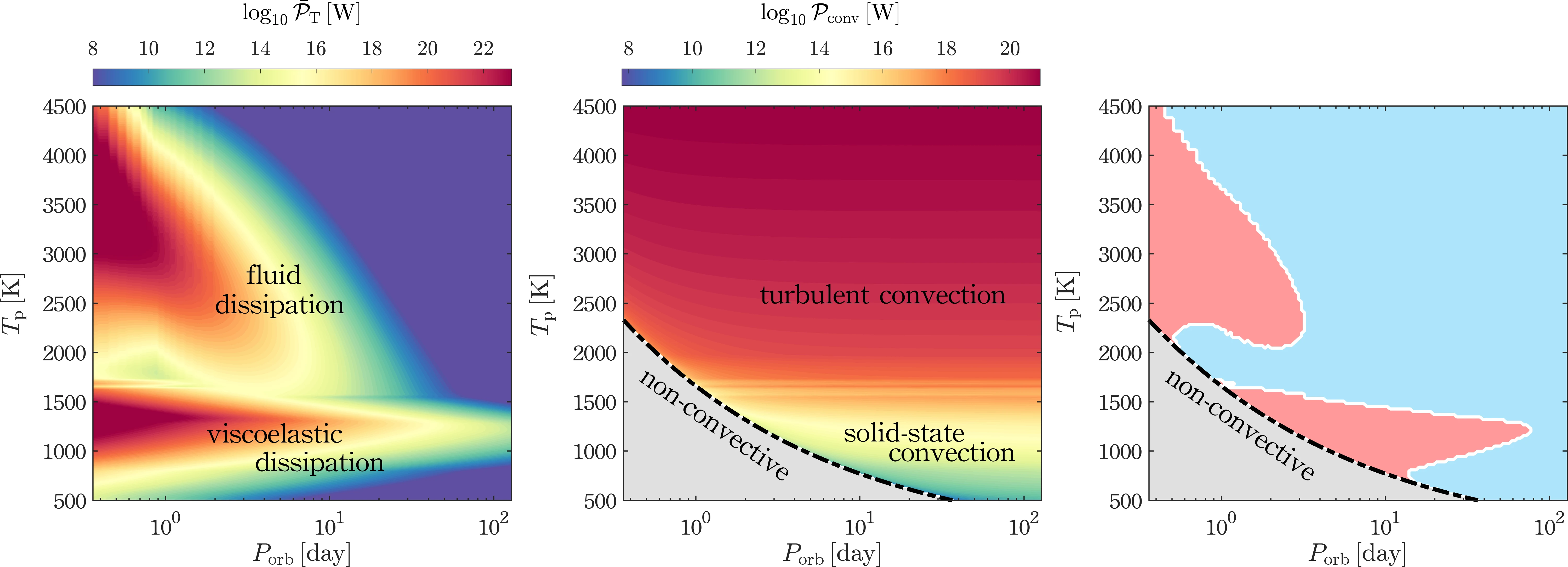
Lava worlds are rocky planets with dayside skins made molten by stellar irradiation. Tidal heating on these shortest-period planets is more than skin deep. We show how orbital eccentricities of just a few percent (within current observed bounds and maintained secularly by exterior companions) can create deep magma oceans. ``Lava tidal waves'' slosh across these oceans; we compute the multi-modal response of the ocean to tidal forcing, subject to a coastline at the day-night terminator and a parameterized viscous drag. Wave interference produces a dayside heat map that is spatially irregular and highly time-variable; hotspots can wander both east and west of the substellar point, and thermal light curves can vary and spike aperiodically, from orbit to orbit and within an orbit. Heat deposited by tides is removed in steady state by a combination of fluid, mushy, and solid-state convection in the mantle. For Earth-sized planets with sub-day periods, the entire mantle may be tidally liquified.
Температура этих лавовых океанов выше, чем в плавильной печи: около 3000 градусов Цельсия.
Лавовые миры, подобные Мустафару из «Звёздных войн», из-за приливов оказываются ещё более бурными, чем в фантастике.