Эхо умолкшей чёрной дыры экспресс
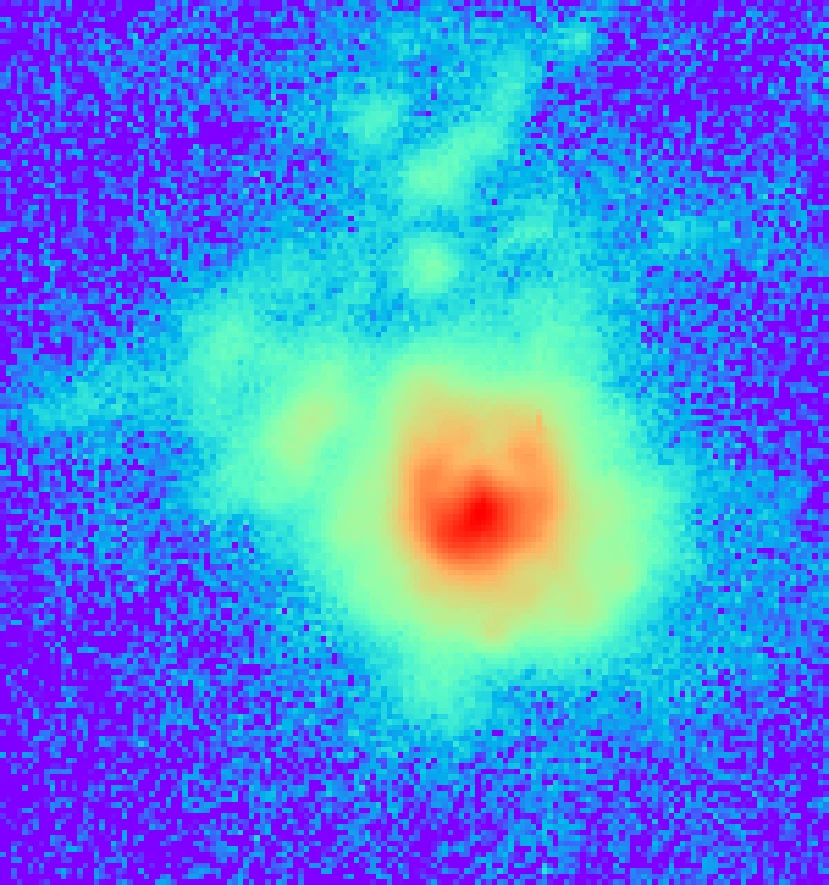
В сердце каждой галактики дремлет сверхмассивная чёрная дыра. Когда она пожирает вещество, окрестности полыхают — это активное ядро. Как узнать о прошлых вспышках, если дыра молчит? Ответ даёт световое эхо.
Подобно эху в пустом зале, где отзвуки блуждают после того, как источник умолк, излучение погасшего ядра странствует по галактике. Астрономы уловили его, измеряя поляризацию — направление колебаний световых волн. В GSN 069 поляризация усиливалась с удалением от центра, а в ядре почти отсутствовала. Значит, источник света погас, но отражённые лучи ещё несут его историю.
Совместный анализ спектроскопии и фотометрии показал, что ядро GSN 069 не просто разрывало проходящие звёзды — оно стабильно светилось, окружённое газовым «бубликом», который направлял излучение. Самое неожиданное: чёрная дыра затихла, когда на Земле уже существовали древние цивилизации. Её сегодняшний сон — лишь короткая пауза в бурной жизни.
Оригинальная аннотация
как её написали авторы, на английском arXiv:2601.08940v1
Context. X-ray quasi-periodic eruptions (QPEs) are repeating, high-amplitude, soft X-ray bursts observed from the nuclei of a dozen nearby low-mass galaxies. Their origin remains a puzzle in the physics of accretion variability. Observational data indicate that X-ray and/or optical tidal disruption events (TDEs) may precede QPE detections. Although both kinds of outburst are driven by supermassive black holes, they are more frequently detected in faded active galactic nuclei (AGNs), when the TDE is not happening in a dormant galaxy. In the case of the QPE discovery source, GSN 069, it remains debated whether its past activity arose from a previous AGN phase or from an enhanced TDE rate. Aims. We investigated the origin of the past nuclear activity in GSN 069. Methods. Past AGN activity imprints detectable polarization in optical light, due to the expected delay between direct and scattered light. On 6 September 2019, we targeted GSN 069 with VLT/FORS2 in both imaging polarimetry and spectropolarimetry modes so that its optical polarization could be investigated while the first detected QPE phase was still active. Results. We measured a rising polarization, from ~0% to ~1.5%, as moving away from the nucleus of GSN 069. This rise is probed to be intrinsic to the central engine, confirming the already detected extended emission line region (EELR) by integral field unit data. Conclusions. The increasing radial polarization demonstrates a switched-off nucleus. The polarization angle traces an axis aligned with elongated [OIII], [NII], and H{\alpha} gas distributions, revealing an EELR that may be consistent with relic polarization cones, therefore suggesting the presence of a torus-like structure in the past. Thus, optical polarization echoes geometrically favor a faded AGN as the origin of the EELR rather than a past elevated TDE rate, although the latter cannot be excluded.
Световое эхо обнажает космические события с задержкой, которая делает нас очевидцами далёкого прошлого — словно мы смотрим фильм, снятый тысячи лет назад.