Однобокий фонтан из молодой звезды экспресс
Молодая звезда, ещё не зажёгшая термоядерную печь, окружена вращающимся диском из газа и пыли. Чтобы набрать массу, ей нужно избавляться от лишнего вращения — иначе вещество не упадёт на звезду, а останется кружиться по орбите. Обычно этот избыток уносится двумя узкими струями газа, которые бьют с полюсов звезды в противоположные стороны, как два фонтана.
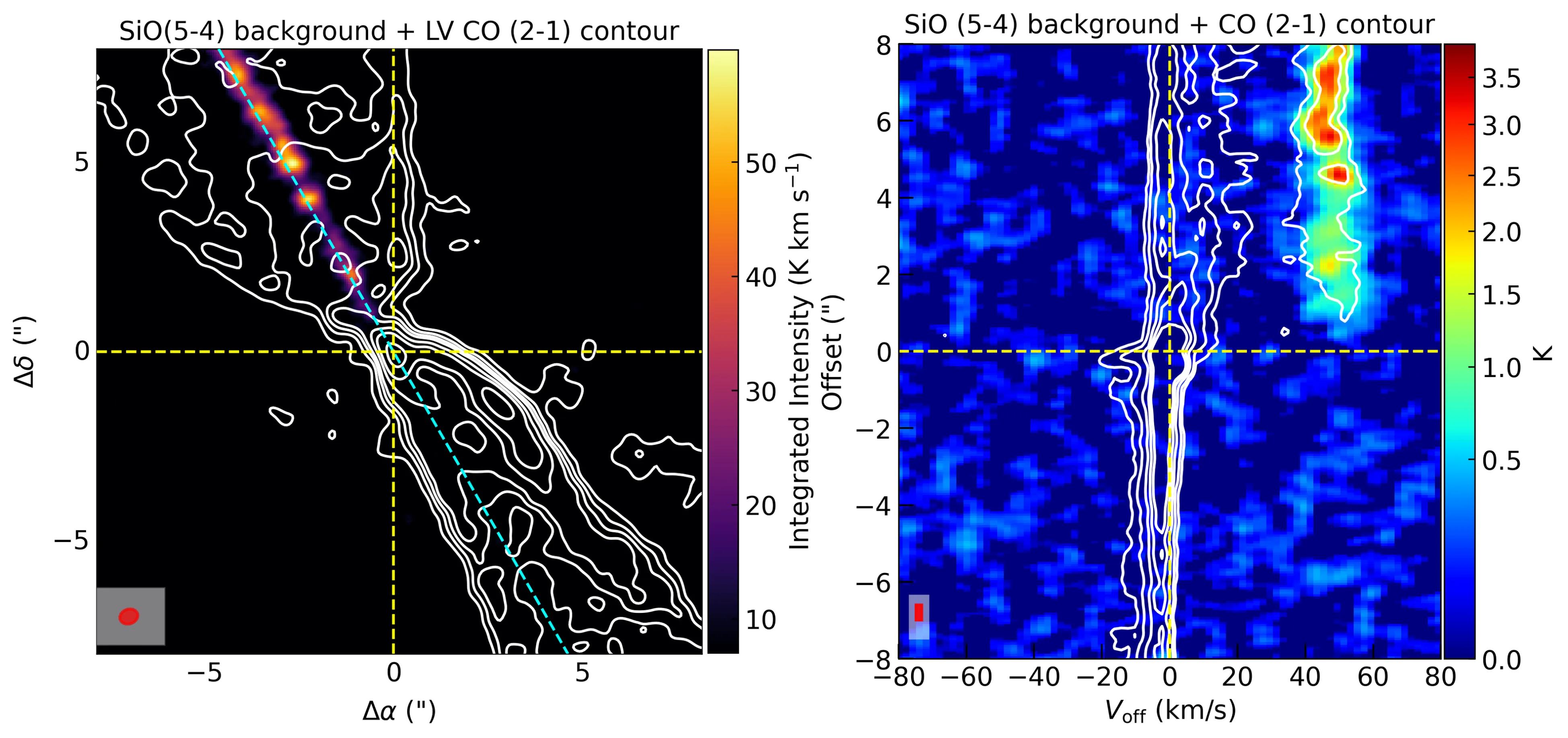
Но у протозвезды HOPS 10 в созвездии Ориона телескоп ALMA увидел только один фонтан. Высокоскоростной джет со скоростью от +44 до +66 км/с направлен лишь в одну сторону, тогда как вторая половина отсутствует. При этом медленный отток газа (от -20 до +30 км/с) наблюдается в обе стороны, как и положено. Диск почти повёрнут к нам ребром, и пыли на пути мало, так что второй джет не может быть просто спрятан за облаком. Следы ударной волны в молекулах SiO подтверждают: струя настоящая, а не случайное облако газа.
Астрономы предполагают, что магнитные силовые линии диска загружены веществом неравномерно: с одной стороны на них попадает больше газа, и именно он выстреливает в виде джета. Это как если бы в двухствольном ружье сработал только один ствол — заряд был только там. Такая асимметрия может многое рассказать о том, как молодые звёзды собирают массу и теряют вращение.
Оригинальная аннотация
как её написали авторы, на английском arXiv:2602.09404
A fundamental challenge in star formation is understanding how a protostar accretes mass from its circumstellar disk while removing excess angular momentum. Protostellar jets are widely invoked as the primary channels for angular momentum removal, yet the mechanism by which they are launched and extract angular momentum remains poorly constrained. Here we report high-resolution ALMA Band 7 (345 GHz) and Band 6 (230 GHz) observations of CO (3-2), CO (2-1), and SiO (5-4) emission from the protostar HOPS 10 (G209.55-19.68S2). The combined data trace both the entrained outflow and the collimated jet with excellent spatial and velocity resolution, revealing a uniquely monopolar protostellar jet, the clearest example reported to date. The system exhibits a distinctly unipolar high-velocity jet with velocity offsets of +44 to +66 km s-1, unlike the predominantly bipolar morphology characteristic of most protostellar jets. While the low-velocity outflow, with velocity offsets of -20 to +30 km s-1, is detected in both directions, the high-velocity jet appears only on one side, and this monopolarity is consistent across all tracers. Given the nearly edge-on geometry and low submillimeter extinction, comparable emission would normally be expected from both lobes. The shock tracer SiO emission confirms a genuine, highly collimated jet rather than cloud contamination, and no ambient structure is capable of obscuring a counterjet. We argue that intrinsically asymmetric mass loading along the disk magnetic field lines provides the most plausible explanation for the observed monopolarity.
Скорость джета HOPS 10 достигает 66 км/с — это быстрее, чем летит пуля из винтовки, но в сотни раз медленнее света.