Суперконденсатор из старой футболки экспресс
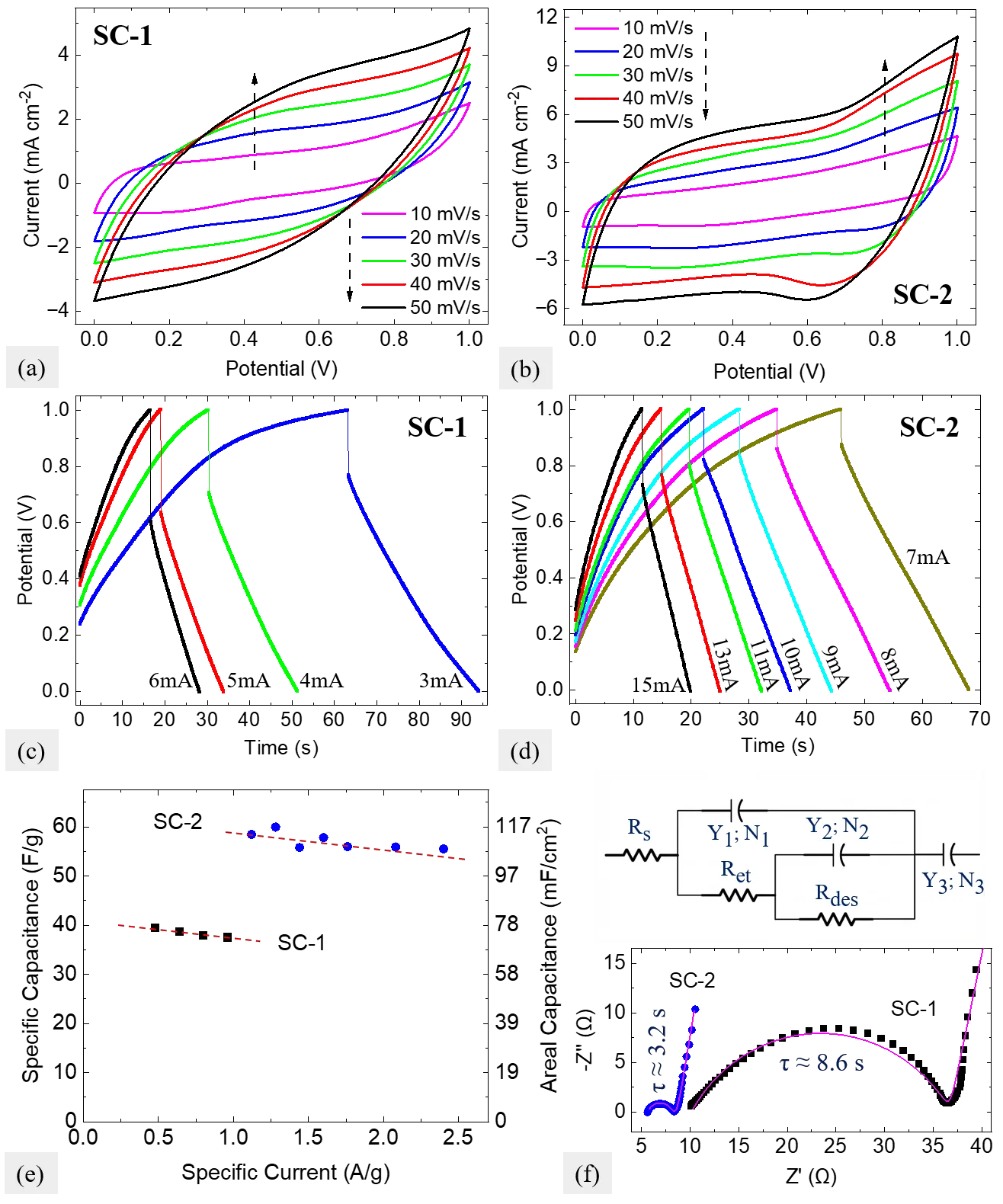
Старую футболку растворили в щёлочи, получили гель — и он стал сердцем накопителя энергии. Второй компонент сделали из хитозана, вещества из панцирей креветок. Никаких металлов: только переработанный хлопок и морепродукты.
Гель пропитали солью аммония, и его проводимость выросла почти вдвое: с 17,1 до 37,8 миллисименс на сантиметр. Это как заменить узкую тропинку для ионов на широкую дорогу — заряды движутся быстрее. В тестах устройство показало время отклика 3,2 секунды, что сравнимо с коммерческими аналогами.
После 1000 циклов зарядки ёмкость не упала, а выросла на 12,3%. Сопротивление немного увеличилось: с 18 до 22 ом. Причина — крошечные следы железа из стального корпуса, которые вступили в реакцию с гелем. В компактной батарейке-таблетке такого бы не было. Это не поломка, а особенность лабораторной установки.
Такой суперконденсатор можно утилизировать без вреда для окружающей среды. Он не требует редких металлов, как литий или кобальт, и сделан из того, что обычно выбрасывают. Возможно, скоро старые джинсы будут питать носимую электронику.
Оригинальная аннотация
как её написали авторы, на английском arXiv:2602.13432
This study presents an eco-friendly and bio-based symmetric supercapacitor using cotton textile waste-derived hydrogels as electrolytes and chitosan-based carbon electrodes as metal-free charge-storage components. Cotton-derived hydrogels were synthesized via an alkaline dissolution-gelation route and modified with ammonium thiocyanate (NH4SCN) to enhance ionic conductivity. The ionic modification increased the hydrogel conductivity from 17.1 to 37.8 mS cm^-1, confirming a nearly twofold improvement in ion transport efficiency. The resulting hydrogel exhibited improved thermal stability, homogeneous ionic transport, and strong polymer-ion interactions confirmed by FTIR and TGA analyses. In a symmetric device, the ion-modified hydrogel enables reduced equivalent series resistance, faster charge-transfer kinetics, and a short time constant (tau = 3.2 s), comparable to commercial energy-storage systems. After 1000 cycles, the device exhibits a 12.3% increase in specific capacitance, confirming stable proof-of-concept operation. Cycling leads to a moderate increase in R_ESR (18 to 22 ohm) and tau (3.2 to 4.1 s), indicating slower charge-ion redistribution. Notably, this R_ESR includes the contribution of the test-cell setup; in compact coin-type configurations, the resistance would be considerably lower. EIS reveals a concurrent rise in interfacial resistive terms, consistent with post-cycling hydrogel darkening and FTIR evidence of Fe-SCN coordination, suggesting that resistance buildup mainly originates from minor Fe-SCN interactions when the expelled liquid reaches the stainless-steel collector, rather than from loss of capacitive functionality. Overall, these results demonstrate the viability of cotton waste-derived hydrogels and chitosan-based electrodes as sustainable components for green energy storage, offering a recyclable and eco-friendly alternative to conventional systems.
Хитозан, использованный в электродах, получают из панцирей креветок и крабов — отходов пищевой промышленности, которых ежегодно образуются миллионы тонн.