Турбулентность ускоряет капли дождя экспресс
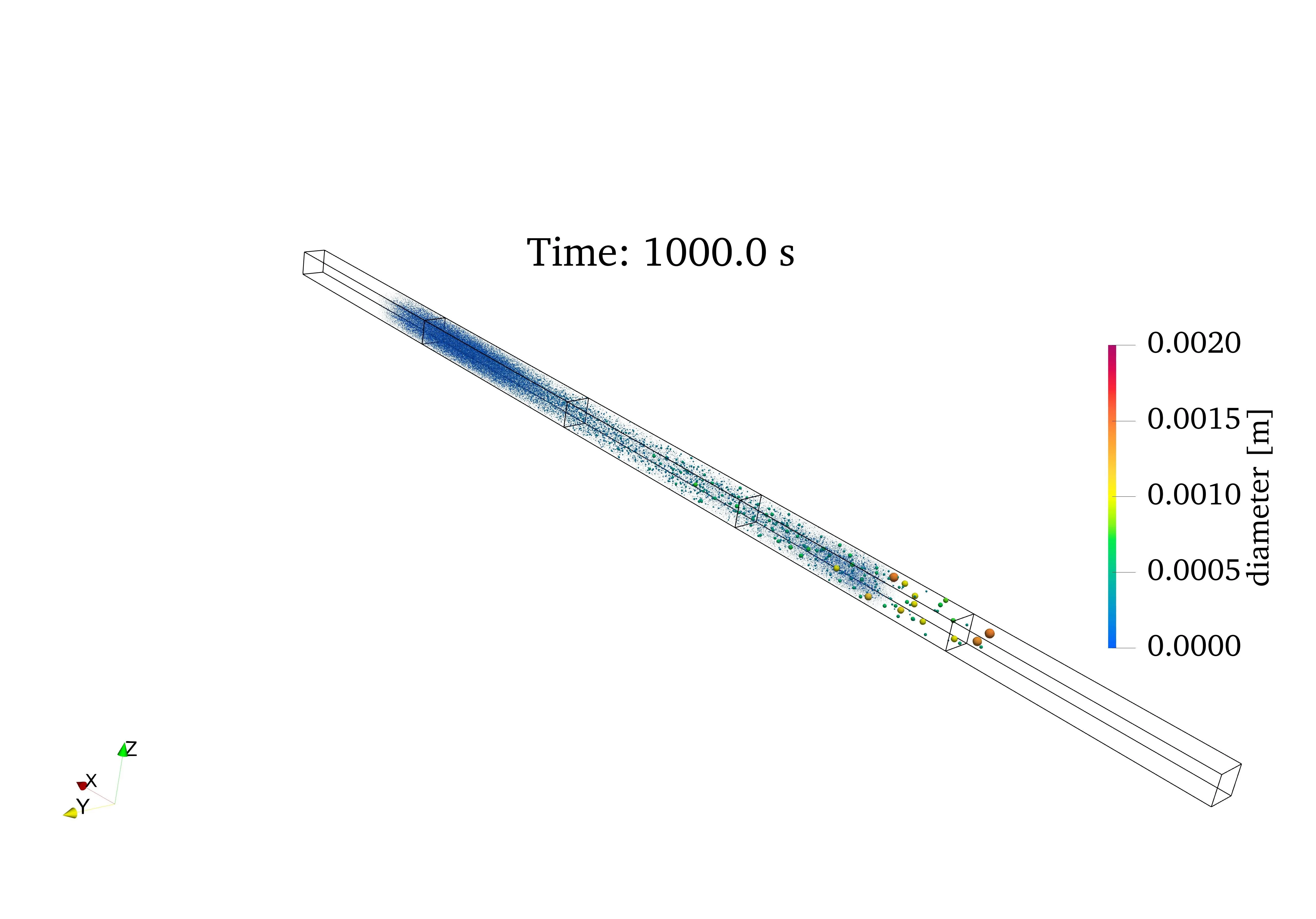
В облаке тысячи крошечных капель воды висят в воздухе. Чтобы пошёл дождь, им нужно вырасти: слипнуться в большие капли и стать достаточно тяжёлыми, чтобы упасть на землю. Но как именно капли находят друг друга в огромном облаке?
Учёные создали компьютерную модель, которая следит за каждой каплей отдельно — как будто у каждой есть свой маленький датчик. Модель охватывает весь столб воздуха от земли до вершины облака. Внутри этого столба они включили турбулентность — беспорядочные вихри воздуха, которые постоянно перемешивают капли. Для сравнения прогнали ту же модель без вихрей.
Результат удивил: вихри работают как невидимые руки, которые сталкивают капли друг с другом. Сначала в середине облака сталкиваются капли одинакового размера — так рождаются первые крупные капли. Потом эти крупные капли, падая вниз, собирают по пути мелкие, как снежный ком, катящийся с горы. Поэтому в турбулентном облаке дождь начинается раньше, и первые капли, упавшие на землю, крупнее, чем в спокойном воздухе.
Оригинальная аннотация
как её написали авторы, на английском arXiv:2604.10564
We developed a new explicit cloud microphysical model, based on direct numerical simulation (DNS) with Lagrangian particle tracking. The model employs a vertically-elongated quasi-1D computational domain extending from the ground to the cloud top to explicitly capture the vertical structure of clouds. This allows us to simulate the all warm-cloud microphysical processes, including activation, condensation growth, collision-coalescence growth, and sedimentation. A homogeneous isotropic turbulence field is incorporated into this domain to explicitly resolve the turbulent wind fluctuations. Cloud microphysics simulations with and without turbulent wind fluctuations were performed to clarify the impact of turbulence on droplet growth. We obtained new insights into the altitude- and time-dependent microphysical statistics, which cannot be obtained through conventional DNS researches for a cubic box domain with periodic boundaries. The comparison have shown that turbulence promoted the collision-coalescence growth of droplets. During the early developing stage, where the updraft was present, turbulence promoted the collisions between droplets with similar sizes (autoconversions) in the middle layer of the cloud. In later stage, relatively large droplets produced by autoconversions actively collected smaller droplets (accretions) in the middle and lower layers. The onset of precipitation at the ground occurred earlier and the first raindrop at the ground was larger in turbulence case than that in non-turbulence case.
Первая капля дождя из турбулентного облака была крупнее, чем из спокойного. Вихри как будто специально собирают для неё больше воды.