Тише зеркала — громче Вселенная экспресс
Зеркала в детекторах гравитационных волн слушают Вселенную, но их заглушает собственное дрожание — как микрофон на шумном вокзале. Тепло внутри заставляет атомы вибрировать, мешая улавливать слабейшую рябь пространства-времени от далёких чёрных дыр и нейтронных звёзд. Райнер Вайсс и Кип Торн десятилетиями искали способ унять этот шум.
Решение — гибридное покрытие: на зеркало наносят тончайший узор, который сам отражает свет почти идеально, а несколько дополнительных прозрачных слоёв компенсируют малейшие неточности. Конструкция получается намного тоньше привычной многослойной стопки, и атомам просто негде трястись — тепловой шум падает примерно в десять раз. Для такого зеркала вибрация от шага человека в паре километров — это оглушительный рёв.
С таким подавлением шума будущие детекторы смогут расслышать не только слияния массивных чёрных дыр, но и более тихие события: взрывы сверхновых или пульсары в двойных системах. Тише зеркала — громче Вселенная.
Оригинальная аннотация
как её написали авторы, на английском arXiv:2605.00714
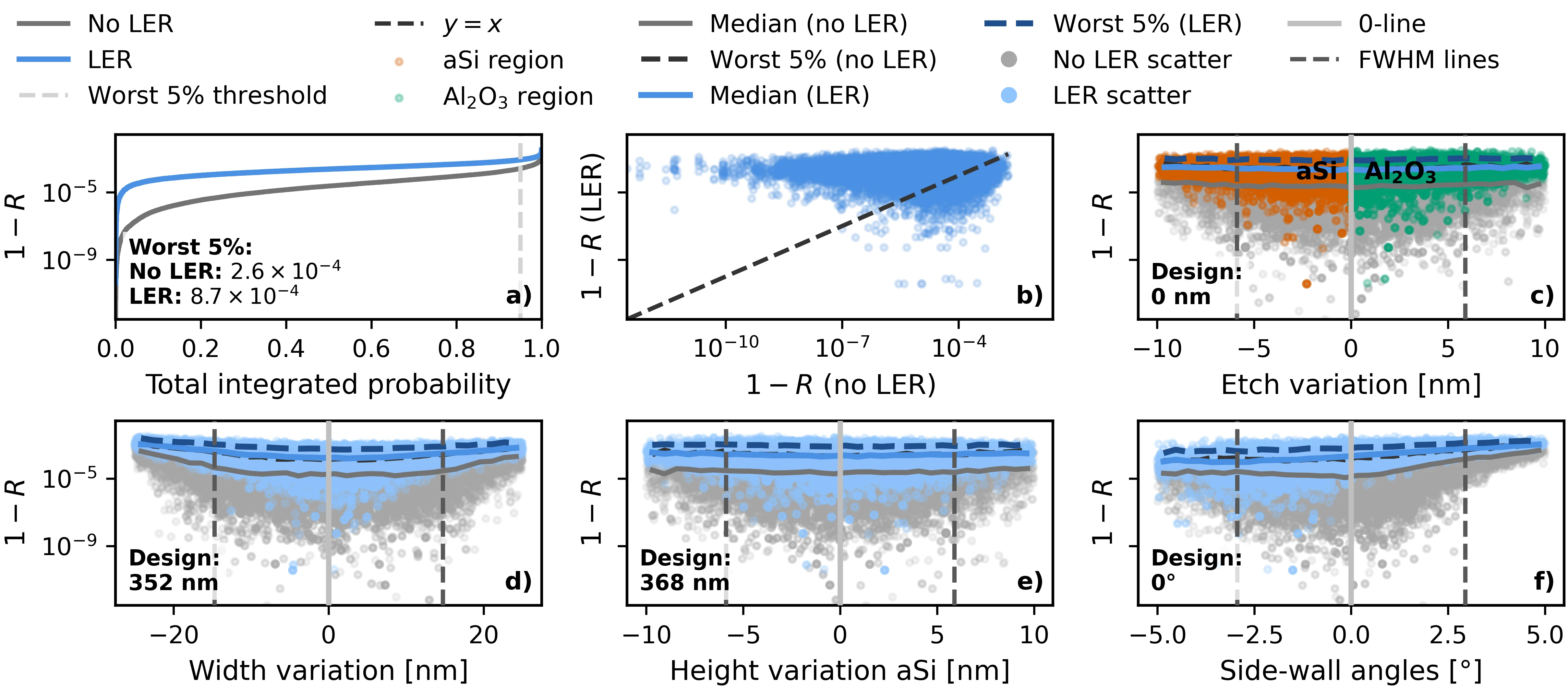
Coating thermal noise in high-reflectivity test-mass mirrors is a major limitation for future gravitational-wave detectors, especially in the 10--300 Hz band. ET-Pathfinder therefore requires mirror coatings that combine very high reflectance at 1.55 micrometer with low thermal noise under cryogenic conditions. Conventional dielectric Bragg mirrors provide high reflectance but require thick coatings, whereas metasurface mirrors can reduce coating-related noise but are limited by fabrication tolerances and line-edge roughness. We present a hybrid metasurface--Bragg mirror concept tailored to ET-Pathfinder. The design combines a fabrication-tolerant one-layer metasurface, an anti-resonant Fabry--Perot spacer, and a reduced dielectric Bragg stack. Optical performance is evaluated using full-wave electromagnetic simulations, while fabrication robustness is assessed with a truncated-Gaussian Monte Carlo analysis. Line-edge roughness is included as a systematic edge-smoothing effect. The resulting reflectance distributions are used to determine the minimum Bragg-stack support required to meet system-level specifications. The ideal metasurface exceeds 99.999% reflectance. When fabrication uncertainties and line-edge roughness are included, the metasurface reflectance is limited to about 99.9% at the 95% yield level. The remaining transmission can be compensated by a supporting Bragg stack with as few as seven layer pairs. For this configuration, the hybrid mirror achieves a total thermal displacement noise about one order of magnitude below the projected ET-Pathfinder coating-noise budget. These results show that fabrication-limited metasurface reflectance can be compensated within a hybrid architecture, enabling reduced coating thickness and thermal noise for next-generation gravitational-wave detectors.
Тепловое дрожание зеркала сравнимо с вибрацией от шага человека за несколько километров — для детектора это оглушительный рёв.
В романе «Контакт» Карла Сагана, чтобы услышать послание звёзд, герои сначала тщательно вычищают все земные помехи — тот же принцип очистки сигнала.