Музыка нейтронных звёзд с экзотической начинкой экспресс
Нейтронная звезда — это кипящий котёл диаметром с город, но массой как полтора Солнца. В её глубинах вещество сжато так, что атомные ядра теряют смысл. Там рождаются странные формы материи: каонный конденсат (похожий на сверхтекучую жидкость) и нейтронные звёзды с гиперонами (тяжёлыми частицами).
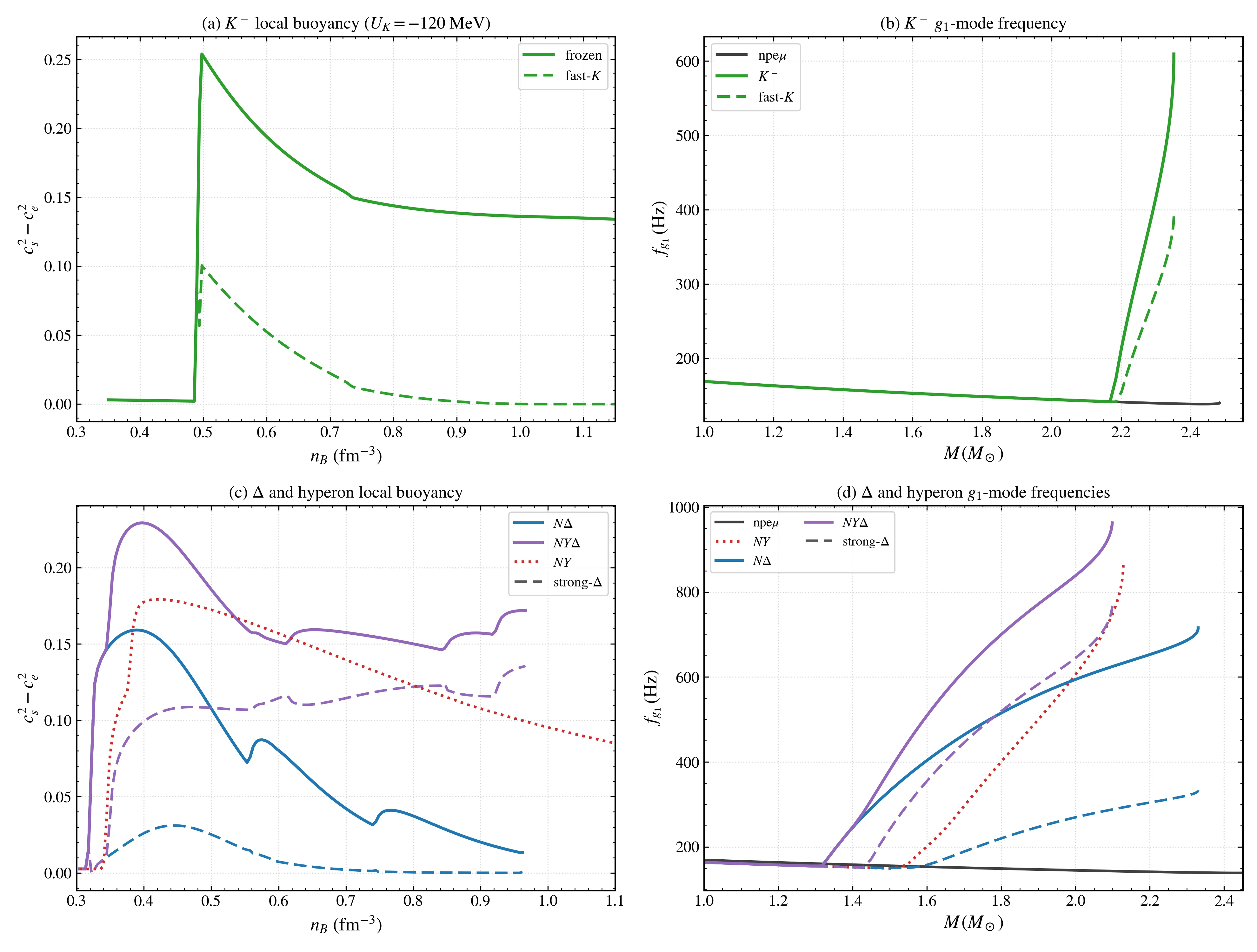
Авторы работы взяли уравнение состояния BigApple и впервые в полной общей теории относительности рассчитали, как колеблется такая звезда. Они следили за g₁-модой — особым типом колебаний, где плавучесть слоёв звезды играет главную роль. Оказалось, что если каоны быстро переходят из нейтронов и протонов, звезда сохраняет до 44% своей плавучей силы, а частота колебаний остаётся выше, чем у обычной звезды. Время затухания при этом растёт в десятки раз.
Так экзотическая начинка меняет музыку звезды, но услышать её будет трудно. Нужны более чувствительные детекторы или более удачные события.
Оригинальная аннотация
как её написали авторы, на английском arXiv:2607.20693
We study core composition \(g_1\) modes of cold, nonrotating neutron stars containing antikaon condensates, hyperons, and \(\Delta(1232)\) baryons and present, to our knowledge, the first calculation in full general relativity of the continuous-composition \(g_1\)-mode frequency and gravitational-wave damping time for stars with a \(K^-\) condensate. Using the BigApple relativistic mean-field equation of state, we compute frequencies, damping times, and frozen-composition tidal overlaps, and identify the buoyancy channels with a species-resolved Ledoux decomposition validated by mode-frequency sensitivities. We compare fully frozen matter with a fast-\(K\) limit for \(n\leftrightarrow p+K^-\) and a strong-equilibrium limit for the \(\Delta\) quartet. Fast-\(K\) equilibration retains \(36\%\)--\(44\%\) of the peak local kaon buoyancy and \(65.7\%\)--\(73.4\%\) of the frozen terminal-configuration frequencies, while increasing the damping times by factors of \(14.4\)--\(31.8\); the mode remains above the nucleonic band. Strong \(\Delta\) equilibration removes most of the direct \(\Delta\)-induced enhancement, returning the \(N\Delta\) mode toward the nucleonic band, whereas the high-frequency \(NY\Delta\) branch survives through the frozen \(\Lambda\) gradient. Eigenfunction tracking confirms a continuous \(g_1\) branch, and representative DD-ME2 calculations reproduce this hierarchy. The direct full-GR frozen-composition phase shifts satisfy \(|\Delta\Phi_{g_1}|\leq1.410\times10^{-3}\) rad, a factor of 21 below the \(0.03\)-rad favorable-event scale for the Einstein Telescope. An exotic species therefore produces a distinct composition mode only if its composition gradient, or a coupled slowly equilibrating gradient, survives over the oscillation period.
Нейтронная звезда вращается так быстро, что её «день» может длиться миллисекунды, а колебания g₁-моды — это медленные внутренние волны с периодами в доли секунды.
В романе «Яйцо Дракона» Роберта Форварда описана жизнь на поверхности нейтронной звезды, где гравитация в миллиарды раз сильнее земной, а ядерные реакции идут за доли секунды.