ضوء أحادي الاتجاه: سحر ذرات ريدبرج سريع
عادةً ما ينتشر الضوء العادي في جميع الاتجاهات، لكن الفيزيائيين حولوه إلى ما يشبه السير الناقل — تدفق أحادي الاتجاه لا يرتد للخلف. ولتحقيق ذلك، قاموا بتمرير شعاعين متعاكسين عبر سحابة من ذرات ريدبرج، المتضخمة إلى حجم ذرة غبار صغيرة. يؤدي الاهتزاز الحراري لهذه الذرات العملاقة إلى كسر التناظر، مما يجبر الضوء على التحرك في اتجاه واحد فقط.
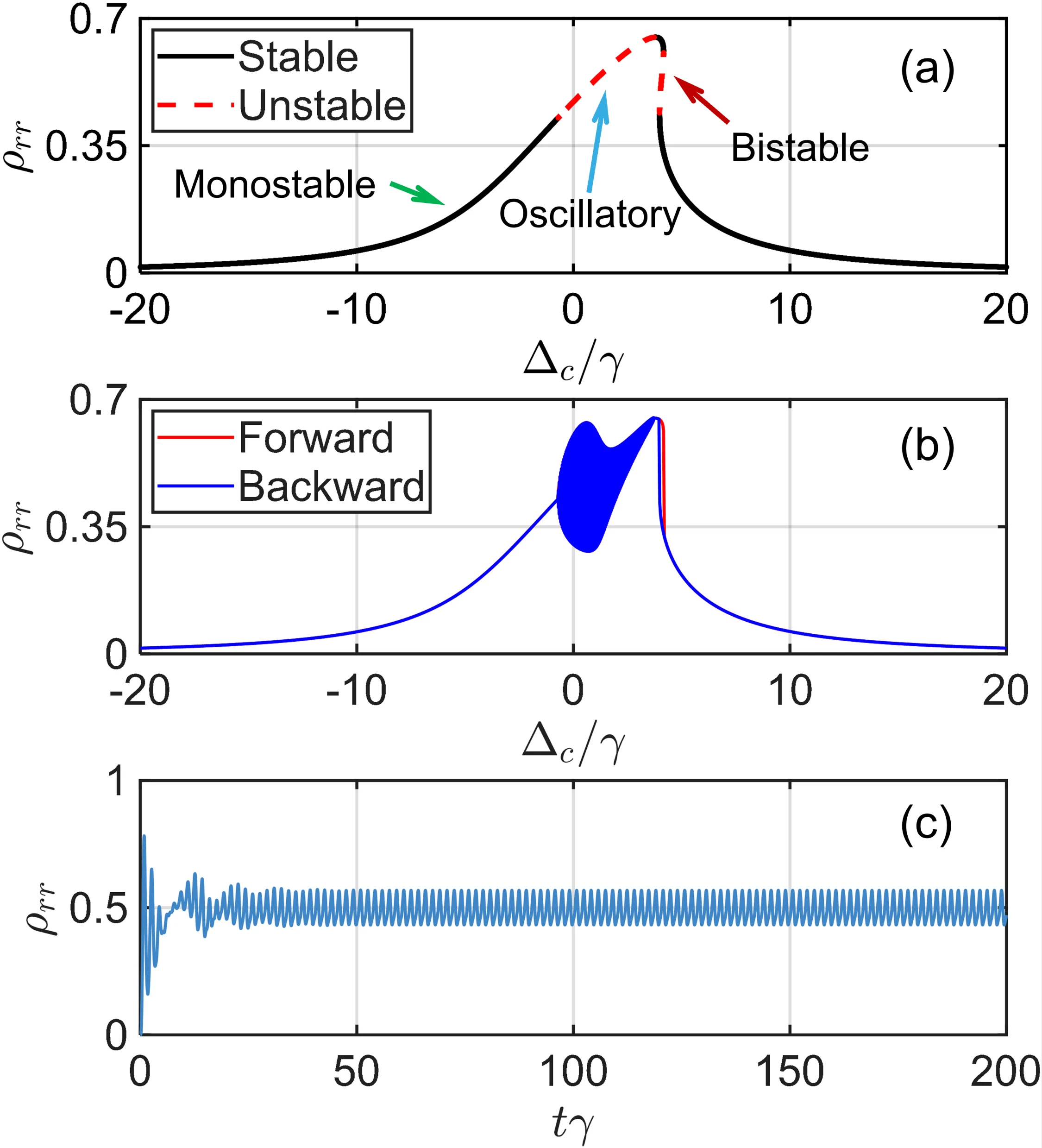
يجبر هذا السير الناقل الضوئي جميع الذرات على التذبذب بشكل متزامن، مثل صناديق تقفز بنفس الإيقاع. تنشأ بنية دورية تشبه البلورة الزمنية — وهي فكرة اقترحها فرانك فيلتشيك في عام 2012. تم اكتشاف هذا التأثير عند درجة حرارة الغرفة باستخدام القياس الضوئي (قياس السطوع) و التحليل الطيفي (دراسة الأطياف). تفتح هذه الحركة أحادية الاتجاه الطريق نحو رقائق بصرية دقيقة خالية من التشويش.
الملخص الأصلي
كما كتبه المؤلفون، بالإنجليزية arXiv:2510.03024
Optical non-reciprocity is a fundamental phenomenon in photonics. It is crucial for developing devices that rely on directional signal control, such as optical isolators and circulators. However, most research in this field has focused on systems in equilibrium or steady states. In this work, we demonstrate a room-temperature Rydberg atomic platform where the unidirectional propagation of light acts as a switch to mediate time-crystalline-like collective oscillations through atomic synchronization. We find that thermal-motion-induced coupling asymmetry, enabled by counterpropagating probe and control fields, generates persistent oscillations; conversely, co-propagation quenches this effect. We identify, through both numerical and analytical approaches, the criteria for realizing optical non-reciprocity within a synchronization regime. These results provide key insights for chiral quantum optics and promote the on-chip integration of non-reciprocal devices in nonequilibrium many-body systems.
يمكن لذرات ريدبرج أن تصل إلى أحجام البكتيريا — حوالي 0.001 ملم، وهو أكبر بآلاف المرات من الذرة العادية.
توصف التذبذبات الإيقاعية التي لا تخمد أبدًا في الخيال العلمي بأنها 'ساعات أبدية' أو شذوذ زمني.