النجوم الأولى: الألعاب النارية التي رآها ويب سريع
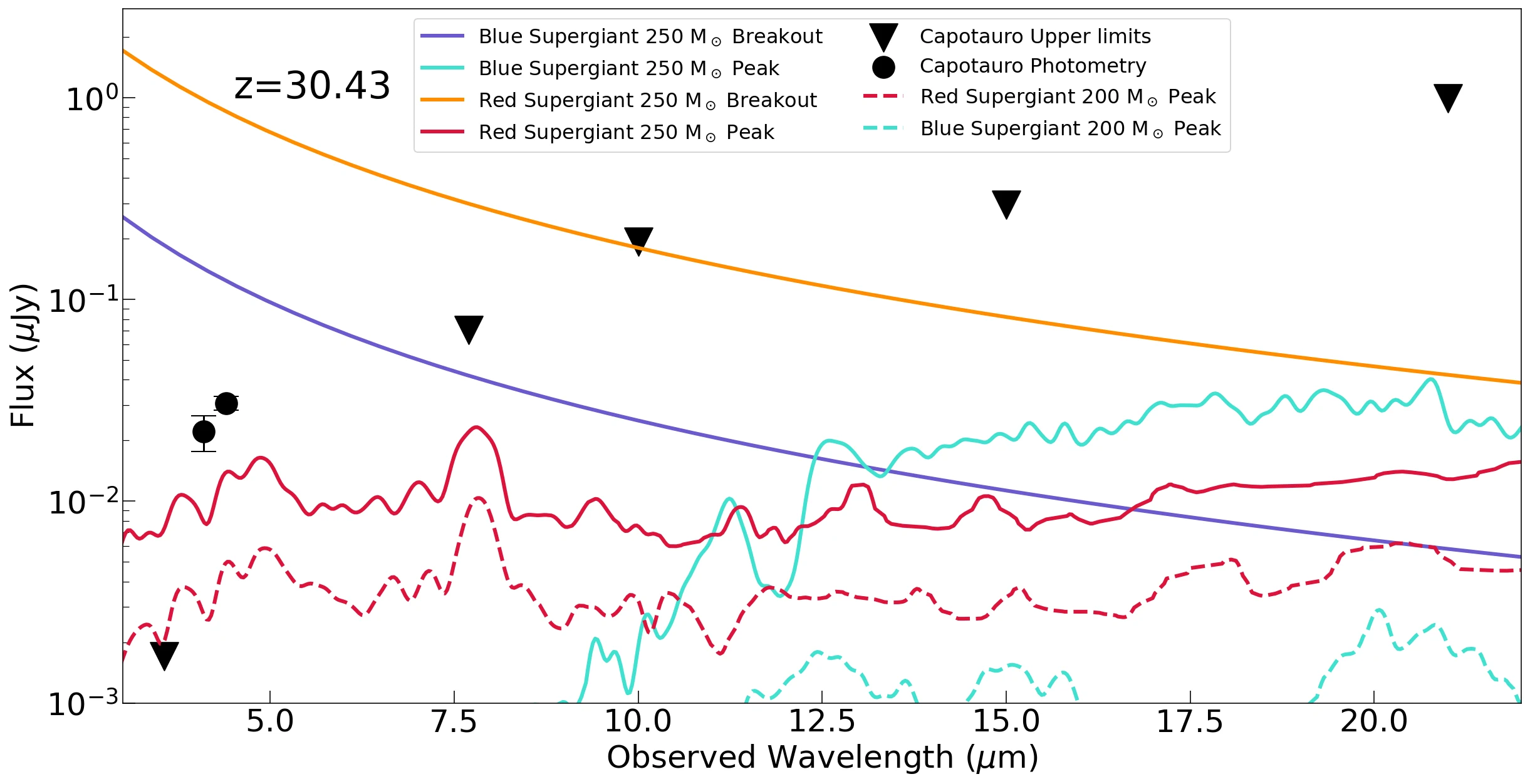
رصد تلسكوب جيمس ويب نقاطًا مضيئة من عصر لم يمضِ على الانفجار العظيم فيه سوى 100 إلى 300 مليون سنة. في البداية، اعتُقد أنها مجرات بعيدة، لكن ثمة فرضية الآن: ربما هي ألعاب نارية منفردة — انفجارات لأول النجوم. بسبب تمدد الكون، تمدد ضوؤها كثيرًا، لكن ويب قادر على التقاطه.
تُسمى هذه الانفجارات مستعرات عظمى غير مستقرة زوجياً. في باطن النجم العملاق، الذي يتكون بالكامل تقريبًا من الهيدروجين والهيليوم، تحول الضوء إلى جسيمات وجسيمات مضادة، مما دمر النجم في لحظة. مثل هذه الأحداث نادرة للغاية — لعبة نارية واحدة لكل حجم هائل من الفضاء. لكن إذا رصد ويب ومضة واحدة على الأقل، فسيكون ذلك أول رصد مباشر لولادة النجوم في الكون.
الملخص الأصلي
كما كتبه المؤلفون، بالإنجليزية arXiv:2601.02469v2
The James Webb Space Telescope (JWST) has spectroscopically confirmed galaxies up to $$z\sim14$$, 300 Myr after the Big Bang, and several candidates have been discovered at $$z\sim15-25$$, with one candidate as high as $$z\sim30$$, only 100 Myr after the Big Bang. Such objects are unexpected, since theoretical studies have not predicted the existence of detectable galaxies at $$z\sim30$$. While any $$z\sim30$$ candidates may be contaminants at lower redshifts, we explore whether such extreme redshift sources could be consistent with hyper-energetic transient events linked to the formation of the first, metal-free, stars. Specifically, we consider pair-instability supernovae (PISNe), a predicted class of extreme thermonuclear explosions that leave no remnant behind. Using cosmological simulations, we investigate an overdense cosmic region, where star formation and subsequent PISNe occur at $$z\sim30-40$$, even within standard cosmology. Assessing the likelihood of such a region, the corresponding number of PISNe at $$z\gtrsim20$$, and their observed flux, we find that JWST has a non-negligible chance to detect a PISN event at extremely high redshifts. If a transient event were confirmed at $$z\sim30$$, this would provide a direct glimpse into the epoch of first star formation, dramatically extending the empirical reach of astronomy.
المستعرات العظمى غير المستقرة زوجياً تحدث فقط في النجوم التي تفوق كتلة الشمس بـ 130 إلى 250 مرة. النتيجة: يتحول النجم بكامله إلى إشعاع، دون أن يترك نجمًا نيوترونيًا أو ثقبًا أسود.
تشبه هذه الألعاب النارية الأولى مشهد “لحظة الخلق” في الخيال العلمي: أضاءت وبددت الظلام البدائي ثم اختفت، فاتحةً الطريق أمام المجرات والحياة لاحقًا.