ذرة غبار ماسية تتحول إلى ليزر صوتي سريع
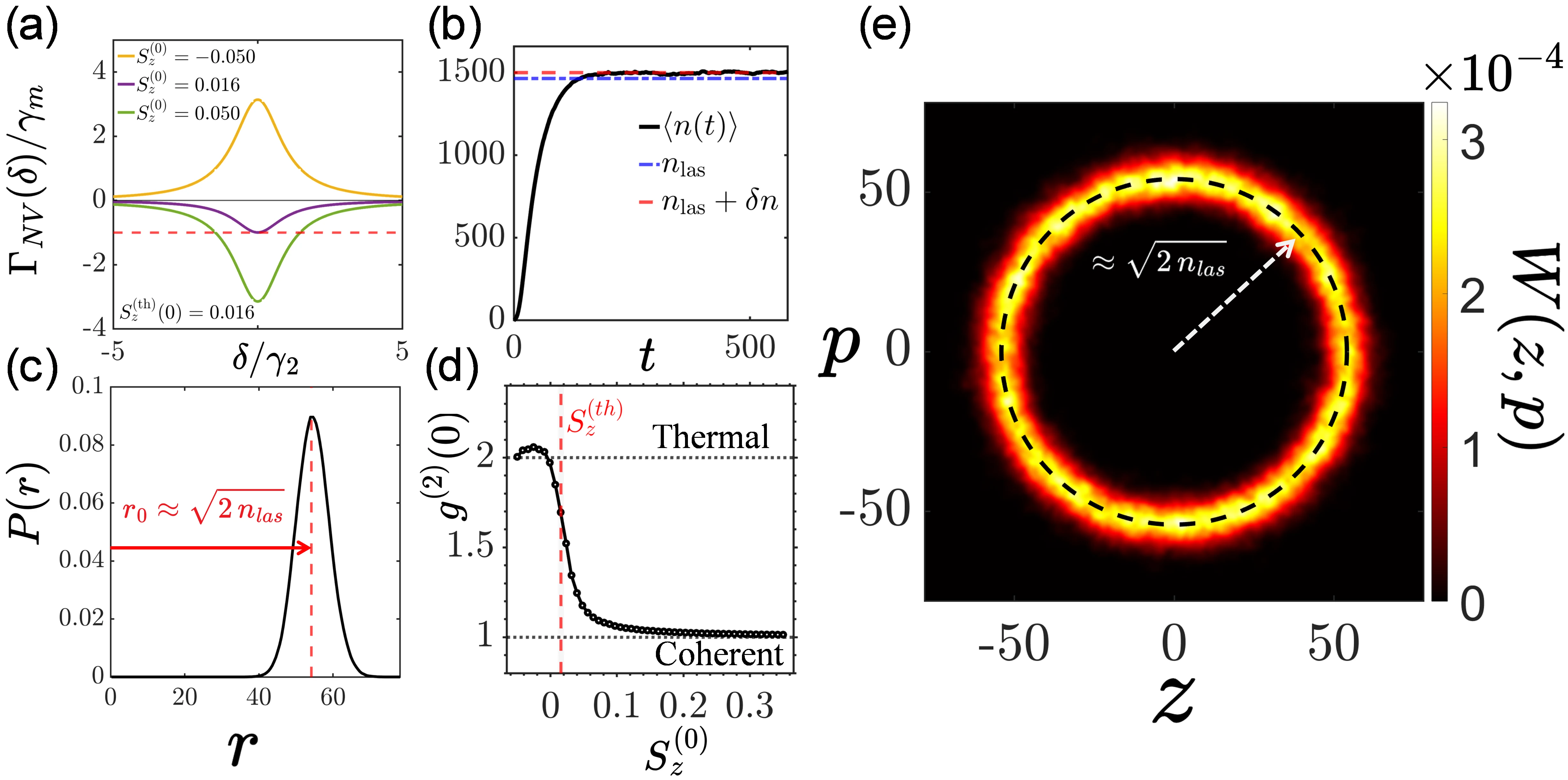
ذرة غبار ماسية من الكربون تطفو في الفراغ على شعاع ليزر. في الداخل — عيب: ذرة نيتروجين بجوار فراغ. تحت تأثير الضوء وأمواج الميكروويف، تبدأ في الارتجاج، مما يُهز الجسيم الماسي بأكمله. هكذا يبدأ الليزر الصوتي: تتحول الدفعات العشوائية الضعيفة إلى طنين قوي ومستقر. تكرر الآلية فكرة تشارلز تاونز، الذي صنع الميزر لأمواج الميكروويف، لكن هنا يتم تضخيم الاهتزازات الصوتية. يكفي تفوق طفيف في الحالات المُثارة — بضعة بالمئة فقط.
تتطابق الحسابات تمامًا مع قوانين البصريات الكمومية. هذا النظام قادر على التقاط موجات الجاذبية أو قوة ارتطام جزيء واحد. وربما، لأول مرة، سيسمح برؤية تأثيرات كمومية — مثل الوجود المتزامن لاهتزازين متضادين — في جسم مرئي بالعين المجردة.
الملخص الأصلي
كما كتبه المؤلفون، بالإنجليزية arXiv:2601.17552
Levitated nanodiamonds hosting a single nitrogen-vacancy (NV) center provide an ultra-low-frequency mechanical mode with widely tunable dissipation and spin backaction under microwave dressing and optical pumping. We demonstrate that the driven NV spin can be tuned to act as an inverted gain medium for the center-of-mass motion, thereby stabilizing an autonomous phonon maser. In the separation-of-timescales regime where spin dynamics is fast, adiabatic elimination yields a reduced mechanical master equation with closed-form, detuning-dependent transition rates and a sharp threshold given by the sign change of the phonon-number damping. For representative levitated-NV parameters, we find that a percent-level dressed-basis inversion is sufficient to reach the threshold, and the small-signal gain can exceed the intrinsic mechanical loss by orders of magnitude. Full master-equation simulations confirm above-threshold self-oscillation and a phase-diffusing, coherent steady state, whose saturation follows the Maxwell-Bloch prediction.
الميزر هو الأخ الأكبر لليزر: تم بناؤه لأول مرة عام 1954 لأمواج الميكروويف، والآن يُحيي المبدأ نفسه الاهتزازات الصوتية في بلورة.
في الخيال العلمي، غالبًا ما تكون البلورات ذاتية الإثارة قلب أجهزة الكشف والمحركات.