حلقة حرارة في مهد نجم سريع
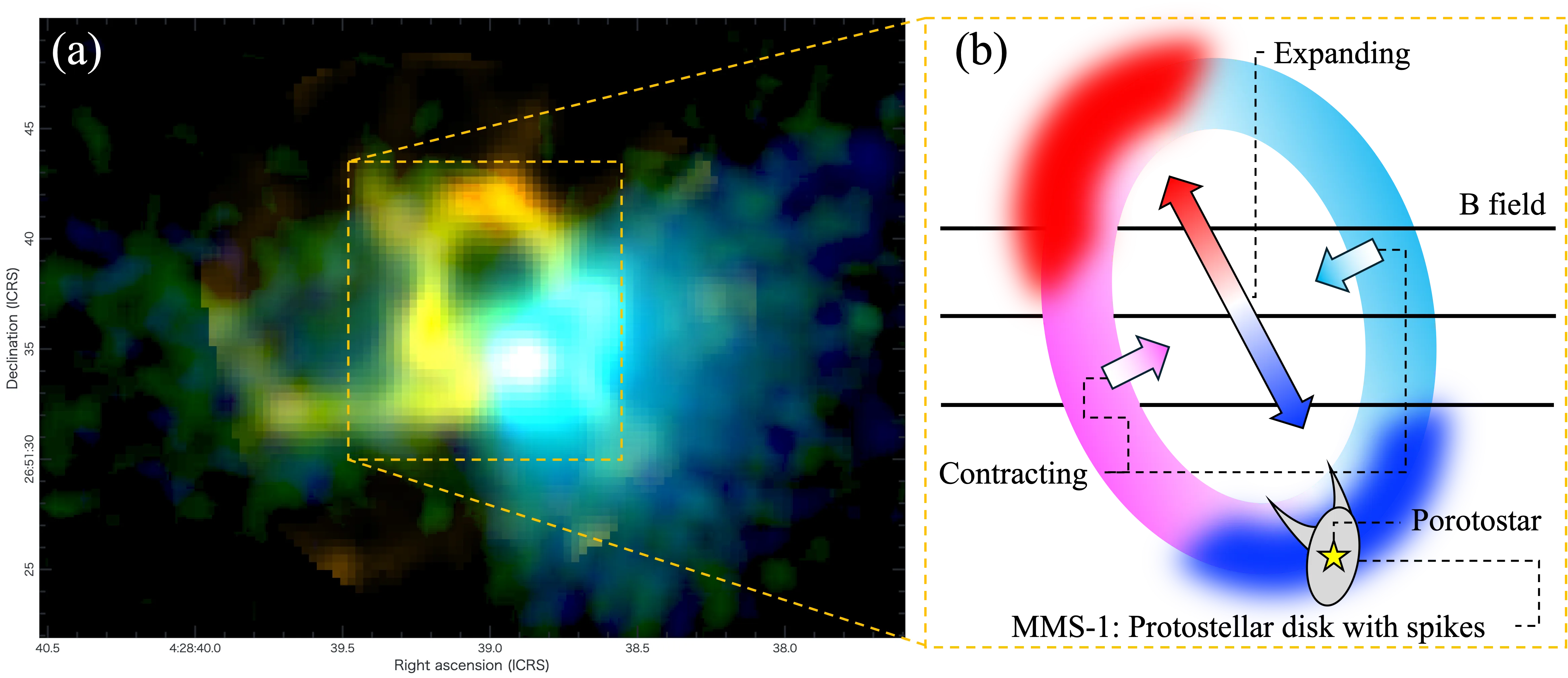
في سحابة غاز باردة ومظلمة، حيث بدأ نجم للتو في التكوّن، رصد تلسكوب ALMA حلقة غير عادية. تتكون هذه الحلقة من غاز أكثر دفئًا وكثافة من الوسط المحيط. لم يكن من الممكن رؤية مثل هذه التفاصيل من قبل، لأن الغاز في مركز السحابة غير شفاف للأرصاد العادية.
يُرجَّح أن هذه الحلقة قد سُخِّنت بموجة صدمية. فعندما تسقط المادة على النجم المتكوّن وتنبعث منه في الوقت نفسه، تتصادم التدفقات وتنضغط بفعل المجال المغناطيسي. عند نقطة التصادم، يسخن الغاز ويبدأ في التوهج في خطوط أول أكسيد الكربون (CO). رصد هذه الخطوط هو وسيلة جديدة للنظر إلى بداية حياة النجم.
يكشف هذا الاكتشاف أنه حتى في أكثر السحب برودة وهدوءًا ظاهريًا، تجري عمليات عنيفة. حلقة الحرارة هي أثر أولى الحركات التي ستشعل في النهاية نجمًا جديدًا.
الملخص الأصلي
كما كتبه المؤلفون، بالإنجليزية arXiv:2602.12661
Infall and outflows, coupled with magnetic fields, rapidly structure the gas around newborn protostars. Shocks from interacting components encode the temperature and density distribution, offering a direct probe of the earliest evolution history. However, interferometric observations characterizing warm envelopes using high-excitation lines remain scarce. We present ALMA Band 9 observations of the Taurus dense core MC 27/L1521F, which hosts a Class 0 protostar, targeting the CO($$J$$=6-5) line at an angular resolution of $$\sim$$2\arcsec\ ($$\approx$$300 au). We detect an off-centered ring-like structure with a diameter of $$\sim$$1000 au that was not identifiable in previous low-$$J$$ CO data, where emission close to the systemic velocity is strongly affected by optical depth. The ring shows a typical peak brightness temperature of $$\sim$$3 K at our resolution. Excitation considerations indicate that the detected CO($$J$$=6-5) emission likely arises from relatively warm ($$T \gtrsim 20$$ K) and dense ($$n({\rm H_2}) \gtrsim 10^{5}$$ cm$$^{-3}$$) gas embedded within the surrounding cold, dense core. The morphology and kinematics suggest an energetic and localized shock-heating event, potentially linked to dynamical gas--magnetic-field interactions in the earliest protostellar phase. Our results demonstrate that high-$$J$$ CO observations provide a powerful new window on warm and dense gas components, enabling a more direct view of the physical processes operating at the onset of star formation.
أول أكسيد الكربون (CO) هو ثاني أكثر الجزيئات شيوعًا في الكون بعد الهيدروجين. وهو يتوهج في نطاق الراديو، لذلك يستخدمه علماء الفلك كـ"طلاء" لرسم خرائط السحب الباردة.