مطبخ كوني: كيف يغيّر الكربون والأكسجين شكل الأقراص سريع
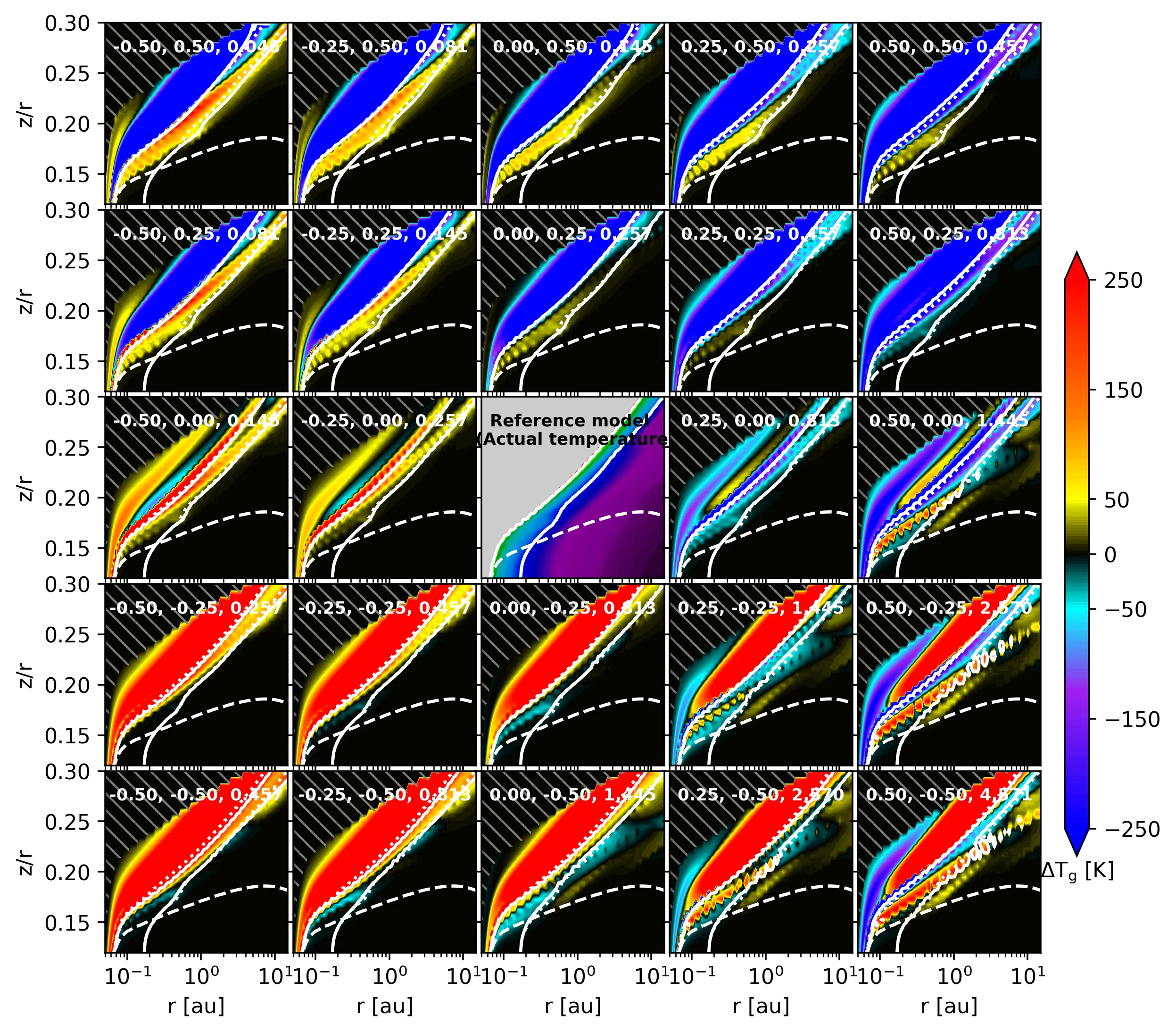
عندما يطبخ الطاهي طبقًا، ليست نسب المكونات هي المهمة فحسب، بل كميتها الإجمالية أيضًا. فكعكتان بنفس نسبة السكر إلى الدقيق، لكن من حصتين مختلفتين في الحجم، ستكونان مختلفتين. وكذلك الحال مع الأقراص حول النجوم الفتية: الكربون والأكسجين هما «التوابل» الرئيسية، وكميتهما المطلقة تغيّر مظهر «المطبخ» الكوني لا تقل عن نسبتهما.
قام علماء الفلك بمحاكاة 25 نموذجًا لهذه الأقراص، مع تغيير محتوى الكربون والأكسجين. اتضح أن التوهج تحت الأحمر للجزيئات — مثل الماء وثاني أكسيد الكربون والأسيتيلين — قد يختلف بأكثر من عشرة أضعاف، حتى لو كانت نسبة C/O متطابقة. السبب هو أن الكمية الإجمالية للعناصر تحدد أين بالضبط في القرص تسخن الجزيئات وتبدأ في التوهج.
وجد العلماء «إشارات ضوئية» مريحة: نسبة سطوع ثاني أكسيد الكربون إلى الماء تشير إلى نسبة الكربون، بينما تشير نسبة الماء إلى الأسيتيلين إلى نسبة الأكسجين. بدمج هاتين الإشارتين، يمكن استعادة نسبة C/O نفسها. هذا يعمل حتى لو كانت بنية القرص معروفة بشكل تقريبي فقط.
الملاحظات الحديثة لتلسكوب جيمس ويب الفضائي تؤكد: في الأقراص حول النجوم الفتية من نوع T الثور، التركيب مختلف بالفعل. ربما نقل المادة داخل القرص والفجوات فيه يخلطان «المكونات»، مما يخلق وصفة فريدة لكل نظام كوكبي مستقبلي.
الملخص الأصلي
كما كتبه المؤلفون، بالإنجليزية arXiv:2602.16030
Mid-infrared observations of planet-forming disks reveal a wide diversity in molecular spectra. Carbon and oxygen abundances play a central role in setting the chemical environment of the inner disk and the spectral appearance. We aim to systematically explore how variations in elemental carbon and oxygen abundances affect the mid-infrared spectra of planet-forming disks, and to identify robust mid-infrared molecular diagnostics of C/H, O/H, and the C/O ratio. Using the thermochemical disk code ProDiMo and the line radiative transfer code FLiTs, we construct a grid of 25 models with varying carbon and oxygen abundances, covering a broad range of C/O ratios. We analyze the resulting mid-infrared molecular emission, including species such as $$\rm H_2O$$, $$\rm CO$$, $$\rm CO_2$$, $$\rm C_2H_2$$, $$\rm OH$$. We find that the mid-infrared molecular spectra are highly sensitive not only to the C/O ratio, but also to the absolute abundances of carbon and oxygen. Despite the same disk structure and C/O ratios, molecular fluxes (e.g., $$\rm C_2H_2$$, $$\rm CO_2$$) vary by more than an order of magnitude. This variation stems from the differences in excitation conditions and emitting regions caused by the elemental abundances of oxygen and carbon. We identify diagnostic molecular flux ratios - such as $$\rm CO_2$$/$$\rm H_2O$$ and $$\rm H_2O$$/$$\rm C_2H_2$$ - that can serve as tracers of C/H and O/H respectively. By combining these diagnostics, we demonstrate a method to infer the underlying C/O ratio. Our model grid provides a framework for interpreting mid-infrared molecular emission from disks, allowing estimates of elemental abundances if the disk properties and structure are known. Comparisons with recent JWST observations suggest that a variety in C and O abundances is seen in a sample of T Tauri disks, possibly shaped by disk transport processes and the presence of gaps.
في أحد الأقراص المحاكاة، كان الأسيتيلين أكثر بعشرة أضعاف مما في قرص آخر، على الرغم من أن نسبة الكربون إلى الأكسجين كانت متطابقة — فقط الكمية الإجمالية للعناصر اختلفت.