ساعة رملية في سحابة مظلمة سريع
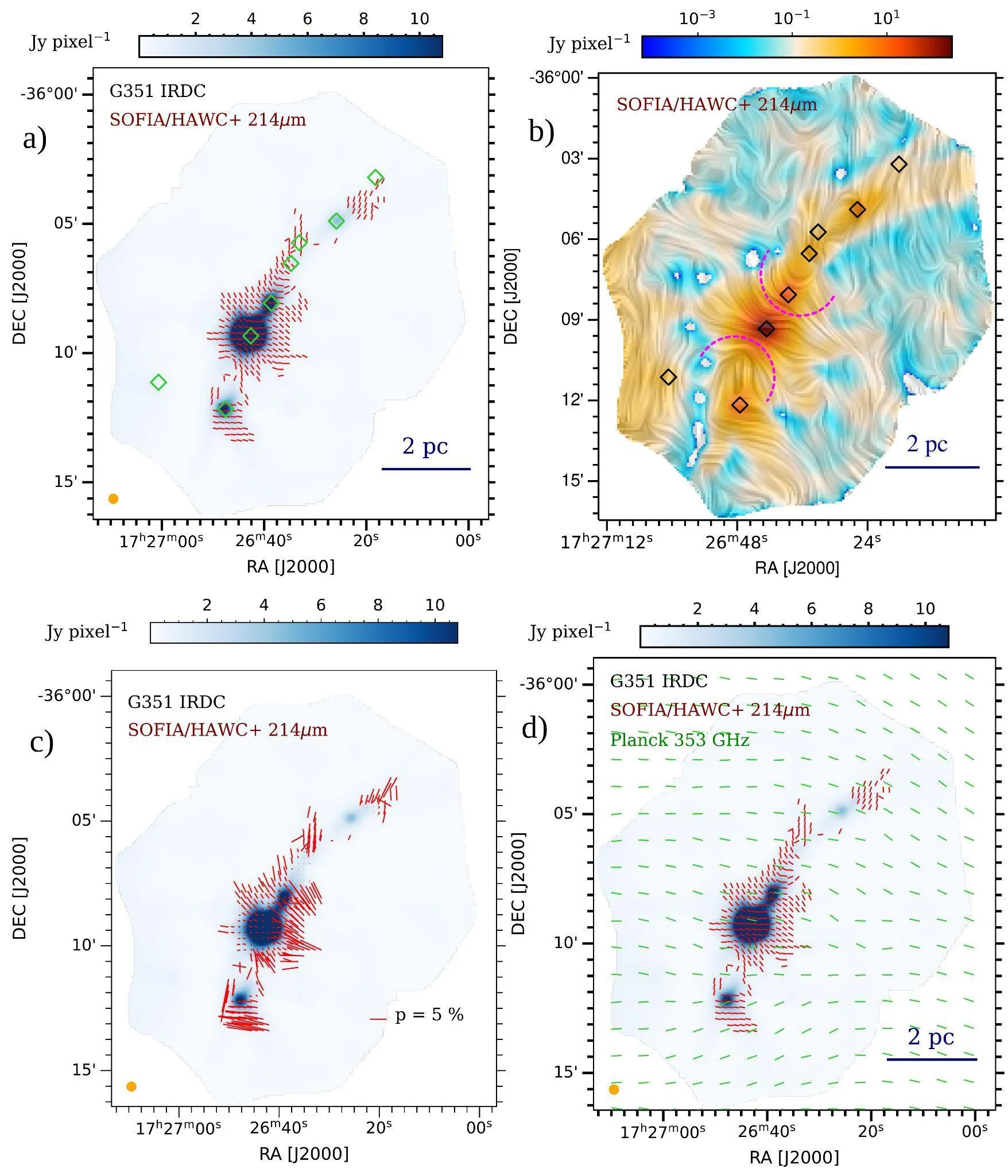
في السحابة المظلمة G351، حيث توشك نجوم جديدة على الظهور من الغاز والغبار، انحنى المجال المغناطيسي مثل الساعة الرملية. هذا الشكل هو دليل على أن المجال لا يراقب ولادة النجوم فحسب، بل يشارك فيها بنشاط.
استخدم العلماء تلسكوب SOFIA المثبت على طائرة لرؤية الغبار في السحابة. تصطف حبيبات الغبار على طول خطوط المجال المغناطيسي، ومن توهجها يمكن تحديد اتجاه المجال. اتضح أنه في جزء من السحابة، انضغط المجال في "برزخ" ضيق، واتسع عند الأطراف - مثل الرمال المتدفقة في الساعة. تصل قوة المجال هناك إلى 0.8 ملي غاوس - وهذا أضعف بحوالي 1000 مرة من مغناطيس الثلاجة، لكنه كثير جدًا لسحابة غازية.
هذا التوازن يعني أن المجال يمكن أن يبطئ انكماش السحابة ويؤثر على عدد النجوم التي ستولد وما هي كتلتها. إذا كان المجال أقوى، فلن يسمح للسحابة بالانهيار بسرعة كبيرة. إذا كان أضعف، ستنتصر الجاذبية وستظهر النجوم بشكل أسرع.
تظهر دراسة G351 أن المجالات المغناطيسية ليست متفرجين سلبيين، بل لاعبون مهمون في ولادة النجوم. بدونها، ربما لم تكن شمسنا لتشتعل أبدًا.
الملخص الأصلي
كما كتبه المؤلفون، بالإنجليزية arXiv:2603.16425
We present the SOFIA/HAWC+ 214 $$\mu$$m polarimetric observations toward the infrared dark cloud G351.77-0.53 (hereafter G351), complemented by existing multi-wavelength data sets. Infrared excess from the embedded sources indicate ongoing star formation activity in the cloud. The G351 cloud hosts two prominent star-forming clumps, i.e., c1 and c2. The plane-of-the-sky magnetic field lines from Planck observations are predominantly oriented perpendicular to the filament's major axis. Magnetic field orientations from SOFIA/HAWC+ 214 $$\mu$$m observations reveal distinct hourglass-shaped field configuration toward c1, while the field lines remain perpendicular to the rest of the filament. Using the Davis-Chandrasekhar-Fermi method, we estimate a mean plane-of-the-sky magnetic field strength of $$\sim$$147 $$\pm$$ 60 $$\mu$$G in the G351 filament, with values reaching $$\sim$$0.8 mG toward c1. The mass-to-flux ratio analysis indicates that the filament is magnetically transcritical, where the gravitational and magnetic field energies are comparable. The hourglass-shaped magnetic field observed toward c1 could result from magnetically regulated gravitational collapse, the alignment of converging sub-filaments with the magnetic field, or a combination of both processes. The energy budget analysis further indicates that magnetic fields play an important role in governing the cloud's gas dynamics, followed by contributions from turbulence and gravity.
السحابة G351 كثيفة جدًا لدرجة أن الضوء المرئي لا يمر عبرها - لذلك يطلق عليها "سحابة مظلمة تحت حمراء". لكن في الأشعة تحت الحمراء، تكشف أسرارها.
في رواية "مشكلة الأجسام الثلاثة"، تلعب المجالات المغناطيسية دورًا رئيسيًا في التحكم بالجسيمات - هنا، يتحكم المجال بسحب كاملة من الغاز.