خيوط مرنة تحول الملابس إلى كاشف للإشعاع سريع
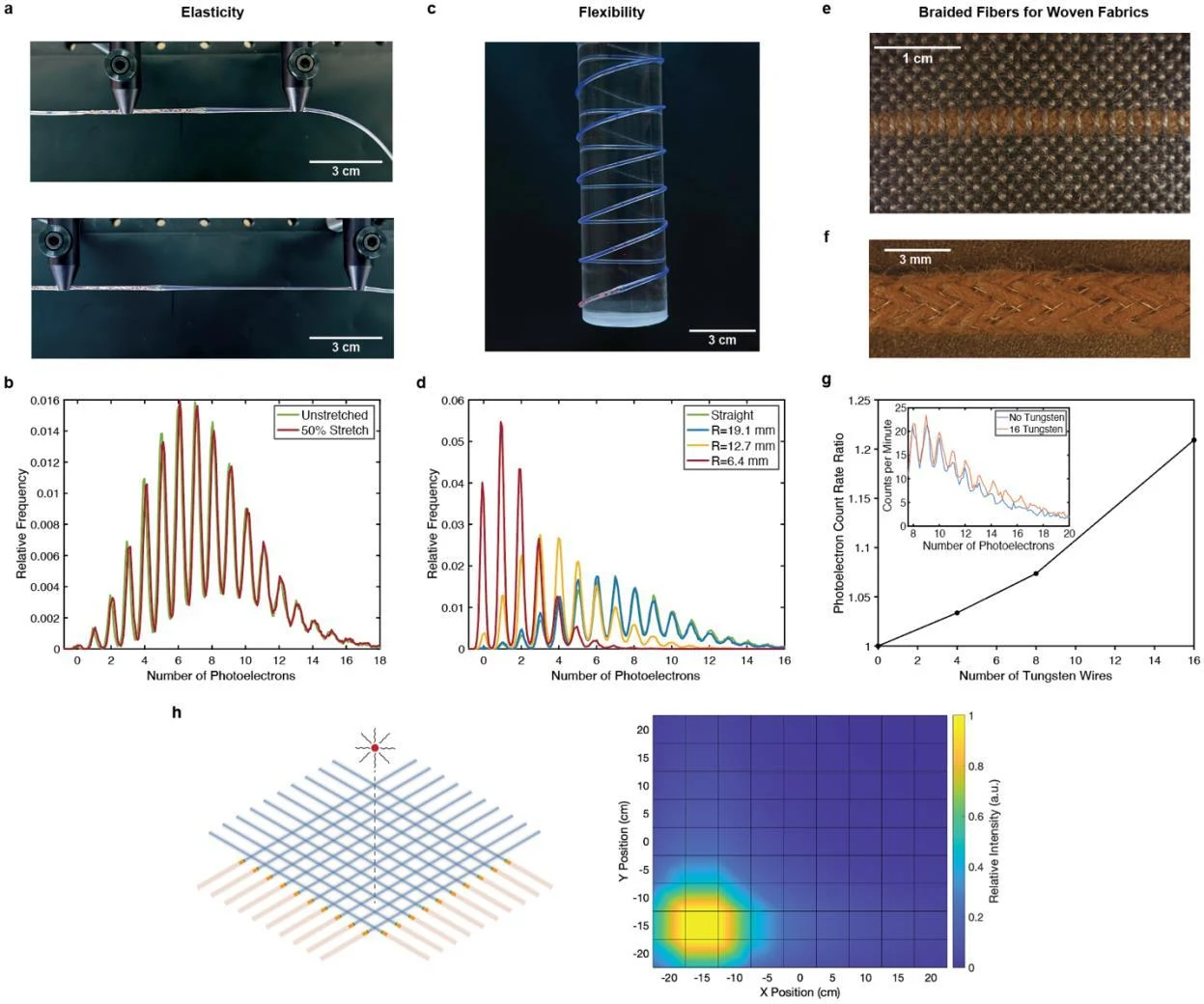
داخل خيط البوليمر الرقيق للغاية توجد بلورات مجهرية — وميضيات. عندما تصطدم جسيمات مشعة غير مرئية، تومض للحظات مثل اليراعات. مستشعر حساس يلتقط كل ومضة من هذا القبيل، محولاً الخيط إلى كاشف مرن.
أظهرت الاختبارات باستخدام سترونشيوم-90 وسيزيوم-137 وكوبالت-60 أن النسيج يستشعر حتى الخلفية الإشعاعية الطبيعية. ولتعزيز الإشارة، أُضيف التنجستن وصوف المارينو إلى الغلاف — وقد أدى هذا المزج بين المعدن والصوف الناعم إلى زيادة الحساسية بنسبة 20% بشكل غير متوقع. يحول التنجستن أشعة غاما إلى وابل من الإلكترونات، تلتقطها البلورات بسهولة أكبر. يساعد هذا أيضًا في تمييز أنواع الإشعاع، مما يمهد الطريق لإجراء أبحاث محمولة حول الجسيمات الأساسية، والملابس الذكية التي تنذر بالخطر في المحطات النووية والعلاج الإشعاعي.
الملخص الأصلي
كما كتبه المؤلفون، بالإنجليزية arXiv:2604.05061
Nuclear radiation detectors play a key role in applications spanning nuclear and particle physics, nuclear engineering, security, and medicine. With the expanded global interest in nuclear power, discreet, inconspicuous, and readily deployable nuclear detection capabilities are increasingly important. However, conventional dosimeters are often rigid, bulky, or lack spatial resolution, limiting their use for mobile, conformal, or large-area distributed mapping of dynamic fields. Here, we present flexible, radiation-sensitive optoelectronic fibres with up to 50% elasticity for real-time gamma dosimetry. Silicon photomultipliers are thermally drawn into the core of fibres composed of a scintillator waveguide, enabling electronic-photonic integration and detection of scintillation light with single-photon resolution. We show that these fibres are sensitive to localized nuclear radiation exposure from collimated 0.5 {\mu}Ci Sr-90 {\beta}-sources and 10 {\mu}Ci Cs-137 and Co-60 {\gamma}-sources, with extended responsivity measured over 30 cm, and estimated lower detection limits approaching near- background radiation levels (~14-41 nSv/hr). Co-locating the scintillator and detectors in the fibre eliminates past length limitations driven by optical losses and enabling a greater collection cone through capture of transient non- guided modes. We further enhance radiation sensitivity and mechanical robustness by covering the fibres with a tungsten-merino wool composite braid, enabling us to machine-weave them into fabrics alongside common textile yarns. The tungsten wires function as a gamma-electron converter, increasing the detection efficiency of the assembly by ~20%. Distributed woven arrays of fibres formed in this way present an opportunity to create large-area, conformal fabrics capable of real- time dosimetry of gamma radiation fields with high spatial resolution.
أول أجهزة كشف الإشعاع، التي عملت عليها ماري كوري وإرنست رذرفورد، تطلبت مختبرات كاملة. أما الآن فيمكن ارتداء الكاشف كسترة.
في رواية إسحاق أسيموف 'المؤسسة'، ذُكرت مقاييس الجرعات الشخصية، لكن أجهزة الكشف القماشية أصبحت الآن واقعًا.