أشباه النجوم: ثقوب سوداء داخل العمالقة سريع
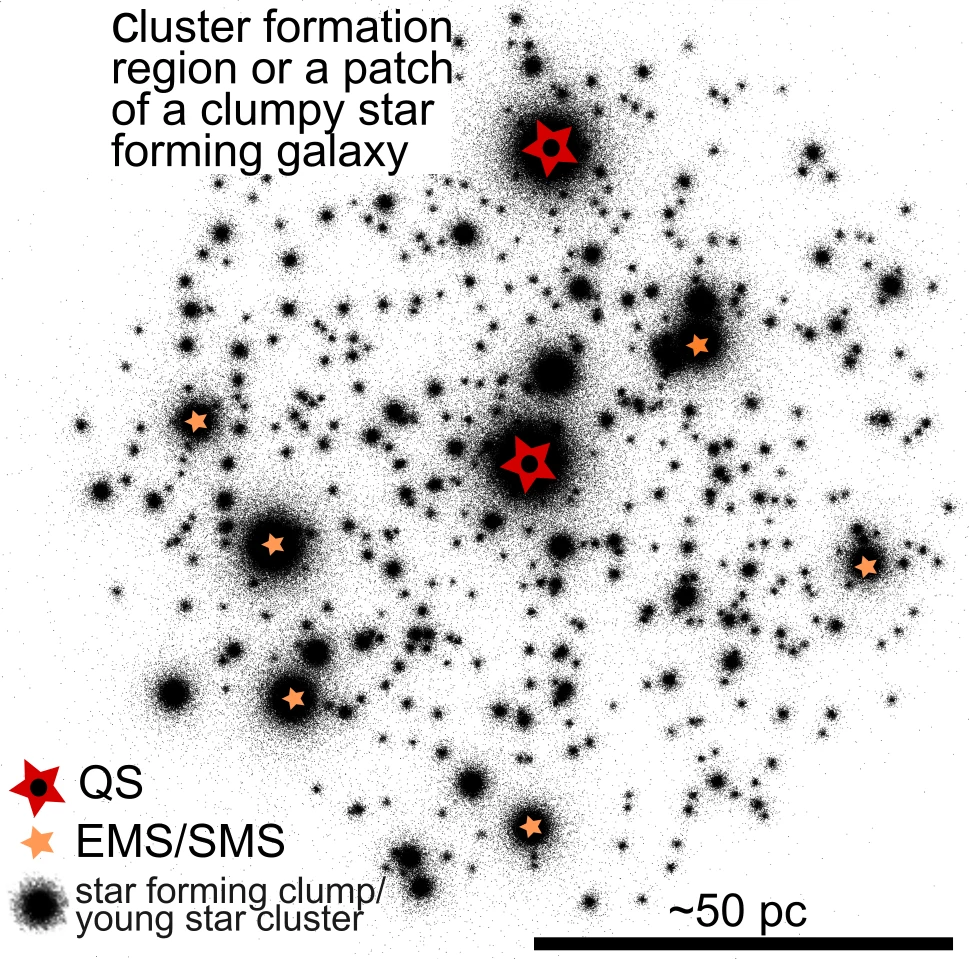
في بدايات الكون، كانت التجمعات النجمية كثيفة لدرجة أنها ولّدت عمالقة بحجم النظام الشمسي. لو وُضع أحد هؤلاء العمالقة مكان الشمس، لامتد طرفه حتى المشتري. كانت هذه النجوم تبتلع أحياناً ثقوباً سوداء صغيرة. يهوي الثقب إلى الأعماق ويبدأ في النمو، محولاً النجم إلى وهج شبح – شبه نجم. وهنا مفارقة غير متوقعة: شبه النجم يزن مثل عشرة آلاف شمس، لكن طبقاته الخارجية رقيقة جداً لدرجة أنه شبه شفاف.
هذا الشبح الكوني يمكن أن يعيش مئات آلاف السنين، بينما يكتسب الثقب الأسود بداخله كتلة هائلة. هذه الأجرام النادرة تفسر النقاط الحمراء الغامضة التي رصدها تلسكوب جيمس ويب في مجرات بعيدة. وإذا سقطت عدة ثقوب سوداء في نجم واحد، ينتج عن اندماجها موجات جاذبية – اهتزازات في الزمكان تلتقطها كواشف على الأرض. هكذا يكشف ضوء النجوم الشبحية القديم أسرار ولادة الثقوب السوداء فائقة الكتلة.
الملخص الأصلي
كما كتبه المؤلفون، بالإنجليزية arXiv:2604.22924
Numerical simulations have established that star clusters with densities comparable to the high redshift ($$z>6$$-$$10$$) James Webb Space Telescope (JWST) proto globular clusters may build up extremely massive (EMSs; $$m_\mathrm{\star}>1000 M_\odot$$) or even supermassive stars (SMSs; $$m_\mathrm{\star}>10000 M_\odot$$) and potentially intermediate mass black holes (IMBHs) through runaway stellar collisions. Using direct simulations of assembling star clusters including post-Newtonian black hole dynamics and stellar evolution, we demonstrate that in such dense environments ($$\Sigma_\mathrm{h} \gtrsim 10^6 M_\odot$$pc$$^\mathrm{-2}$$) stellar BHs ($$m_\bullet \lesssim 60 M_\odot$$), driven by rapid mass segregation and relaxation effects within the sphere of influence of the EMSs/SMSs, may strongly interact with the extremely massive stars and become embedded within their gaseous layers. We suggest that this quasi-star (QS) like embedded BH phase is a natural outcome of the runaway formation of EMSs/SMSs in the densest star clusters. The QS phase is orders of magnitude longer in duration than the lifetime of the SMS, enabling an extended growth period by stellar collisions, and allows the formation of embedded gravitational wave sources if the QS captures more than a single stellar BH. The star cluster assembly region sizes ($$\sim100$$ pc), QS masses ($$\gtrsim 10^4 M_\odot$$) and their proximity to young, massive blue star forming clumps are consistent with the faint population of multiple little red dots (LRDs) recently discovered by the JWST.
يزن شبه النجم حوالي 10 آلاف شمس، لكن طبقاته الخارجية رقيقة جداً لدرجة أنه شبه شفاف – شبح كوني حقيقي.