بصمة السيليكون لنجوم قديمة سريع
المجرة NGC 1277 تشبه كتابًا قديمًا لم يفتحه أحد لمليارات السنين. لقد تشكلت بسرعة، في فجر الكون، ومنذ ذلك الحين لم تتغير تقريبًا — لم تصطدم بجيرانها، ولم تضف طبقات جديدة. يطلق علماء الفلك على مثل هذه الأنظمة اسم «الأثرية»: فهي تحفظ التركيب الكيميائي للنجوم الأولى، كما يحفظ الكهرمان الحشرات في عصور ما قبل التاريخ.
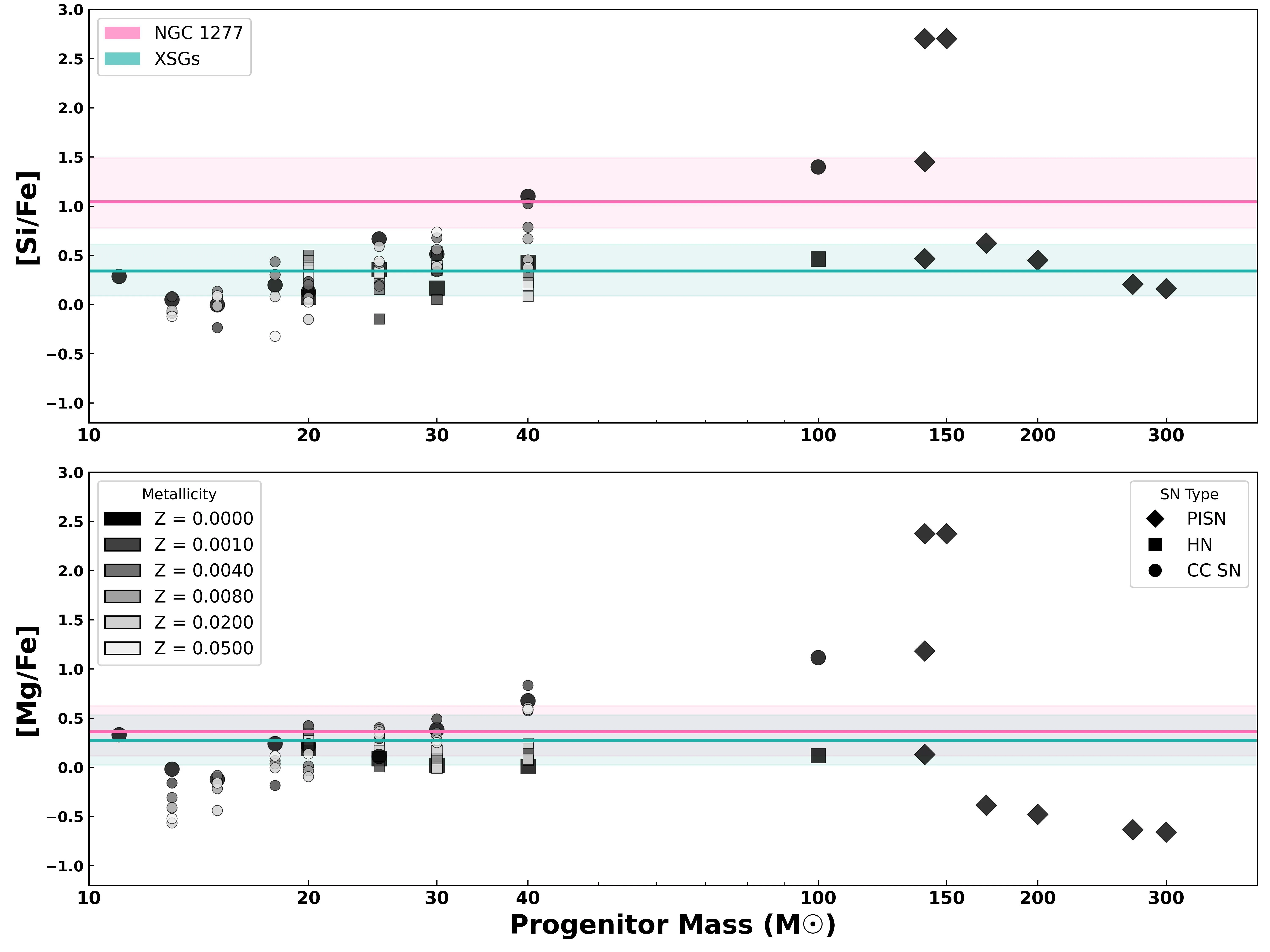
باستخدام التحليل الطيفي بالأشعة تحت الحمراء العميقة، نظر العلماء إلى السجل الكيميائي لهذه المجرة. كان ينتظرهم مفاجأة: خطوط امتصاص السيليكون كانت قوية بشكل غير عادي. نسبة السيليكون إلى الحديد تجاوزت النسبة الشمسية بعشرات المرات، والأهم من ذلك أن السيليكون كان أكثر بكثير من المغنيسيوم. النماذج الحديثة للتجمعات النجمية وانفجارات المستعرات العظمى النموذجية بانهيار النواة لا يمكن أن تعطي هذا الفائض.
هذه المستعرات العظمى، التي تسمى بعدم الاستقرار الزوجي، لا يمكن أن تنشأ إلا في بيئة شبه خالية من العناصر الثقيلة — أي بين الجيل الأول من النجوم. في المجرات الضخمة التي نمت ببطء، طُمست هذه الإشارة منذ زمن طويل بفعل الأجيال اللاحقة. لكن NGC 1277 تشكلت بسرعة وتجمدت، محافظة على توقيع كيميائي نادر. هذا الاكتشاف يفتح نافذة على العصر الذي كان فيه الكون يتعلم فقط خلق الذرات المعقدة، ويعطينا لمحة عن شكل عمالقة النجوم الأولى.
الملخص الأصلي
كما كتبه المؤلفون، بالإنجليزية arXiv:2606.17153
The formation of massive galaxies remains a fundamental question in astrophysics, with recent JWST observations suggesting that intense star formation occurred earlier than previously expected. We used the prototypical massive relic galaxy NGC 1277 as a fossil record to probe the chemical signatures of early star formation. With a stellar mass of $$1.2 \pm 0.4 \times 10^{11}M_\odot$$ and a compact structure (half-light radius of 1.2 kpc), NGC 1277 is representative of massive relic galaxies-systems that formed rapidly at high redshifts ("red nuggets" at $$z>2$$) and have since undergone largely passive evolution, preserving the imprint of their earliest stellar populations. Using deep near-infrared spectroscopy, we identified unusually strong silicon (Si) absorption features in this galaxy. We measure $$[\mathrm{Si}/\mathrm{Fe}]=1.05^{+0.45}_{-0.27}$$ and $$[\mathrm{Mg}/\mathrm{Fe}]=0.36^{+0.27}_{-0.24}$$, corresponding to a significantly enhanced silicon-to-magnesium ratio ($$[\mathrm{Si}/\mathrm{Mg}]=0.67^{+0.45}_{-0.27}$$) which cannot be reproduced by current stellar population models or typical core-collapse supernova yields. This enhancement suggests a contribution from very massive, metal-poor progenitors during the earliest phases of star formation. Such conditions are consistent with nucleosynthetic yields from pair-instability supernovae or other enrichment channels associated with extremely massive stars, whose chemical signatures are expected to remain less diluted in systems like NGC 1277 due to their rapid formation timescales and minimal late-time accretion. This result provides rare chemical evidence of early massive-star enrichment preserved in a local relic galaxy and opens a new observational window into the chemical evolution of the Universe.
المستعرات العظمى بعدم الاستقرار الزوجي لا تترك خلفها نجمًا نيوترونيًا ولا ثقبًا أسود — فالنجم يتحطم تمامًا، ناثرًا كل مادته بما في ذلك كمية هائلة من السيليكون.