مرشح ضوضاء للموجات الثقالية سريع
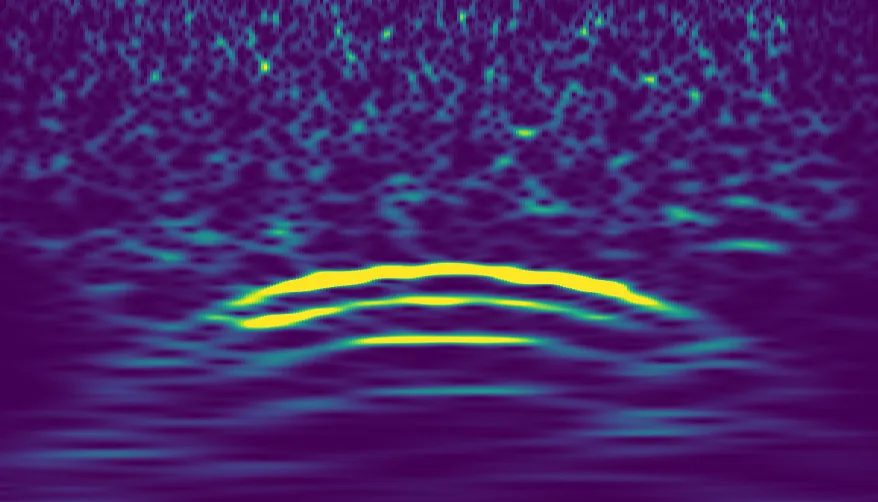
كاشفات الموجات الثقالية تشبه ميكروفونات حساسة تلتقط همس الكوارث البعيدة. لكن بين الحين والآخر، ينفجر فيها طقطقة حادة — ضوضاء قصيرة تُعرف بالغلتش. قد تشبه هذه الطقطقة إشارة حقيقية من اندماج ثقبين أسودين، وعندها يخاطر الفلكيون بأن يخلطوا بين الضوضاء والاكتشاف.
الأداة الجديدة bilby_glitch تعمل مثل مهندس صوت يسمع في الوقت نفسه الموسيقى والطقطقات في التسجيل. إنها لا تحاول تخمين أين الإشارة وأين الغلتش، بل تبني نموذجًا لكليهما معًا. تعتمد على البرنامج الشهير bilby، وأُضيفت إليه ثلاثة نماذج للضوضاء: تشتت بطيء (مثل صدى من جدار)، وومضة جيبية-غاوسية (sine-Gaussian)، و"شيربليت" (chirplet) — إشارة قصيرة بتردد متغير تشبه صفير صاروخ يسقط.
اختُبرت الطريقة على حدثين حقيقيين. بالنسبة إلى GW191109، تطابقت النتيجة مع التحليلات السابقة — حالة هادئة. أما GW200129 فكان متقلبًا. عندما نُموذج الغلتش باستخدام المويجات (wavelets) — وهي موجات قصيرة — والإشارة باستخدام التقريب IMRPhenomXPHM، بدا دوران الثقب الأسود واضحًا. لكن عندما استُخدم تقريب أدق للإشارة هو NRSur7dq4، كادت أدلة الدوران أن تختفي. الخلاصة: تصوراتنا عن كيفية دوران الثقب الأسود قد تعتمد على طريقة تنظيف الصوت.
هكذا يحصل الفلكيون ليس فقط على أداة، بل على تذكير: في صمت الكون، حتى ضوضاء صغيرة قد تغير القصة.
الملخص الأصلي
كما كتبه المؤلفون، بالإنجليزية arXiv:2607.09111
Non-Gaussian noise transients ("glitches") in gravitational-wave observatories degrade our ability to accurately perform astrophysical inference. We present the analysis pipeline bilby_glitch, which allows for simultaneous Bayesian inference of gravitational-wave signals and glitches. Our framework is modular and built on top of the popular bilby framework, facilitating future extensions with additional glitch and signal models. We integrate transdimensional bilby into our framework and discuss three glitch models: a physically-motivated slow scattering model, and flexible sine-Gaussian and chirplet models. Using a combination of simulated and real data, we demonstrate that bilby_glitch produces reliable results. We then reanalyse two gravitational-wave events - GW191109 and GW200129 - which show signs of interesting black-hole spins, but which may also be affected by data-quality issues. Our results for GW191109 are consistent with previous analysis. For GW200129, we recover results consistent with Payne et al., where the evidence of spin-precession is much weaker when using the waveform approximant NRSur7dq4 in combination with wavelet-based glitch modeling. Furthermore, we show the astrophysical conclusion of this event is dependent on the interplay between the waveform approximant and glitch model, since in contrast to NRSur7dq4 we find that inference with the waveform approximant IMRPhenomXPHM shows strong evidence of spin-precession when used in combination with wavelet-based glitch modeling.
الغلتشات في كواشف LIGO تُسمى أحيانًا "الحيتان" أو "الغربان" — لكل نوع اسم محاكاة صوتية يعتمد على شكل الإشارة.