ثلاث طبقات من غيوم المشتري سريع
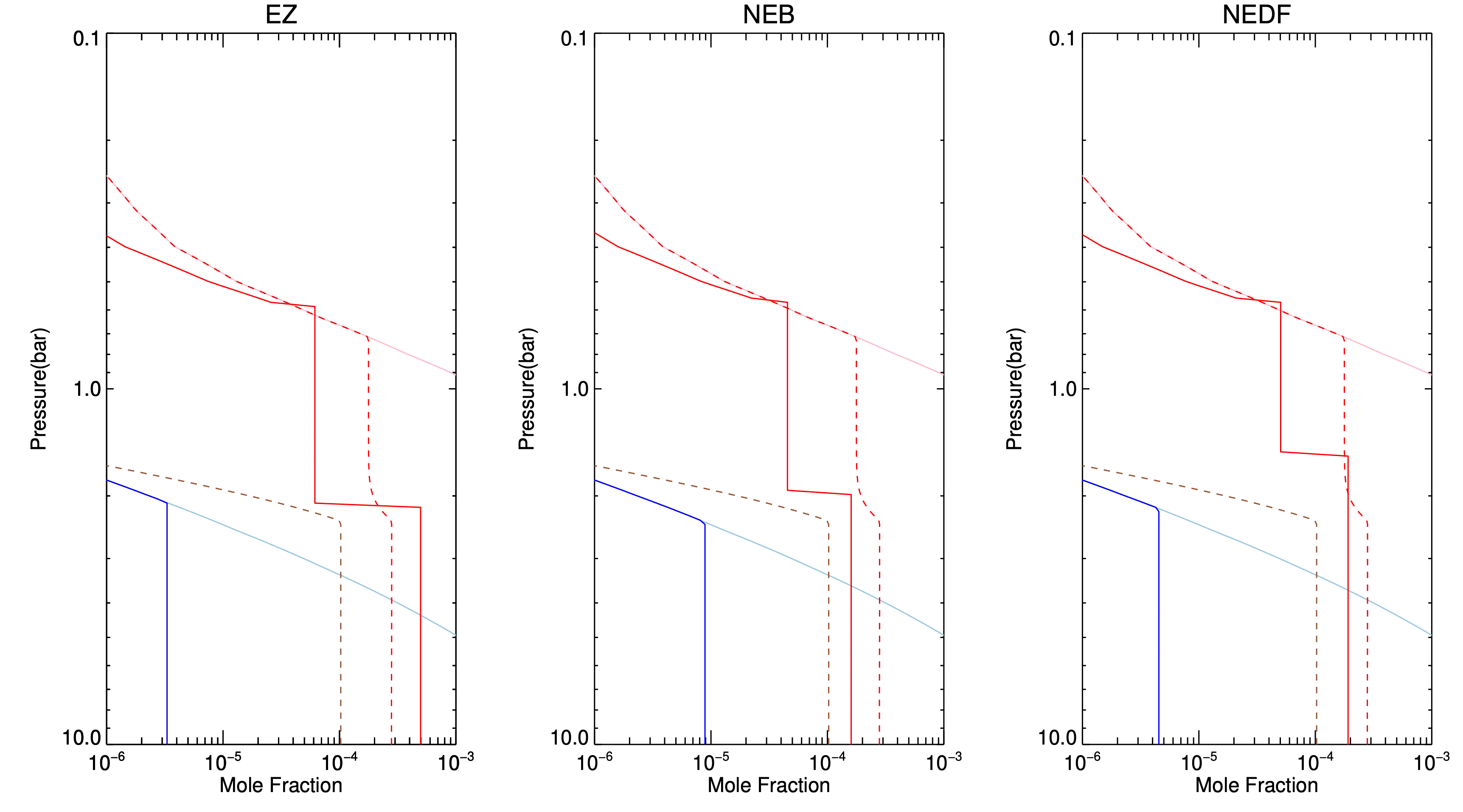
يشبه الغلاف الجوي للمشتري كعكة متعددة الطبقات، حيث لكل طبقة دورها. أخذ العلماء بيانات من أربعة أجهزة في آن واحد — VLT/MUSE وCassini/VIMS وIRTF/SpeX وJuno/JIRAM — وبنوا نموذجًا للغيوم والأمونيا في المنطقة الاستوائية للكوكب، من 0.1 إلى 10 بار (ضغط يعادل العمق على بعد مئات الكيلومترات تحت محيطات الأرض).
يتضمن النموذج ثلاثة مكونات. الأول: سحابة سفلية كثيفة على عمق 1–2 بار، تتكون من جسيمات كبيرة نصف قطرها حوالي 10 ميكرومتر. الثاني: سحابة علوية رقيقة عند مستوى ~0.55 بار، من جسيمات بنفس الحجم. الثالث: طبقة من جسيمات تمتص اللون الأزرق (نصف قطرها ~0.2 ميكرومتر)، مدمجة مباشرة في السحابة السفلية. هذه الجسيمات الصغيرة، مثل مرشح أزرق، تمتص الضوء الأزرق وتكسب الغيوم لونها البني المحمر المألوف.
يرتبط ملف الأمونيا ارتباطًا وثيقًا بالغيوم: السحابة السفلية تتزامن مع بداية انخفاض تركيز الأمونيا، والسحابة العلوية مع مستوى تكاثفها. تشير الخصائص الطيفية للجسيمات إلى وجود جليد مائي في الطبقة السفلية وجليد أمونيا في الطبقة العلوية. ومن المثير للاهتمام أن المؤلفين استغنوا عن ضباب كيميائي ضوئي منفصل: جميع الميزات المرصودة عند أطوال موجات امتصاص الميثان تُفسَّر بتغيرات في العتامة والامتداد الرأسي للسحابة العلوية. وهكذا، تبين أن كعكة الغلاف الجوي للمشتري متعددة الطبقات أبسط مما كان يُعتقد سابقًا.
الملخص الأصلي
كما كتبه المؤلفون، بالإنجليزية arXiv:2607.25542
We present a combined cloud/ammonia model for Jupiter's equatorial atmosphere from 0.1 to 10 bar, consistent with observations made at a range of observation geometries from 0.35 to 5.15 $$\mu$$m by VLT/MUSE, Cassini/VIMS, IRTF/SpeX and Juno/JIRAM. Our cloud model has three components: 1) an optically-thick lower cloud (radius $$r$$$$\sim$$$$10$$ $$\mu$$m) at 1-2 bar; 2) an optically-thin upper cloud ($$r$$$$\sim$$$$10$$ $$\mu$$m) at $$\sim$$0.55 bar; and 3) a layer of blue-absorbing chromophore particles ($$r$$$$\sim$$$$0.2$$ $$\mu$$m) situated within the main lower cloud. The ammonia profile is intimately linked with the cloud profile with the lower cloud coinciding with an initial drop in ammonia abundance and the upper cloud coinciding with the ammonia condensation level. The large lower cloud particles are highly scattering at visible wavelengths, allowing sunlight to scatter through the clouds and be Rayleigh-scattered from the deep atmosphere. At 5 $$\mu$$m, the lower cloud particles are found to be more absorbing, with the belt/zone differences mostly accounted for by changes in the single-scattering albedo of these particles and secondarily by changes in the cloud opacity. The spectral properties of these lower cloud particles are possibly consistent with a component of water ice. The upper cloud particles need a distinct absorption band near 3 $$\mu$$m, possibly consistent with a component of ammonia ice. We note that we do not need a separate upper-level photochemical haze in our model. Instead, we find that the features seen at methane-absorbing wavelengths are caused by variations in the opacity and vertical extent of the upper cloud layer.
الجسيمات التي تلوّن غيوم المشتري باللون البني أصغر بمئة مرة من جيرانها الشفافين — مثل حبة رمل بجانب تفاحة.
الغيوم متعددة الطبقات للمشتري تذكرنا بغلاف كوكب بيسپين في «حرب النجوم»، حيث كان يُستخرج غاز التيبانا في مدينة سحابية.