Mini

A Glass Loom for Light: 99.7% Fidelity Across 24 Quantum Threads

Original: "A low-loss, 24-mode laser-written universal photonic processor in a glass-based platform"
arXiv:2505.01609v2 · 2025-05-02 · CC BY 4.0 · ⏱ 1 min · Quantum Physics Applied Physics Optics
Scientists built a programmable optical processor directly in glass, transforming photons into entangled states with 99.7% fidelity and minimal losses.
Links in the knowledge graph 1

In the glass core, 24 quantum threads intertwine, obedient to a thermal conductor. Machine intelligence calibrates their dance with just 0.3% error—and suddenly, problems that would stump a classical supercomputer for the age of the universe are solved in the palm of your hand. Glass is learning to be a brain.

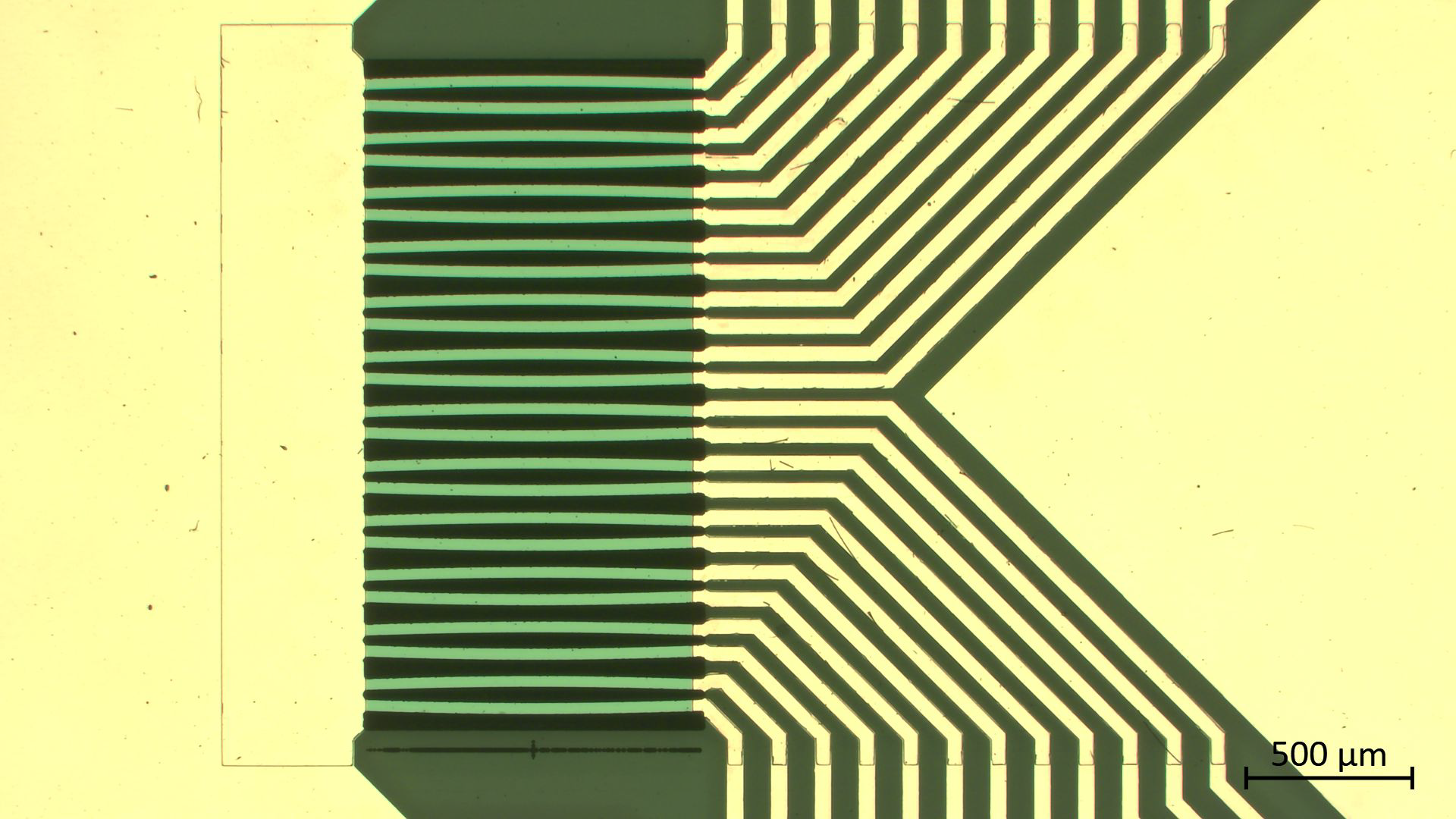
🎯 The processor's glass is almost the same as in smartphone displays—but its exceptional transparency and thermal stability turn it into an ideal canvas for laser “embroidery” of waveguides. The thermal isolation trenches, 60 microns deep (thinner than a human hair), reduce thermal crosstalk by orders of magnitude, like soundproofing in a recording studio.

🎬 This universal optical processor echoes the light-based computers from Neal Stephenson's “Snow Crash,” where information was processed by holograms and optical neural networks. Today's chips are the first step toward making light not just illuminate, but think.

F = \frac{1}{N} |\text{Tr}(U^{\dagger} V)|
Here U is the target unitary matrix, V is the measured one, N is the dimension. The closer F is to 1, the more accurately the device reproduces the given quantum transformation.
\Delta\phi = \frac{2\pi}{\lambda} \frac{dn}{dT} \Delta T L
A temperature change ΔT over a length L alters the refractive index of the glass (dn/dT is the thermo-optic coefficient), causing a phase shift for light of wavelength λ. This lets micron-scale heaters control photon interference.
Scientists
Erwin SchrödingerHugh Everett IIIWolfgang PauliPaul DiracStephen HawkingJacob Bekenstein
Tags
quantum computer quantum optics quantum information quantum measurement quantum algorithm quantum decoherence quantum entanglement entropy superconductivity
Laws
second law of thermodynamicsSchrödinger equationPauli exclusion principleHawking radiationBekenstein-Hawking entropyBoltzmann distribution
Original: arXiv:2505.01609v2 · CC BY 4.0 · bridge42worlds