Glass Processor for Quantum Computing: 24 Modes, Record Accuracy ✛ ✦
Context
Scaling up quantum computing requires compact, stable, and reprogrammable devices for processing quantum information. Universal photonic processors are programmable integrated circuits capable of performing arbitrary linear optical transformations on many light modes. Such processors could become the foundation for implementing quantum algorithms proposed by Richard Feynman and David Deutsch, as well as for creating entangled states.
Methods
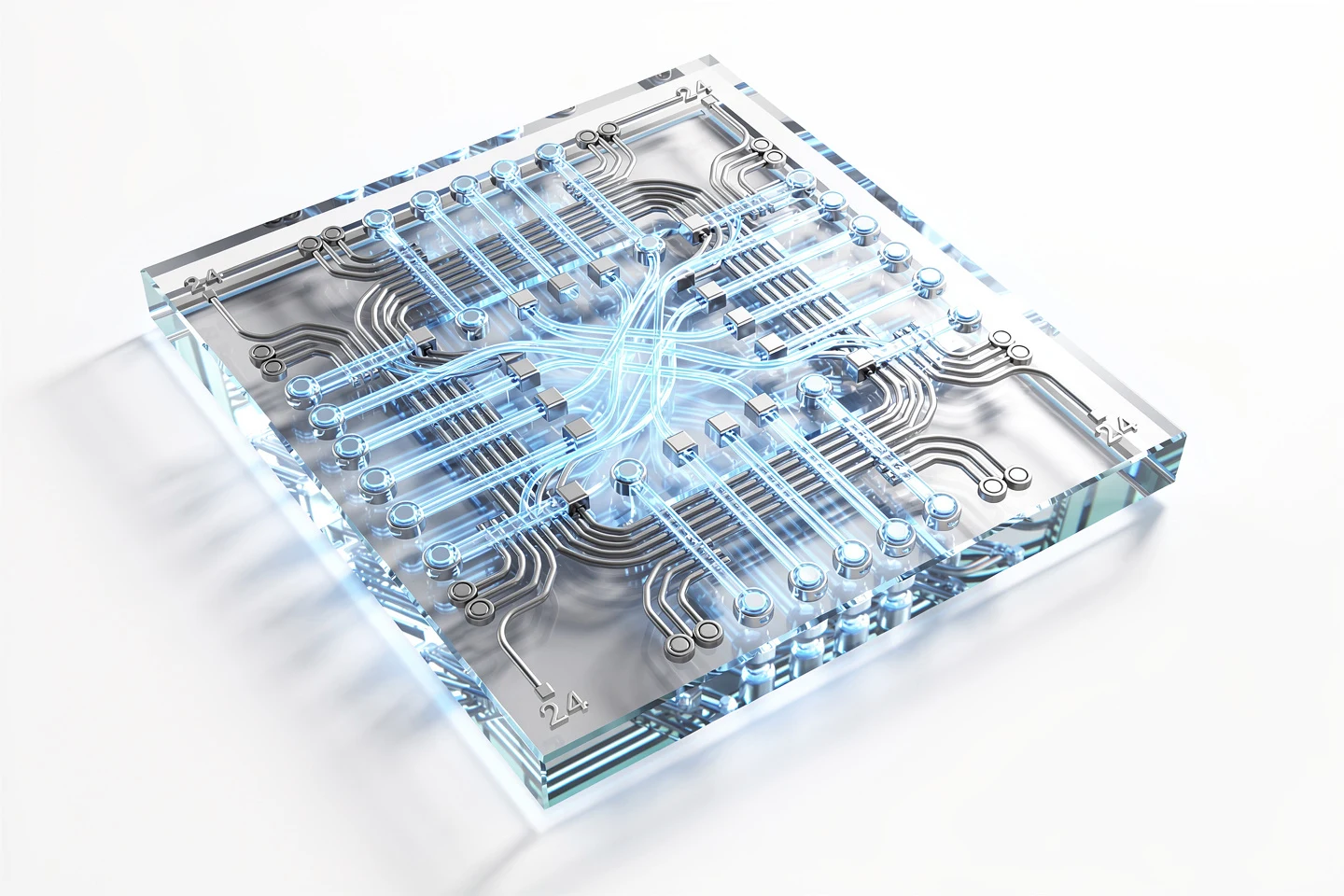
The 24-mode optical processor circuit was created using femtosecond laser writing in Corning EAGLE XG glass. Laser pulses are focused at a depth of 35 µm and form single-mode waveguides with losses below 0.3 dB/cm, optimized for a wavelength of 925 nm—the emission of single-photon sources based on quantum dots. For thermo-optic control, chromium micro-heaters are placed near each of the 552 directional couplers; connections are made with copper using two-step lithography with dry photoresist. Thermal isolation is enhanced by deep trenches (60 µm) that form "bridges" of waveguides surrounded by air, dramatically reducing thermal crosstalk. Calibration involved measurements of 30,000 states and machine learning to determine 576 phase shifts and 13,824 thermal coupling coefficients.
Results
After packaging, the total insertion losses averaged 4.35 dB—a record low for devices of this complexity. The micro-heaters demonstrated high stability: during continuous operation for 12 hours, the resistance drift did not exceed 0.005%/h. A model was trained for calibration, accounting for static phase offsets, coupler splitting ratios, and thermal crosstalk; in total, 30,000 unitary transformations were processed. Final verification on 2,000 random matrices chosen according to the Haar measure (uniformly distributed in the space of all unitary matrices) showed an average amplitude fidelity of 99.7%. Low insertion losses minimize decoherence, which is critical for entangled states. Electrical power consumption for all tested transformations remained below 10 W, allowing the processor to be cooled with a simple thermoelectric element.
Implications
The demonstrated processor sets a new benchmark for scalable quantum photonic circuits. It proves that femtosecond laser writing enables combining three-dimensional design, low losses, and efficient thermal management with a mode count sufficient for non-trivial quantum tasks. This brings closer the creation of quantum simulators and computers, fulfilling the long-standing dream of John von Neumann for programmable information processing. Successful calibration using machine learning methods paves the way for fast and accurate tuning of even larger circuits without the need for expensive individual debugging, which is important for optimization problems and modeling.
Future development
Further development of the technology will follow the path of increasing the number of optical modes to hundreds and thousands, which will require solving calibration and heat dissipation problems. A transition to cryogenic temperatures is likely for interfacing with superconducting electronics and detectors. Integration with single-photon sources and detectors on the same chip will turn the processor into a complete "all-in-one" quantum platform. Moreover, automatic calibration algorithms based on machine learning could become a standard for controlling multi-mode photonic circuits.
Impact
The development will impact quantum communications (including quantum key distribution) and quantum sensing, where programmable linear interferometers are required.
Next steps
Next steps include demonstrating quantum algorithms (e.g., boson sampling) on the 24-mode device and integration with solid-state single-photon emitters on the same glass chip.
Key open problems
The work is directly linked to the problem of scaling quantum computers: how to maintain a low level of decoherence and high control accuracy as the number of qubits (modes) grows. In addition, the complexity of calibrating large systems resonates with fundamental questions of complexity in quantum control theory.
The knowledge machine's view
This section is addressed to the author of the paper and their colleagues. Neighbouring works were found by meaning-based search across our archive, not by word overlap. We do not review: we show the field around the work.
What the work does
The authors created a 24-mode universal photonic processor using femtosecond laser writing in glass, with thermo-optic control and machine learning for calibration. They achieved record-low insertion losses of 4.35 dB and an average accuracy of 99.7% on random unitary transformations, with power consumption below 10 W.
Where its strength is
The combination of a three-dimensional architecture, low losses, and efficient thermal control at a scale of 24 modes sets a new benchmark for photonic quantum processors. High accuracy and stability make the device ready for practical quantum experiments.
Where it could go next
- It might be interesting to consider integrating the processor with imperfect frequency converters for operation in cryogenic conditions, which would expand compatibility with other quantum systems.based on: Light in a Cryostat: How Imperfect Converters Build Quantum Bridges arXiv:2505.00542v1
- A nearby approach is to combine photonic processors into quantum networks using optical switches; this could pave the way for scaling beyond a single chip.based on: Quantum Networks: How Optical Switches Link Processors arXiv:2501.05598
- In our archive, there is work on an optical quantum computer with record speed; perhaps your processor could be used as a programmable core for such high-speed computations.based on: Photonic Quantum Computer Sets a Speed Record arXiv:2508.09092
Worth trying
- Test the calibration model on a larger number of modes to assess the scalability of the method.
- Verify the processor's operation with single-photon sources based on quantum dots, as intended in the design.
- Investigate the possibility of using the processor for generating and measuring entangled states.
Why this may matter
The demonstration of a scalable and accurate photonic processor brings us closer to practical quantum computers and simulators, and could also accelerate the development of quantum communications.
Nearby works in our archive
- Three Emitters Instead of a Laser Batterysimilarity 0.67
- Light in a Cryostat: How Imperfect Converters Build Quantum Bridgessimilarity 0.65
- Quantum Networks: How Optical Switches Link Processorssimilarity 0.64
- Photonic Quantum Computer Sets a Speed Recordsimilarity 0.64
- Light Trap: Holding the Elusivesimilarity 0.64
- Light Instead of Wires: A Quantum Computer on Fiber Opticssimilarity 0.63
The closest work in the archive sits at 0.67 by meaning — the usual level for our corpus.
Original abstract
as written by the authors arXiv:2505.01609v2
We report the fabrication of the first 24-mode universal photonic processor (UPP) realized through femtosecond laser writing (FLW), marking the most complex UPP demonstrated to date. Optimized for quantum dot emission at 925 nm, the device exhibits total insertion losses averaging only 4.35 dB, enabling its direct application in advanced multi-photon quantum experiments. Leveraging the versatility of FLW, we introduce suspended waveguides and precisely engineered 2D and 3D microstructures, significantly enhancing thermal isolation and minimizing power dissipation. As a result, our processor operates efficiently at less than 10 W, requiring only a simple thermo-electric cooler for stable thermal management. The device exhibits exceptional performance after calibration, implementing Haar-random unitary transformations with an amplitude fidelity of 99.7 %. This work establishes FLW-based integrated photonics as a scalable and robust platform for advancing quantum computing, communication, and sensing technologies.
The glass used in the processors is similar to the material in smartphone screens, but its transparency and thermal stability make it ideal for femtosecond laser writing of waveguides. Interestingly, the depth of the thermal isolation trenches (60 µm) is thinner than a human hair, yet that's what reduces crosstalk by orders of magnitude.
The idea of a universal optical processor echoes the concept of light-based computers from science fiction, for example, in Neal Stephenson's novel 'Snow Crash', which features holographic interfaces and optical neural networks.
Key numbers
- number of optical modes: 24
- insertion loss (fiber-to-fiber): 4.35 dB
- amplitude fidelity: 99.7%
- power consumption: <10 W
- heater stability (drift): <0.005%/h