Record-Precise Light Processor on Glass ✛ ✦
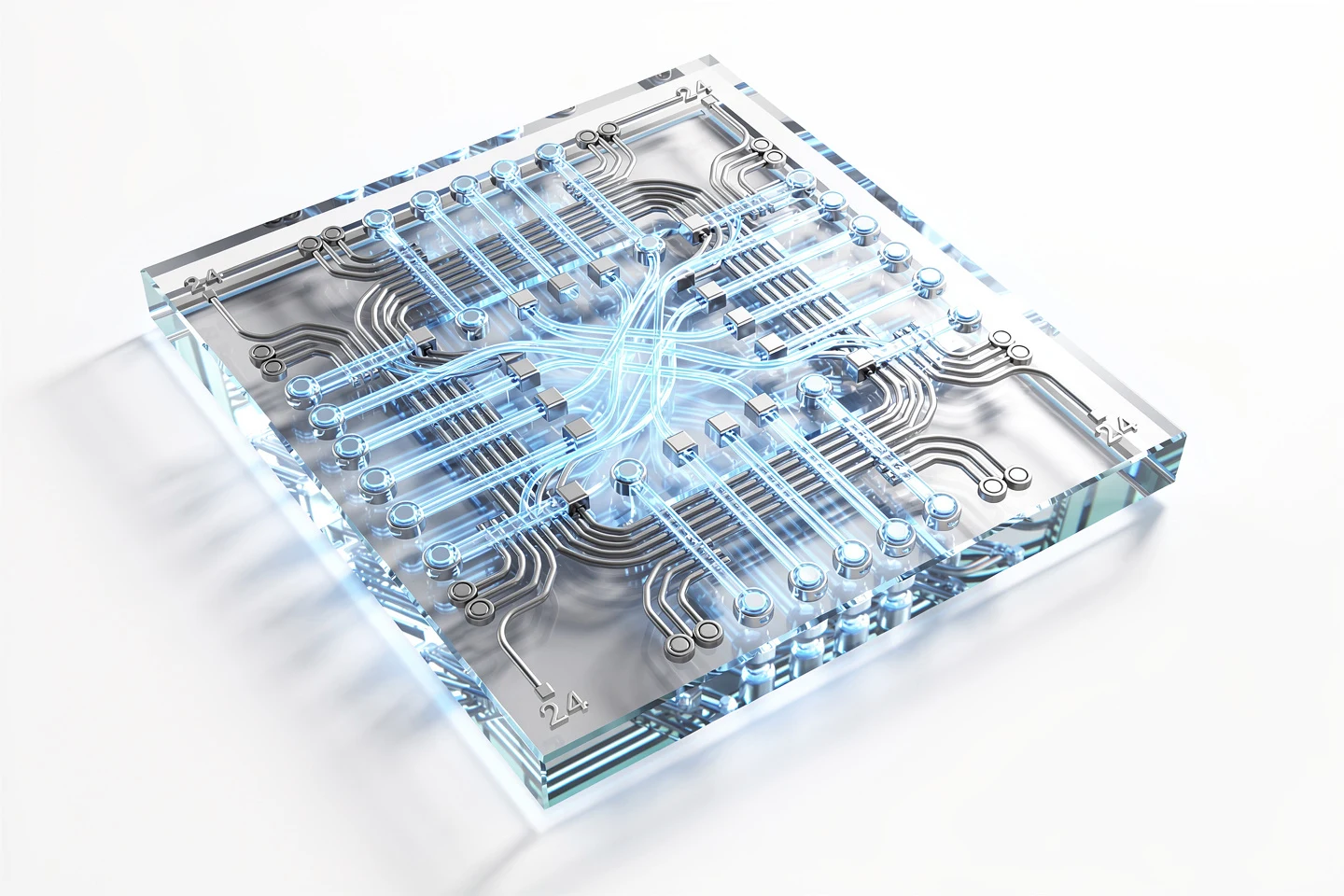
A fingernail-sized glass chip mixes 24 light beams with 99.7% accuracy — like a DJ mixer, but with light signals instead of sound. Losses stay under 5%, and it sips just 10 watts.
Laser engraving carves a transparent labyrinth inside the glass. Microscopic heaters, like mixer knobs, precisely steer each beam, preventing the signals from getting jumbled. This allows it to run quantum algorithms — instructions for the computers of the future — and process quantum information, where data is stored in the properties of photons. Photons can be entangled — an invisible link that breaks at the slightest disturbance (decoherence), so jewel-like tuning and precise measurements are essential.
The record was confirmed by generating 2000 random light patterns and measuring their entropy — a gauge of their variety: the mixing proved almost ideal. Such a quantum processor based on quantum optics opens the way to machines that model chemistry and enable secure communication. On the horizon: integration with superconducting single-photon detectors. At the origins: Feynman and Deutsch; von Neumann dreamed of a universal automaton — and here is its light-based embodiment.
Grooves thinner than a hair provide thermal insulation, and the heaters' stability doesn't drift by even 0.005% over 12 hours.
The idea of light-based computing was anticipated by Neal Stephenson in 'Snow Crash', where he described optical holograms that process data.