A Hologram from a Speckle of Light express
Shine a flashlight through rough glass, and the wall lights up with a speckled pattern of bright and dark dots. Once dismissed as useless noise, this pattern now serves as the key to reconstructing 3D images.
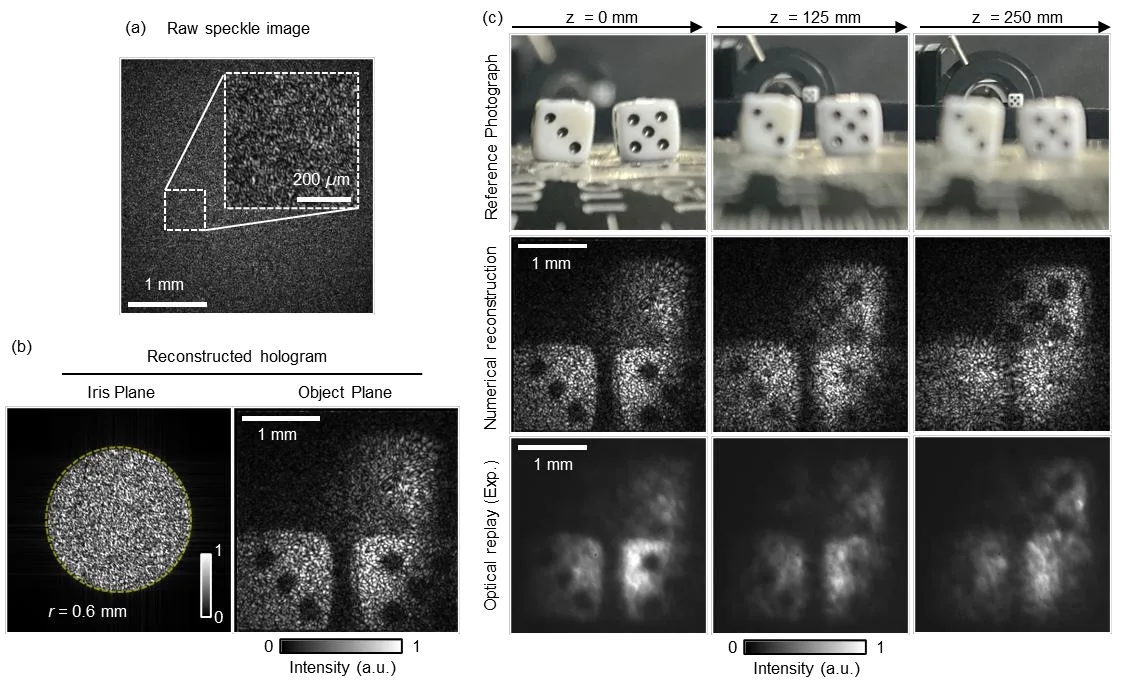
In the new system, light from an object passes through a specially designed plate with known irregularities. The plate mixes the rays, creating a speckle pattern, like the dappled shadow of leaves on the ground. A single snapshot of this pattern replaces multiple cameras: the computer uses it to calculate exactly how the light waves traveled and builds a hologram. The hologram is then displayed on a screen that controls light, and the viewer sees a 3D scene.
The system demonstrated live video at about 28 frames per second. Data transmission required only a standard internet connection. This is a step toward simple, inexpensive devices for 3D video calls — without bulky cameras and mirrors.
Original abstract
as written by the authors arXiv:2601.00630
We present a reference-free holographic telepresence system that directly captures and replays complex optical wavefronts from a single intensity speckle measurement. Using a pre-characterized geometric phase diffuser, the incident field self-interferes to form a speckle pattern, from which the wavefront is recovered via a speckle-correlation scattering-matrix approach and refined using smoothed amplitude flow with Nesterov acceleration. The reconstructed phase is directly projected onto a spatial light modulator for holographic replay. We demonstrate volumetric refocusing, dynamic three-dimensional reconstruction, and sustained video-rate operation at approximately 28 frames per second with modest communication bandwidth. The results highlight measurement-driven wavefront acquisition as a practical pathway toward compact and physically faithful holographic telepresence.
The speckle pattern from a laser on a wall is not just pretty: it encodes information about the surface that reflected the light. The new system uses a similar principle, but instead of a wall, it uses a special plate.