A wavefront is an imaginary surface that connects all points of a wave that are in the same phase — for example, all the crests of a light wave at a given instant. For a simple point source, wavefronts are spheres expanding outward; for a perfectly collimated beam, they are flat planes. The concept is central to physical optics because it provides a geometric way to track how light propagates, bends, and focuses, even when the wave is distorted by lenses, mirrors, or turbulent media.
History
The wavefront concept was formalized by Christiaan Huygens in his 1690 Traité de la Lumière, where he introduced the principle of secondary wavelets to explain reflection and refraction.
How it works
Wavefronts are defined by the wave equation: at any moment, the wave's phase is constant along the surface. As the wave travels, each point on a wavefront acts as a source of secondary spherical waves (Huygens' principle), and the new wavefront is the envelope of these secondary waves. This allows one to compute the evolution of lightthrough complex optical systems by tracing how the surface deforms — for instance, a perfect lens turns a spherical wavefront into a planar one, while a turbulent atmosphere wrinkles it into an irregular shape.
In practice
Adaptive optics systems in telescopes measure and correct distorted wavefronts in real time to sharpen images of stars and satellites; wavefront sensors are also used in laser eye surgery and optical testing.
Fun fact
A hologram stores the full wavefront of light scattered from an object, not just its intensity, which is why a holographic image appears three-dimensional and changes perspective when viewed from different angles.
A spotlight with an adjustable beam width sweeps along the shore. Its light is the long ocean waves that are born in the surf zone and spread in both directions: toward the beach and out to the open sea. Previously, this spotlight was considered a point source, but the actual breaking zone, where short waves break, has a finite width, and it changes as the wave front advances and retreats.
Waves on the water's surface usually break against any obstacle — a rock, a piling, an island. But what if you arrange obstacles so cleverly that the wave barely notices them? In a new study, scientists assembled a pattern of many points on the water, arranged according to special mathematical rules, and sent waves through them.
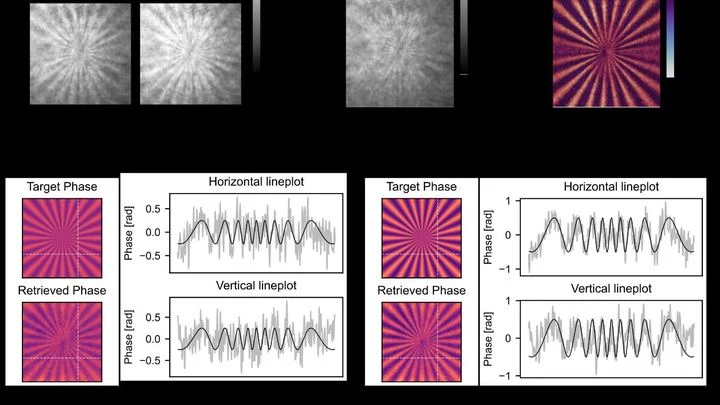
Starlight passing through the atmosphere and telescope optics shimmers like sunlight dancing on water. Hidden in that ripple are planets — faint sparks next to a blinding glare. To see them, you have to freeze the ripple: make the light as smooth as glass.
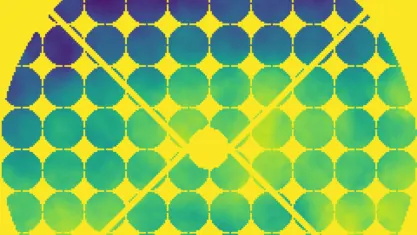
The orchestra plays, but the musicians can't hear each other. The conductor keeps stopping the music and walking over to each player to tune the instrument. That's roughly how space telescopes with segmented mirrors work.
A stone falls into water, and ripples spread in all directions. Throw a handful of stones at once, and the ripples overlap: you can no longer tell which ripple came from which stone. A neutron beam hitting a detector looks much the same: a bright spot blurred by many causes.
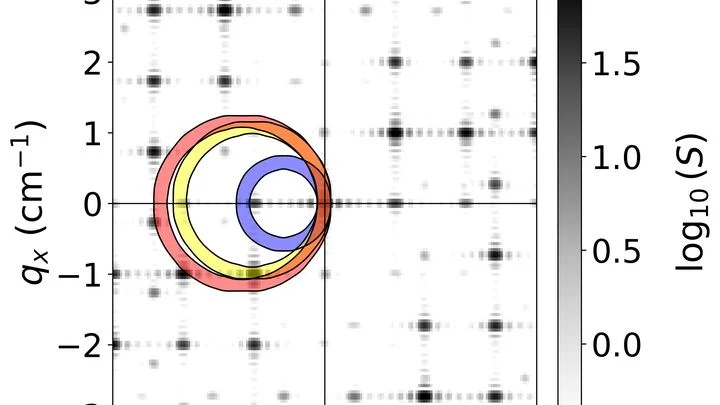
A stone drops into a pond, and ripples spread across the water. If a protruding branch blocks the ripples' path, part of the wave reflects, and part bends around the obstacle. Gravitational waves, ripples in spacetime itself, behave similarly when passing by galaxy clusters or black holes.
A solar telescope is like an eye trying to spot an ant through a pot of boiling soup. The daytime sky dazzles, the air shimmers, and the image swims. To freeze it, you need adaptive optics — a system that predicts distortions and corrects them hundreds of times per second.
Light, like a shaken rope, oscillates in a specific plane. Astronomers and engineers often rotate images using a three-mirror system, the so-called K-mirror, but this inadvertently rotates the plane of oscillation as well. For precise measurements, that's a problem.
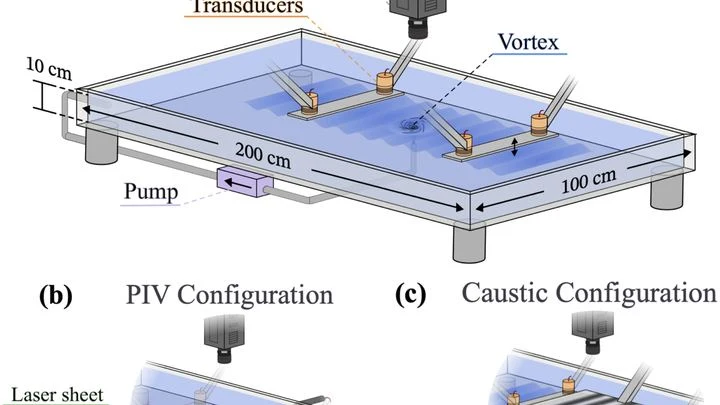
Water going down the drain swirls into a vortex. An everyday sight in the kitchen. But this very vortex turned out to be able to reproduce two effects that physicists usually associate with black holes and the rotation of planets.
The first effect is the shift of a wave as it goes around an obstacle.
A conventional antenna array is like a choir: many voices singing in unison, with the sound amplified in only one direction. To catch a signal from another side, you have to rearrange the whole choir. Now imagine a single voice that can change its timbre so that the sound itself focuses in the desired direction.
When light passes through a turbid medium, like a glass of milk or frosted glass, it scatters in all directions. But sometimes, instead of spreading out, it gets trapped in tiny 'pockets' inside the material. Physicists call these pockets localized modes: light falls into them as if into a trap and cannot escape.
A glass marble in a glass of water is nearly invisible, but if you look through it at a checkered tablecloth, the lines behind it appear distorted. Transparent cells behave the same way: light passes through them but is slightly slowed and changes direction.
A stone drops into a pond — ripples spread across the water. Do short waves outrun long ones? No, in deep water it's the opposite: long waves overtake short ones. In metal, sound of one pitch travels at one speed, another pitch at another.
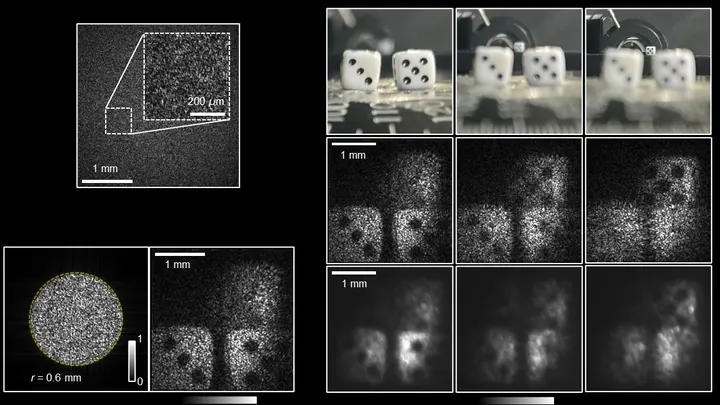
Shine a flashlight through rough glass, and the wall lights up with a speckled pattern of bright and dark dots. Once dismissed as useless noise, this pattern now serves as the key to reconstructing 3D images.
In the new system, light from an object passes through a specially designed plate with known irregularities.