A hologram is a recorded interference pattern that, when illuminated appropriately, reconstructs a three-dimensional image. Unlike a photograph, which captures only lightintensity, a hologram encodes both the amplitude and phase of light waves, allowing the viewer to see depth and parallax. Holography was invented in 1947 by Dennis Gabor, who later won the Nobel Prize in Physics for his work.
History
Dennis Gabor conceived holography in 1947 while working on improving electron microscopy, but practical holograms became possible only after the invention of lasers in the 1960s. Emmett Leith and Juris Upatnieks created the first laser transmission holograms in 1963, and Yuri Denisyuk developed reflection holograms shortly after.
How it works
To create a hologram, a coherent light beam (typically from a laser) is split into two parts: one illuminates the object, and the other serves as a reference beam. The light scattered from the object interferes with the reference beam, and the resulting interference pattern is recorded on a photosensitive medium. When the developed hologram is illuminated with the same reference beam, it diffracts the light to recreate the original wavefront, producing a 3D image that appears to float in space.
In practice
Holograms are used in security features on credit cards and currency, in data storage, in interferometric testing of optical components, and in medical imaging techniques like holographicmicroscopy.
Fun fact
The hologram on a credit card is a type of rainbow hologram that can be viewed in ordinary white light, unlike the original laser-illuminated transmission holograms.
A thin film of neodymium nickelate, fifteen nanometers thick, sits on a neodymium gallate substrate. Below one hundred eighty kelvin it behaves as an insulator: electrons are locked inside their atomic cells and cannot move freely.
Two photons meet at a half-silvered mirror. If they arrive at exactly the same time, they always leave together — side by side, like twins who refuse to be parted. This effect, discovered in 1987, became the basis of a quantum ruler for measuring tiny delays.
In 2019, the world saw the first image of a black hole's shadow — an orange doughnut on a black background, becoming a symbol of scientific progress. But this image wasn't captured by a camera: it was born from mathematical alchemy, where data from eight radio telescopes, which gathered only crumbs of signal, merged into a single picture.
If you clap your hands in an empty room, the echo will tell you about its size and shape. Every object (a chair, a book, a person) adds its own signature to this echo: sound reflects off it in a particular way. The authors of the paper have figured out how to completely rewrite this acoustic signature. They surrounded a region of space with a closed surface of microphones and loudspeakers.
A thrown stone follows a smooth arc: its path is easy to predict. But if the stone skips across water, the trajectory becomes jagged and far more interesting. Quantum particles behave much the same way when their state is not a calm wave with fixed energy but a turbulent mix of several waves at once.
Light from an ordinary bulb seems utterly chaotic: its waves oscillate out of sync, like a crowd where everyone walks in their own direction. Such light is called incoherent. For a long time, it was believed that elegant topological structures (knots, rings, links) could only be created in coherent laser light, where all waves march in step.
A deuterium molecule, two atoms of heavy hydrogen, falls apart under a laser pulse. One electron is ripped away, leaving an ion behind. At that moment, they are still linked: the direction of one immediately tells you which way the other went. This link is called quantum entanglement.
A laser beam hits an atom, and an electron is knocked loose. It accelerates, returns, and, crashing into the atom, emits a flash of light — a harmonic. If there are two light beams and they are crossed like an intersection, the electron can choose different routes. In the new experiment, the two beams had comparable strength and were directed at right angles.
A drummer stays silent, but from the pauses you can tell where he didn’t hit. Similarly, physicists built an image by catching not light, but moments of absolute darkness. The picture emerged from silence.
In the experiment, they shone light from an ordinary lamp onto the object.
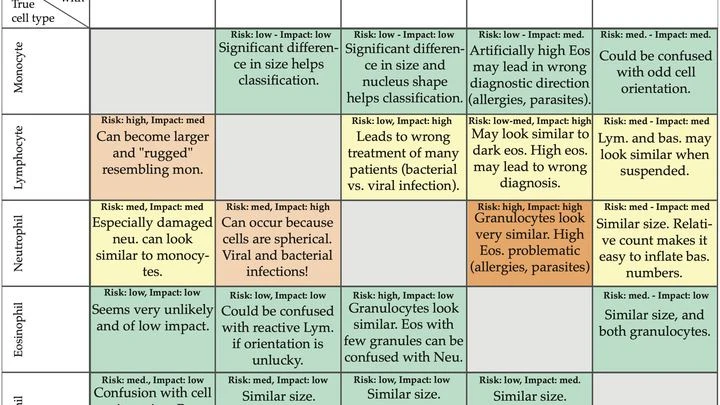
A drop of blood lands on a tiny sensor, and within a minute the doctor knows how many different defenders are in it. That's the future of blood testing, brought closer by Danish engineers.
Instead of a regular microscope with lenses, they built a lensless device. A cell flows over the sensor, which records a pattern of dark and light rings — a hologram.
A typical 3D printer squeezes out plastic like a pastry chef piping cream from a bag. Here, instead of plastic, it's light. A laser beam draws in liquid resin, making it solidify at precise points. This creates parts too small to see without a microscope.
Until now, such printers were slow: the beam crawled across the surface like a pen on paper.
A flashlight beam in fog draws a cone, but it can't carve a figure out of a cloud. A hologram, though, is like a stencil for light: it knows in advance where to gather into bright points and where to remain shadow. Now such a stencil makes liquid resin solidify throughout the entire volume at once, without layer-by-layer printing.
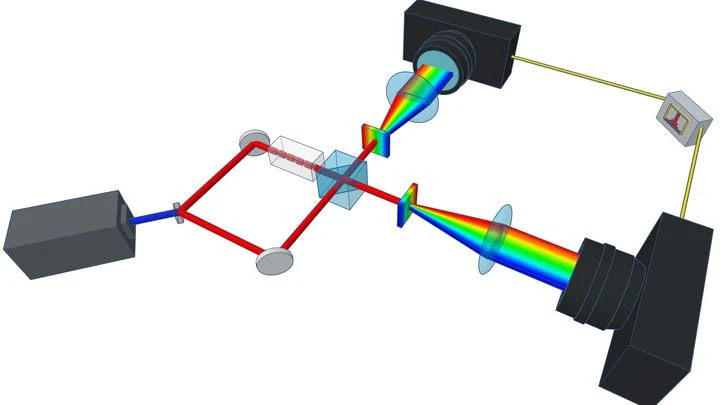
Light is like a many-voiced choir: color, direction of oscillation, and instantaneous changes all intertwine. An ordinary camera hears only one voice, while the rest are lost. Scientists have built a camera that listens to the entire choir at once, and from a single image understands what is happening.
As light passes through a patterned plate, it folds inside a transparent liquid into a three-dimensional pattern. Where the light is brighter, the resin hardens. After 7.5 seconds, a finished part is lifted out of the liquid — complete with cavities, channels, and tiny protrusions.
A regular 3D printer prints point by point or layer by layer.
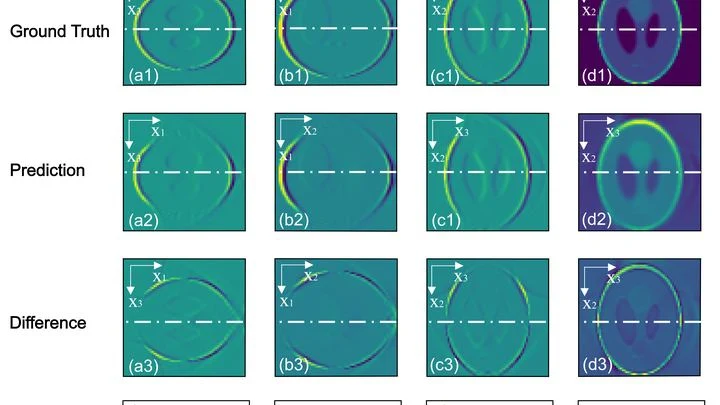
A laser hits tissue, and the tissue responds with a barely audible click — a sound wave. Sensors pick it up, and from that, an image of what's inside is built. That's how photoacoustic imaging works: light reaches deep, and sound carries the picture out.
In the new scheme, there are no sensors. Instead, several thin light beams are sent through the area where the wave has passed.
Time flows slower near the ground than on the roof: this was predicted by Einstein in his theory of relativity. To spot the tiny difference, physicists propose using a pair of photons, linked like voices in a duet.
A ruler made of light: that's one way to describe a new method for measuring tiny time delays. In 1987, Chong Ki Hong, Zhe-Yu Ou, and Leonard Mandel noticed that when two indistinguishable photons hit a beam splitter simultaneously, they always exit together from the same port.