Carbon is what all living things are made of. If you burn a piece of wood, the black charcoal is almost pure carbon. It is like a magical constructor: from it you can build both the soft graphite of a pencil and a hard sparkling diamond.
History
The elemental nature of carbon was established at the end of the 18th century by Antoine Lavoisier, who obtained carbon dioxide by burning diamonds and proved that diamond, graphite, and coal are the same substance. Lavoisier introduced the term 'carbon' in 1789. The development of organic chemistry in the 19th century solidified the central role of carbon. Johann Balmer, by creating a formula for the spectral lines of hydrogen, opened the way for spectral analysis of carbon in flames and stars. Cecilia Payne-Gaposchkin in the 20th century confirmed that carbon is one of the main elements of stellar composition.
How it works
The chemical flexibility of carbon is provided by four valence electrons capable of orbital hybridization (sp, sp², sp³), which determines bond geometry and types of allotropes. In stars, carbon is formed in the triple-alpha process: three helium-4 nuclei fuse into carbon-12, which requires precise energy matching described by quantum mechanics (the Schrödinger equation). The stability of carbon nuclei is also dictated by the Pauli principle, which forbids fermions from occupying the same state, playing a role in stellar evolution and preventing the collapse of white dwarfs.
Fun fact
There is so much carbon in your body that you could make 9000 pencil leads from it!
Imagine three witnesses who saw the same event. Two tell the same story, the third tells a different one. Whom do you believe? This is exactly the situation in astronomy when measuring carbon in the star J0815+4729, an ancient object with a record-low iron abundance (carbon is one of the key elements used to infer the properties of the…
Imagine three witnesses who saw the same event. Two tell the same story, the third tells a different one. Whom do you believe? This is exactly the situation in astronomy when measuring carbon in the star J0815+4729, an ancient object with a record-low iron abundance (carbon is one of the key elements used to infer the properties of the…
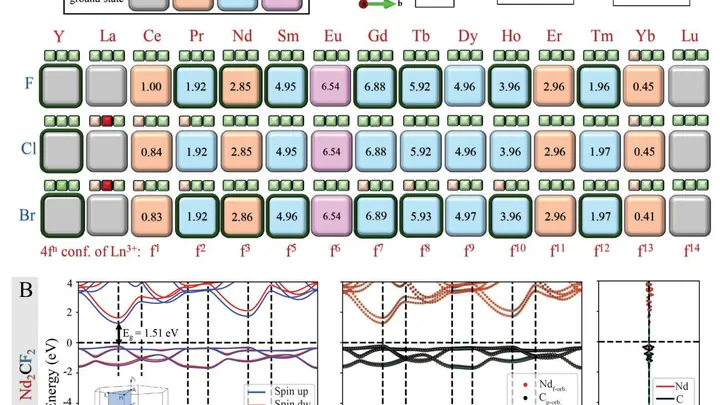
In chemistry's storeroom, records of substances no one thought were special gathered dust. It turns out that among them hide 2D materials — thin as a sheet of paper, but strong and with unexpected properties. Scientists ran a computer search through databases, and it pulled out 38 candidates that had not been recognized as 2D before.
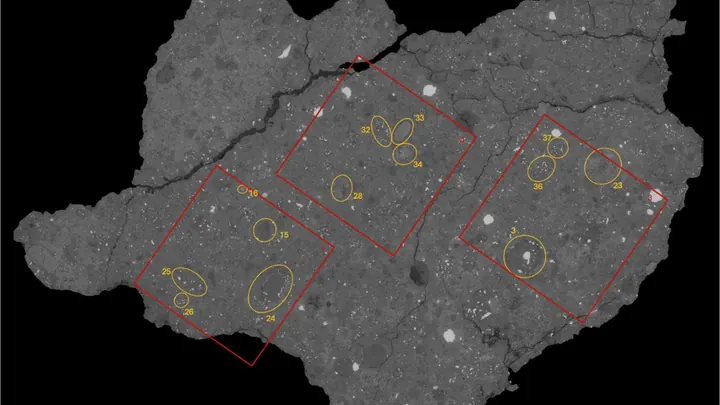
In the cold depths of space float rocks older than Earth itself. Inside some of them hide tiny glassy spheres — chondrules. They formed when a disk of gas and dust still swirled around the young Sun.
Carbonaceous meteorites Asuka 12236, Paris, and Maribo have preserved these spheres almost untouched.
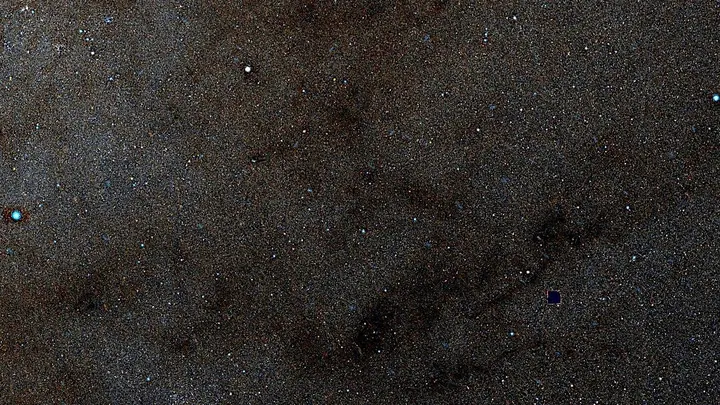
In a dense molecular cloud, at the edge of glowing gas, an invisible assembly line is at work. It takes simple scraps — single atoms and light pairs — and glues them together step by step into long carbon chains and rings. The first piece of this assembly line has long eluded our eyes. Now it has been found.
Every battery or supercapacitor has an unassuming player — the polymer glue. It binds the active material particles together and helps them stick to the current collector. Previously, it was considered just inert mass: it's there, as long as it doesn't get in the way. But in this work, the glue takes center stage.
A playground with swings follows its own rules. Usually, kids sit on the lowest, most stable spots. But sometimes someone climbs higher, and the whole structure tilts a bit. That's roughly how the carbon-14 nucleus behaves — six protons and eight neutrons packed into a tiny volume.
In the black depths of space, on the surfaces of tiny icy dust grains, a quiet construction is underway. There, where temperatures drop to near absolute zero and harsh radiation abounds, the ordinary amino acid glycine, the simplest protein building block, links up with itself.
In 1946, proposed a method that revolutionized archaeology: determining age by the decay of radiocarbon. The clock ticks: every 5730 years, half of the atoms vanish. But why so slowly? For a light nucleus, this is an anomaly — typical lifetimes are millions of times shorter. The mystery held for seven decades.
In the web of life, predators and prey exchange carbon and water, and each act of eating slightly increases the universe's disorder. But the intrusion of disease turns this system into a giant seesaw. When a mid-level predator gets sick, its hunting abilities decline, and it becomes easy prey.
Cooking a complex dish requires a clear recipe: first chop, then sauté, add spices at just the right moment. Chemical transformations also follow step-by-step recipes — mechanisms where atoms of carbon and hydrogen rearrange in a strict order.
Previously, neural networks often invented nonexistent steps, like a whimsical cook swapping salt for sugar.
The carbon nucleus was long imagined as a uniform ball of protons and neutrons, evenly mixed like dough. But physicist George Gamow suspected otherwise: particles inside might group into tiny, sturdy blocks — helium nuclei, or alpha particles.
A solid electrolyte is not just a crystal lattice: it’s a bustling metropolis for ions. Each act of conduction resembles a trip through the city: there are wide highways with low energy barriers, gridlocks in bottlenecks, and tricky detours where an ion can get stuck.
A powerful laser strikes a diamond like a sledgehammer, with matter itself serving as the anvil. The impact lasts only an instant but generates pressures a million times greater than atmospheric. Physicists have long dreamed of peering into that moment to see how atoms rearrange under the onslaught.
The X-ray beam here is like a camera flash.
Ordinary magnetic sensors lose sensitivity as they shrink. But scientists turned a tiny diamond into a light-based compass. Unlike jewelry diamonds, what matters here isn't purity but artificially created defects — these are what turn the crystal into a compass.
Every year, the food we eat costs humanity tens of millions of years of life due to unhealthy diets. At the same time, a third of all greenhouse gases warming the planet are produced along the journey from farm to plate. It seems obvious: switch to healthier eating, and we'll save the climate and improve our health. But new research shows these two goals don't always go hand in hand.
Computational studies of material behavior have long suffered from two extremes: either fast but inaccurate models, or accurate but slow physical calculations. Modern programs, trained on data, have nearly resolved this dilemma — now the bottleneck is not computing power, but human routine: setting up simulations and checking results.
Paimon works like an autonomous chef.
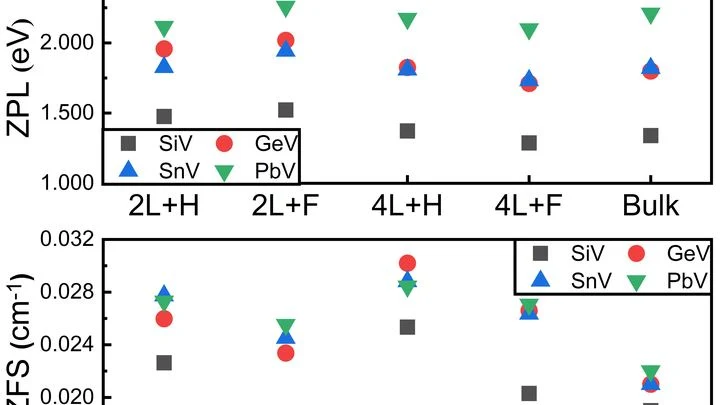
In diamond, as in any crystal, defects are common — empty sites or foreign atoms. When they capture an electron, they can glow or become magnetic, which is valuable for quantum devices. But the electron is easily lost, and to keep it, boron has to be added to the diamond — sort of like constantly warming up an engine so it runs in the cold.
Magnetic particles are attached to the surface of the diamond by DNA strands, like puppets on strings. They constantly dance under the thermal motion of the liquid molecules. The liquid's viscosity sets the pace: in honey, the particles barely tremble; in alcohol, they dance quickly.
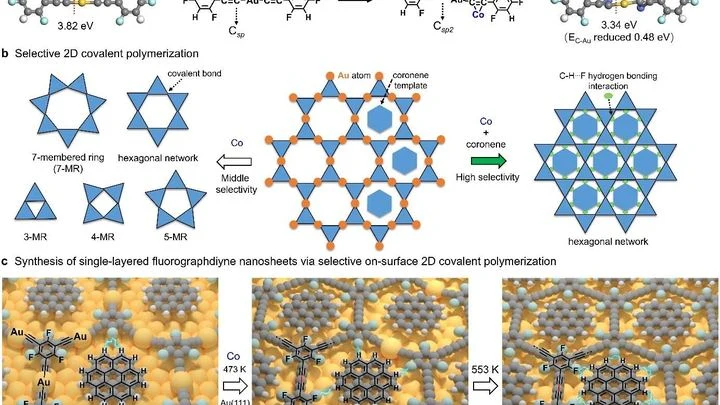
Crocheting, but instead of yarn you have individual molecules, and instead of a hook, a gold surface. Until now, attempts to knit such molecules into a smooth fabric ended in a tangle: the threads hooked where they shouldn't, and the pattern went awry.
A team of scientists has found a way to fix this.
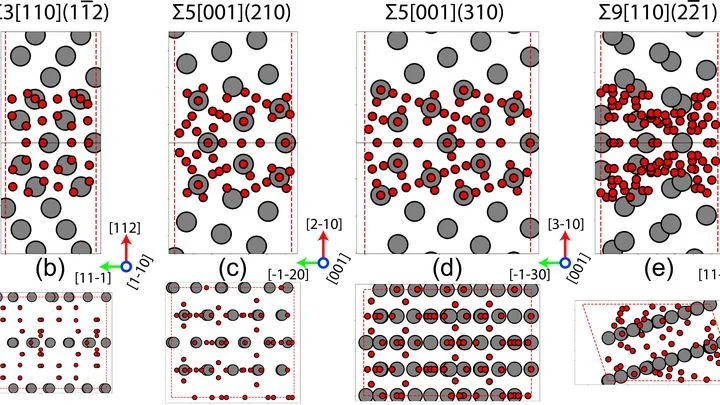
A steel cylinder that has held hydrogen for a long time sometimes breaks not along the usual grain boundaries but right through the crystal grains, leaving a strange pattern, as if the crack chose the wrong road. For a long time, people looked at this and wondered: why?
The MethaneSAT satellite scans for leaks of метана — a gas that's invisible but packs a powerful planetary warming punch. Its "nose" is a спектрометр, a device that spots the subtlest color changes in light passing through the atmosphere — the telltale sign of methane.
From carbon, nitrogen, oxygen, and sulfur, you can assemble 10⁶⁰ different small molecules: that's a 1 with 60 zeros, more than the stars in the visible universe. Life uses only a tiny fraction of this menu, but not randomly.
A crystal is like a row of soldiers on a parade ground: every atom is in its place, and electrons march through it in neat waves. An amorphous material is like a crowd at a train station, where there is no order, just a jostling throng. In such a crowd, an electron usually gets stuck quickly, like a person trying to push through a dense mass of people.
The search for extraterrestrial life is like a detective investigation: from tiny clues, you must distinguish traces of life from random imprints of non-living nature. On Saturn's moon Enceladus, the investigators are lucky — geysers burst from cracks in the icy crust, ejecting water from the subsurface ocean straight into space.
Hydrogen is the most common element. Its atoms are like antennas: they emit and absorb light at very specific frequencies. Einstein predicted that spacetime can ripple: these are gravitational waves.
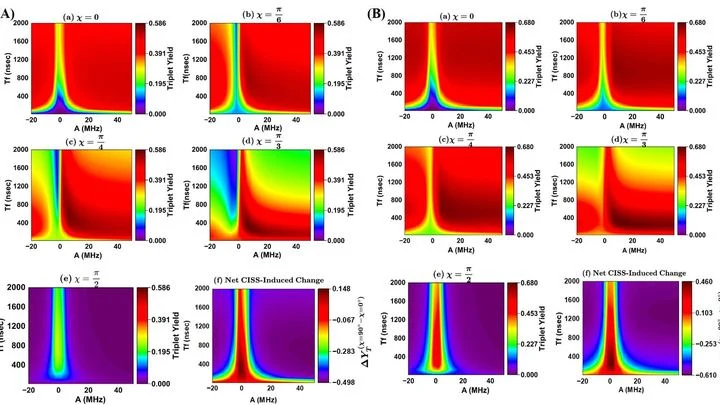
Under sunlight, molecules inside bacteria, like the beaters of a kitchen mixer, capture energy and spin electrons in the right direction. But sometimes the spin gets disrupted — 'stuck' triplet particles appear. It's as if the beater momentarily froze and then jerked backward, splashing hot liquid and scalding the walls.
A tiny grain of sand, older than Earth, was found in the meteorite Meteorite Hills 00526. It measures about one thousandth of a millimeter. It consists of three parts: a silicate with magnesium and calcium, aluminum oxide, and a speck of titanium oxide.
Steel is not a monolith but a mosaic of microscopic grains fused together. Their seams, the grain boundaries, are the most vulnerable spots: this is where cracks begin. Impurity atoms, even in negligible amounts, accumulate at these seams like sand between gears, and they can either lubricate the mechanism or jam it completely.
A giant cloud of gas and dust, so cold that its warmth barely flickers, just a few degrees above absolute zero. This is TMC-1 in the constellation Taurus, one of the darkest and densest cradles of molecules in our Galaxy. In recent years, it has become a true treasure trove for astrochemists: the number of substances found there has more than doubled.
Every carbon atom in a molecule carries a passport — the energy with which its deepest electrons sit in their orbitals. This energy is sensitive to neighbors: add an oxygen nearby or a double bond, and the number in the passport changes. Chemists have long measured such energies with X-rays, but calculating each new molecule takes hours of machine time.
Chondrules look like frozen raindrops made of stone. They're about the size of a grain of sand, but they record the history of the first few million years of the Solar System. Once, these droplets floated in the scorching gas around the young Sun, then clumped into asteroids and fell to Earth as meteorites.
In dark, cold clouds of interstellar gas, astronomers have for several years been spotting aromatic molecules — compounds built around a benzene ring (a hexagon of carbon atoms), like the benzene we know. One such substance, benzonitrile (benzene with a cyano group attached), had only been found in very calm and cold places, like the Taurus cloud.
Diamond is the hardest natural material and usually does not conduct electricity. But if you add a few foreign atoms to its crystal lattice, it can become a semiconductor, like silicon in computer chips.
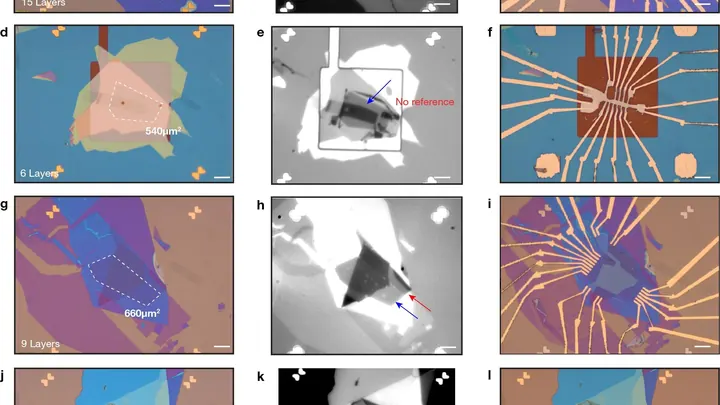
A graphene sheet is a one-atom-thick grid of carbon atoms. Stacking several such sheets with a specific twist yields a material with unusual properties: it can be a magnet or a superconductor depending on how you poke it. The trouble is that in natural graphite, such 'properly twisted' layers are rare, and growing them artificially is tricky.
Silicon carbide is the material used to armor electronics. It withstands heat, impacts, and radiation like the ceramic tiles on a spacecraft's heat shield. But even this armor has a weak spot: ordinary metal contacts quickly degrade under X-rays.
The Red Planet is surrounded by the rubble of failed worlds — rocky boulders stuffed with metal. Shipping a kilogram of steel from Earth to Mars costs as much as several cars. It's far cheaper to pick up space junk right in orbit.
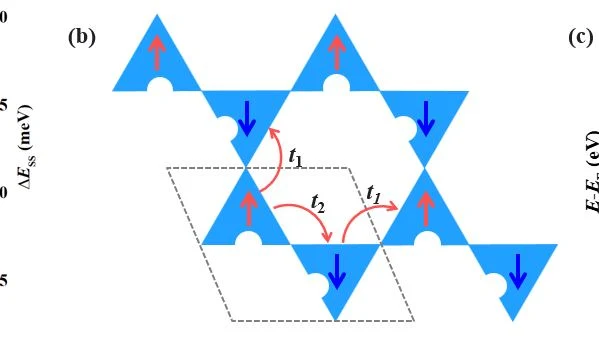
Honeycombs are built from identical cells, but tweak the shape of just one, and the whole structure gains new properties. Researchers did something similar to create a magnet without a single metal atom. They took flat carbon molecules shaped like triangles, triangulenes, and arranged them in a hexagonal lattice, just as bees build honeycombs.
Graphene is a carbon film exactly one atom thick. Two such sheets placed on top of each other with a slight twist behave very differently from a single sheet. At an angle of about 1.1 degrees, electrons slow down so much that the material can become a superconductor or an insulator — depending on the conditions.