Smashing a moon slowed down the main asteroid express
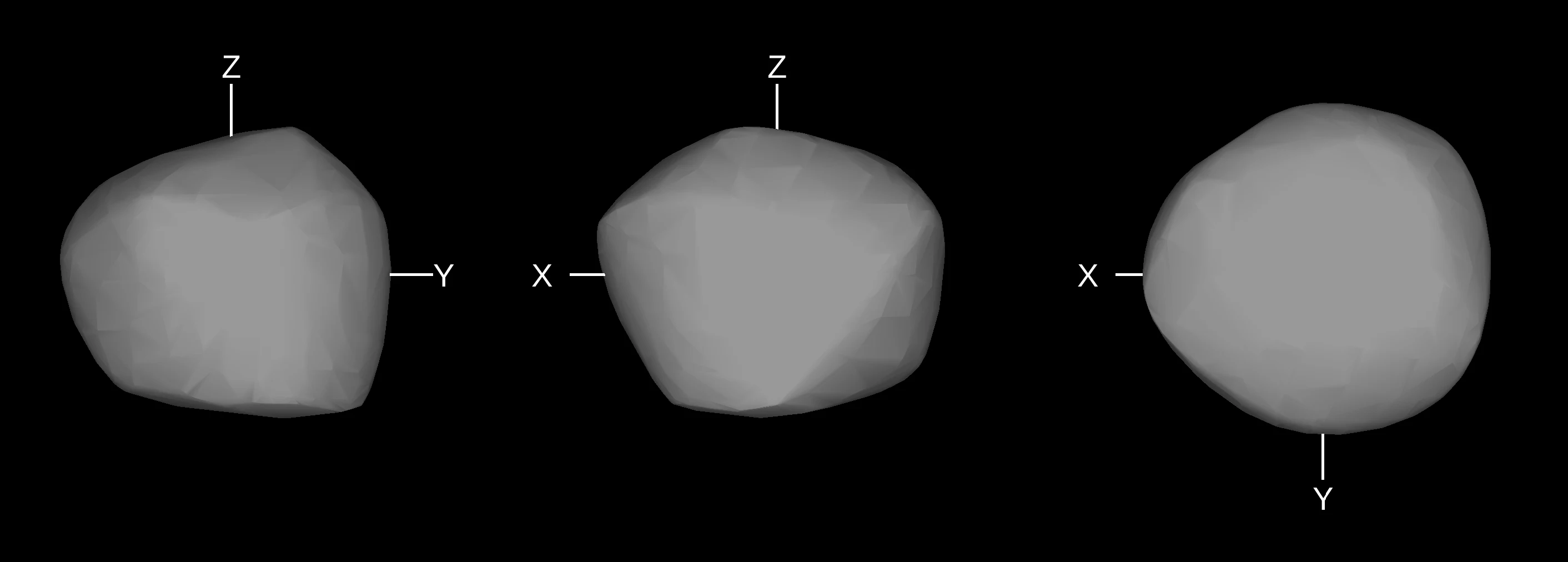
Asteroid Didymos slowed its rotation after the DART probe slammed into its moon Dimorphos. The reason: the impact flattened Didymos, making it wider at the waist, like a figure skater spreading their arms. This 'spread' added 0.18 seconds to each rotation — less than an instant, but astronomers noticed it thanks to 20 years of observations. They monitored changes in the system's brightness as one asteroid passed in front of the other, transits, and caught the tiny lengthening of the day using brightness measurements. This is the first evidence that a kinetic impactor can not only deflect an asteroid but also permanently change its shape and rotation. And the most unexpected part? Dimorphos itself began orbiting Didymos 37 minutes faster after the impact. No matter where you look, surprises abound.
Original abstract
as written by the authors arXiv:2601.04793v1
On 26 September 2022, the NASA Double Asteroid Redirection Test (DART) spacecraft impacted Dimorphos, the secondary component of the binary asteroid (65803)~Didymos. This experiment tested the Kinetic Impactor technology for diverting dangerous asteroids. Due to the impact, the binary system's angular momentum has changed, resulting in a significant change in the orbital period of Dimorphos. Precise values of the pre- and post-impact orbital periods were derived from a large set of photometric light curves measured for the Didymos-Dimorphos system during six apparitions from 2003 to 2023. We used these data to detect a possible change in the rotation period of the primary as a consequence of the impact. We analyzed the binary system's light curves using the binary asteroid light curve decomposition method. We selected parts of the light curves covering orbital phases outside mutual events, which represent the primary rotational light curves. We applied the light curve inversion method to construct a convex shape model of Didymos and determine its rotation period before and after the impact. These two periods were treated as independent free parameters of the modeling. We found a value of 2.2603891 +/- 0.0000002 h for the pre-impact period and 2.260440 +/- 0.000008 h for the post-impact period. Their difference 0.18 +/- 0.03 s is small yet significant, indicating that the rotation of Didymos became slower after the DART impact. The most plausible physical explanation is Didymos's post-impact reshaping, making its shape more oblate.
Dimorphos's orbit around Didymos shrank by 37 minutes: from 11.9 to 11.23 hours.
If in 'Armageddon' they nuke an asteroid, DART simply rammed its target, and that was enough to change not only its orbit but also its spin.