Popular

William Borucki

1939- · Astronomy, exoplanetology, space research
American scientist, the visionary and leader of the Kepler mission, which discovered thousands of exoplanets using the transit method. He fought for funding for the project for over 20 years, facing repeated rejections, but managed to prove the feasibility of his idea.

Biography

Worked at NASA's Ames Research Center. In the 1980s, he proposed using the transit photometry method to search for exoplanets. His proposals were repeatedly rejected, but he built laboratory prototypes, demonstrating the accuracy of the method. In 2001, the Kepler mission was finally approved. The launch took place in 2009, and the telescope revolutionized planet hunting. Borucki retired in 2015. Laureate of the Shaw Prize and the Bower Award.
Key discoveries

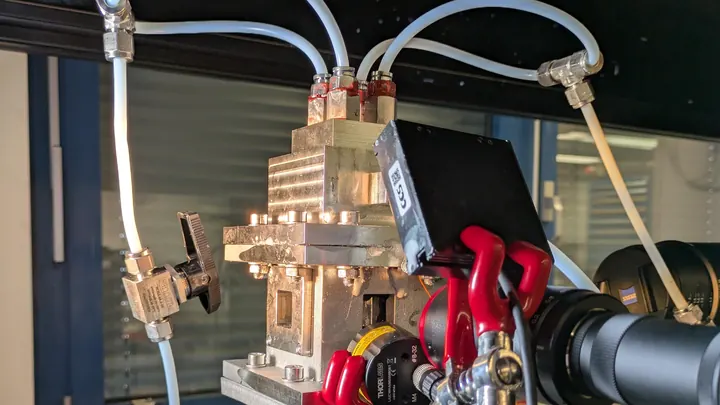
💡 Borucki's proposal for the Kepler mission was rejected five times over a decade. To convince skeptics, he built his own photometer with CCD sensors in the laboratory and proved that the method works.
Quote: "We have gone from not knowing whether there are planets the size of Earth to understanding that there are more of them than stars."
Links in the knowledge graph 1
Related tags
exoplanetphotometrytransit method
Related laws
Kepler's third law
Related scientists
David Charbonneau

Related articles

The Invisible Conductor of the Super-Puff Planet System

Meticulous 14-year observations of three 'cotton-candy' exoplanets in Kepler-51 yielded an unexpected surprise. The James Webb Space Telescope recorded the outermost known planet crossing the star's disk two hours ahead of schedule. The anomaly was only explained by adding an invisible fourth planet
arXiv:2410.01625 · 2024-10-02

How Hydrogen and Magma Create Water Deep Inside Planets

By recreating the interiors of sub-Neptune planets, scientists discovered that under high pressure, hydrogen interacts with magma, pulling out oxygen. Water forms, and its fraction can reach tens of percent. So water doesn’t always come from icy outskirts — it’s born right on the spot. This changes
arXiv:2511.06507 · 2025-11-09

Shadow or Mirage: Hunting a Moon Around a Scorching Jupiter

Analysis of a single transit with James Webb pointed to a possible moon around exoplanet Kepler-167e. But a slow brightness drift scrambled the clues: it could be a starspot. A new transit in 2027 will settle the case.
arXiv:2511.15317 · 2025-11-19

The Red Dwarf Oxygen Trap

Around dim stars like TRAPPIST-1, photosynthesis barely produces oxygen—visible light is scarce. Infrared bacteria, on the other hand, thrive, gobbling up nearly all the available energy. As a result, an oxygen atmosphere may never form, and complex life never arise.
arXiv:2601.02548v1 · 2026-01-05

The Stumbling Dance of Two Planets Around TOI-4495

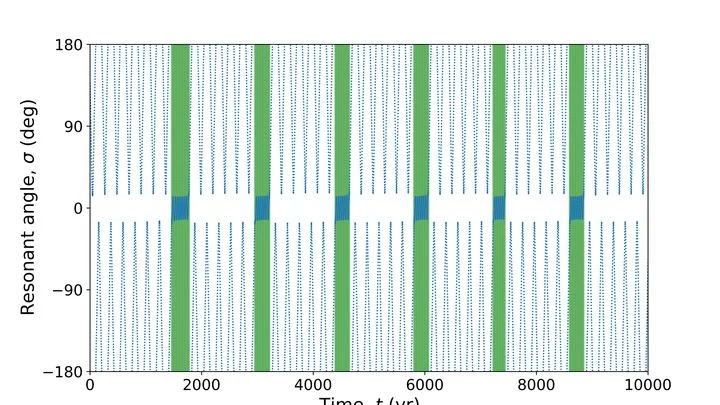
Around TOI-4495, two planets orbit wrapped in thick gas blankets. Their orbits are almost tuned—two revolutions of the inner planet for one of the outer—but exact synchronization is absent. The elongated path of the inner planet persists for billions of years thanks to the unusual elasticity of its
arXiv:2601.02665v1 · 2026-01-06

A Waterfall of Planets: The Mystery of the Vanishing Water Worlds

The model divides exoplanets into rocky and water worlds. Water worlds with steam atmospheres nicely account for the size gap, but at three Earth radii, their numbers plummet — like water over a cliff. This points to the inevitable capture of light gases by large planets.
arXiv:2602.11923 · 2026-02-12

Starlink and OneWeb Satellites: An Unexpected Swap in Brightness

Comparing 1.6 million brightness measurements over five years, astronomers noticed opposite trends: Starlink satellites with sun visors (VisorSat) became 0.6 magnitudes brighter, while OneWeb spacecraft became 0.4 dimmer. Both changes are statistically significant with an error probability below 0.3
arXiv:2604.13145 · 2026-04-14

Atmosphere found on a small icy body beyond Neptune

Astronomers have for the first time found an atmosphere on a small object (612533) 2002 XV93 in the Kuiper Belt. Previously, it was thought that only large bodies could retain gases, but this icy ball 250 km in diameter proved otherwise. The discovery forces a fresh look at the hidden activity of sm
arXiv:2605.02243 · 2026-05-04

Alien Radio Hum: How to Eavesdrop on Distant Civilizations

Traditionally, SETI has searched for narrow radio signals. But Earth's technosphere is humming ever louder, creating a broad radio background. Astronomers have developed a method to detect such a planetary hum around other stars using modern telescopes. This will allow us to find civilizations up to
arXiv:2605.10212 · 2026-05-11

Ultraviolet Trap: How TRAPPIST-1 Star Fakes Signs of Life

TRAPPIST-1 e is a rocky planet in the habitable zone of a red dwarf, one of astrobiologists' prime targets. But decoding its atmosphere requires a precise ultraviolet 'autograph' of the star. Simulations showed: different UV spectra dramatically alter the chemical portrait, producing deceptive pairs
arXiv:2606.05451v1 · 2026-06-03

Cosmic Tan: How Stellar Flares Repaint Water Worlds

Atmospheres of many sub-Neptunes are shrouded in dense organic hazes that hide their true composition. In lab experiments, such hazes were recreated from water vapor, methane, and carbon dioxide, then irradiated with ultraviolet light, mimicking flares from red dwarfs. It turned out that after irrad
arXiv:2606.06691v1 · 2026-06-04

The Cosmic Forge: Why GJ 3929 b Lost Its Air

Ultra-precise photometry of four secondary eclipses of the planet in the red dwarf system GJ 3929 yielded a depth of 118±22 ppm, corresponding to a dayside temperature of about 640 K. Modeling showed that a dense carbon dioxide envelope like Venus's cannot be held, though traces of gases might remai
arXiv:2606.07511v1 · 2026-06-05

Dark Matter Sways Distant Planets

Planets on the outskirts of star systems prove to be perfect scales for invisible matter. A drifting clump of dark matter nudges their orbit just enough— a shift we can now measure. This method could uncover the primordial invisible structures lingering from the Big Bang and let us chart the dark un
arXiv:2606.14827 · 2026-06-12

Cosmic Carving: Birth of a Bloated Neptune from a Jupiter

Astronomers discovered exoplanet TOI-2195 A b – a hot Neptune with a mass 1.5 times that of Neptune, but a radius almost as large as Jupiter's. Orbital analysis suggests a likely polar orbit. Modeling indicates the planet may have formed as a cold Jupiter, losing up to 90% of its mass during highly
arXiv:2607.01315v1 · 2026-07-01

Cosmic Kick: Warm Orphans Born from Stellar Death

Analytical estimates and numerical simulations show that kicks during white dwarf formation directly liberate only ~1% of known exoplanets, but in multi-planet systems they trigger dynamical instability in 40–47% of cases, leading to planet ejections. These free-floating planets are heated to up to
arXiv:2607.02653v1 · 2026-07-02

Gravitational Infancy: Record Orbits in the Cradle of HD 114082

310 light-years from Earth, astronomers have found a remarkable system: a 15 million-year-old star surrounded by two transiting gas giants with record-long orbits of 225 and 314 days. Observations with TESS, CHEOPS, and ground-based telescopes measured their radii and set upper limits on their masse
arXiv:2607.02685v1 · 2026-07-02

Cosmic Debt: How a Planet's Mass Locks Civilizations Forever

Scientists from Blue Marble Space combined geophysics, atmosphere, and rocket dynamics to find the limits of chemical escape from exoplanets. A payload of 1,000 kg — like that of the Voyager probes — was used as a benchmark. It turned out that for a planet more massive than about 11.5 M⊕, the number
arXiv:2607.02691v1 · 2026-07-02

Cosmic Drops: How Gravity Revealed Four New Cold Giants

Astronomers have reported the discovery of four cold giant planets around low-mass stars. They were betrayed by brief anomalies in the light curves — as if a water droplet on a windowpane momentarily focused distant light. All planets lie beyond the snow line, up to 6 astronomical units from their s
arXiv:2607.04594v1 · 2026-07-06

Waltz of Invisible Moons: The First Spectroscopic Find

Astronomers have discovered planetary-mass moons around a brown dwarf for the first time using high-precision spectroscopy. Observations with the VLT and the CRIRES+ spectrograph revealed periodic wobbles in the radial velocity of the starlike object CD-35 2722 B, hinting at at least one moon about
arXiv:2607.05193v1 · 2026-07-06