Brightness is the amount of light emitted, reflected, or transmitted by an object, typically measured as the power per unit area (flux) or in logarithmicmagnitude scales. In astronomy, brightness is a key observable that allows scientists to infer the luminosity, distance, and physical properties of celestial objects. In everyday life, brightness determines how we perceive the intensity of light sources and illuminated surfaces.
History
The magnitude scale was formalized by Hipparchus in the 2nd century BCE and later refined by Norman Pogson in 1856, who established the logarithmic relationship.
How it works
Brightness is quantified by measuring the radiantflux received from a source. In astronomy, apparent magnitude is a logarithmic scale where a difference of 5 magnitudes corresponds to a factor of 100 in brightness. The intrinsic brightness of an object is its luminosity, which, combined with distance, determines the apparent brightness via the inverse-square law. In photometry, brightness is often weighted by the human eye's spectral sensitivity, giving photometric magnitudes.
In practice
Brightness measurements are used in astronomy to classify stars, measure distances via standard candles, and monitor variable objects like supernovae and exoplanet transits.
Fun fact
The human eye can detect a single photon, but the brain requires about 5-9 photons arriving within a short timewindow to consciously perceive a flash.
Units by system: SI: watt per square meter · CGS: erg per square centimeter per second
A light ray passing by a massive body slightly changes its direction, like a stream of water bending around a rock in a creek. In the solar system, there are many such "rocks": planets, their moons, asteroids. And each one, with its own gravity, bends the path of light coming from distant stars.
Light waves are never perfectly smooth — they are constantly jittered by quantum ripples. These almost invisible nudges were studied by Nobel laureate Roy Glauber, who laid the foundations of quantum optics. Now physicists have learned to freeze these ripples.
In astrophysics, some numbers seem random yet recur with the persistence of a spell. One such number is the ratio of X-ray brightness to H-alpha hydrogen emission in turbulent gas tails. From galactic winds to ‘jellyfish’ slicing through clusters, this ratio steadily holds at around three.
Hydrogen is the most common element. Its atoms are like antennas: they emit and absorb light at very specific frequencies. Einstein predicted that spacetime can ripple: these are gravitational waves.
Edwin Hubble and Georges Lemaître discovered the expansion of the Universe nearly a century ago. One way to test it is the surface brightness test: in an expanding cosmos, the light of a distant galaxy should fade like a pattern on a stretching film.
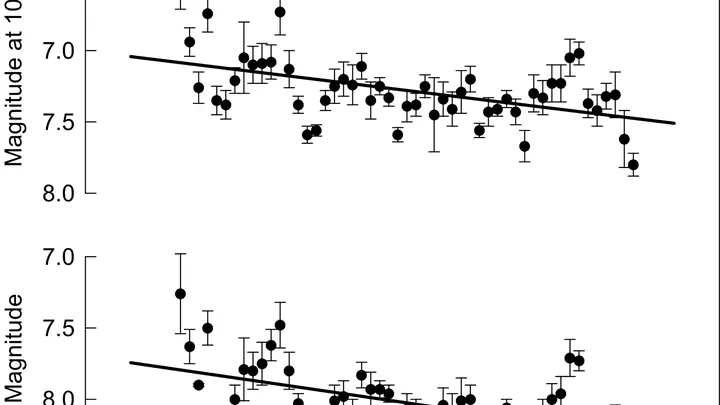
For five consecutive years, the automated MMT9 observatory measured the brightness of Starlink and OneWeb satellites using photometry (precise light measurement). The results were surprising: VisorSats, equipped with visors to reduce glare, became brighter by 0.6 magnitudes, while OneWeb, on the contrary, dimmed by 0.4.
Even a laser beam has an invisible tremor — quantum noise. Physicists have learned to 'squeeze' it, like a balloon pinched at the waist: the noise quiets in one direction but amplifies in another. Scientists hid the excess noise where it doesn't interfere with precise light measurements.
Shine a flashlight through a narrow slit, and the beam doesn't stay a thin stripe; it spreads out sideways. Light has a habit of bending around obstacles, and because of that, the smallest spot you can get with an ordinary lens is no smaller than half a wavelength.