An asteroidimpact is a collision between an asteroid and a planetary body, such as a planet, moon, or another asteroid. These impacts are among the most fundamental processes shaping the solar system, responsible for creating craters, ejecting surface material, and even influencing the geological and biological evolution of planets. On Earth, large impacts have caused mass extinctions, while on the Moon, they have created the heavily cratered highlands and contributed to the similarity in isotopic composition between lunar and terrestrial rocks.
History
The recognition of asteroidimpacts as a geological process began in the early 20th century with the work of Grove Karl Gilbert, but it was not until the 1960s, with Eugene Shoemaker's studies of Meteor Crater and the Apollo missions, that impacts were widely accepted as a major force in planetary evolution.
How it works
When an asteroid strikes a surface, the kinetic energy of the impact is converted into a shock wave that compresses and heats the target material, causing it to melt, vaporize, and eject outward. The result is a crater, often surrounded by a blanket of ejected debris. The impact can also throw material into space, some of which may escape the body's gravity and later fall onto other planets, as seen with Martian meteorites found on Earth. The size and effects of the impact depend on the asteroid's mass, velocity, and angle of entry.
In practice
Understanding asteroidimpacts is crucial for planetary defense, as scientists track near-Earth objects and develop deflection strategies. It also informs the study of impact cratering on other worlds, which helps date planetary surfaces and understand their histories.
Fun fact
The Moon is thought to have formed from debris ejected when a Mars-sized body, Theia, struck the early Earth, and this impact may have also delivered the water and other volatiles that made life possible.
On the surface of the Moon and asteroids, you can find pits smaller than a pinhead but with shiny, melted rims. Such marks are left by tiny meteorites, but the exact impact speed at which melting occurs remained unclear.
The birth of a moon is a cosmic car crash. Two young planets collide, and a cloud of scorching debris swirls around the surviving world. From this disk, like clay on a potter's wheel, a satellite gradually takes shape. That's probably how our Moon came to be.
On September 26, 2022, the DART probe slammed into the natural satellite at a speed of 6,6 km/s. A fountain of debris burst into space. Rocks, dust, sand grains — everything erupted in a silent flash.
Two years later, a numerical simulation of 20 million trajectories revealed the fate of each particle.
In a single star system, two teams of planets orbit. Some follow neat paths, like figure skaters on an ice rink, avoiding collisions. Others crowd together, their trajectories cross, and sooner or later a cosmic accident occurs — a giant impact.
Around some young stars where star formation has recently ended, there swirl not just dust rings but actual planetary battlefields — extreme debris disks.
The birth of planets resembles the workings of a cosmic forge. Rocky blocks collide and fuse together. A powerful impact strikes a spark — material heats to white-hot and glows like cooling metal. Computer simulations show: the flash is visible from days to years, peaking at a tenth of the sun's light.
Young Earth was a boiling sphere of liquid rock, while Theia, which crashed into it, had had time to cool and solidify. It’s like dropping a chunk of cold butter into a pot of soup: the soup splashes out, but the butter barely moves. Similarly, Earth’s interior spewed into space, forming a cloud of cosmic dust and debris.
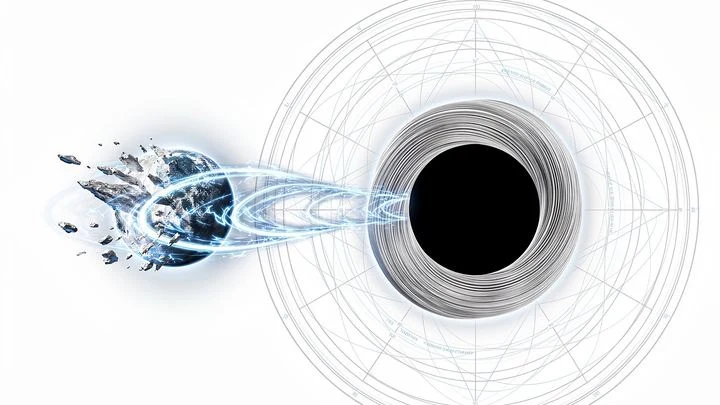
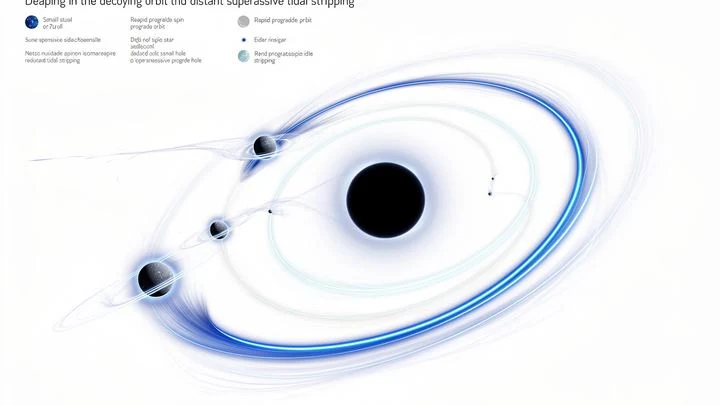
At the center of a distant galaxy, a supermassive black hole is surrounded by a flat, rotating disk of gas and dust — a giant cosmic funnel of matter. A small compact object, such as another stellar-mass black hole, may find itself in this disk.
In the catalogs of exoplanets, there are many worlds with sizes between Earth and Neptune. They are divided into two groups: rocky super-Earths and gaseous mini-Neptunes. The Solar System has none of these, and scientists debate where they come from.
The authors of the study looked into each planet's 'passport'—its orbit.
On the periphery of the Solar System lurk thousands of objects comparable in size to an exoplanet — a body of planetary mass not bound to our star. Their orbits are chaotic, and from time to time the trajectory of such a wanderer crosses Earth's path.
A thick stew slowly cools in a pot. Suddenly, the flame beneath it flares up, and the stew begins to boil, breaking into many small whirlpools. Much the same happens to the disk of gas and dust around a young star when it experiences a flare — a sudden influx of matter from the disk onto the star.
In the accretion disks that gird the nuclei of active galaxies (quasars, discovered by Maarten Schmidt way back in the 1960s) a river of incandescent gas and dust churns. In its backwaters, where turbulent flows subside, against all odds, planets are born.
Perth residents know: when the daytime heat becomes unbearable, relief arrives from the ocean — a fresh breeze affectionately called the Freo Doctor. The same wind, only on a global scale, decides the fate of cosmic visitors plunging into the atmosphere. A meteorite fall is a two-act spectacle.
Eight hundred million years ago, in the main asteroid belt, a giant inkwell shattered. The parent body, over a hundred kilometers in diameter, made of primitive carbonaceous chondrites, suddenly broke apart near the J3:1 resonance with Jupiter.
In the centers of galaxies, where supermassive black holes lie dormant surrounded by stellar swarms, lights of monstrous power sometimes flare up — tidal disruption events. But some of these events behave oddly: they repeat again and again, and each new ignition is dimmer than the last.
Among the icy chunks hurtling through the void, there are special travelers — interstellar comets. They were born around distant stars and happened to wander into our neighborhood. One of them, 3I/ATLAS, came under the gaze of telescopes as it approached the Sun. Its material, frozen gases and refractory dust, began to evaporate, leaving a glowing tail behind.
A stone falls into a pond — ripples spread across the water. If the stone doesn't fall but whizzes over the surface at tremendous speed, a straight wave runs along the water. When it hits a floating log, ripples spread out from the point of impact. That's roughly how gravity works in the new study.
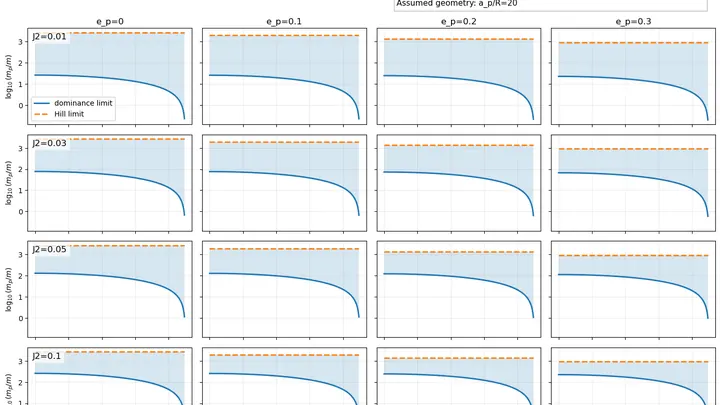
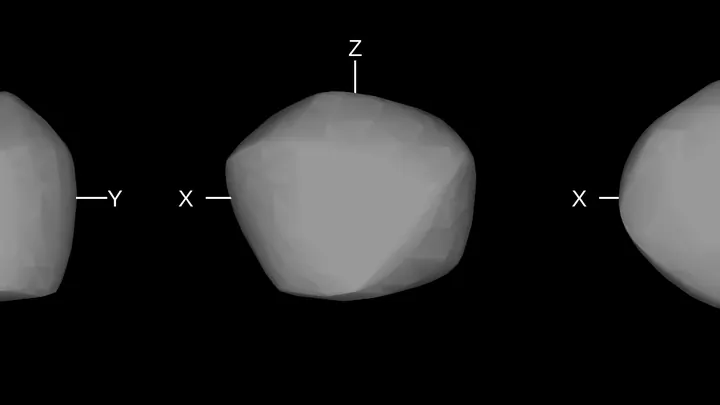
A spinning top launched into weightlessness doesn't just rotate around its axis: it also wobbles, like a drunken sailor. That's exactly how the asteroid Apophis behaves: it doesn't spin neatly but tumbles through space. On April 13, 2029, this celestial wanderer will whiz past at about 38,000 kilometers from Earth — closer than communications satellites.
The Red Planet is surrounded by the rubble of failed worlds — rocky boulders stuffed with metal. Shipping a kilogram of steel from Earth to Mars costs as much as several cars. It's far cheaper to pick up space junk right in orbit.
A landscape cut by roads or rivers into isolated patches resembles a shared apartment after partitions are installed: residents no longer bump into each other in the common hallway. Species that once competed for the same food or space now live apart. Competition weakens, and those that would have lost to pushier neighbors in a continuous landscape now survive.
The light from a distant star is never steady. It shimmers like heat over hot asphalt. When astronomers pointed JWST at the star TOI 700, they saw this shimmer especially clearly: every 16 minutes, the brightness changed by a tiny fraction, just 46 parts per million.For comparison: if you placed a light bulb a kilometer away, this change would be…
Around distant icy bodies the size of a city, circling beyond Neptune, rings of dust and ice have been found. Small moons often whirl nearby. Mathematical analysis shows that a moon's gravity rocks the ring like a swing, making it tilt.
In its youth, Earth resembled a beehive: it grew by sticking together from countless rocky chunks. When the main construction was over, a late swarm of meteorites rained down on the young planet — the so-called late veneer. These impacts, scientists thought, brought platinum, gold, and other rare metals to Earth's upper layers.
The young Solar System resembled a giant construction site: around the newborn Sun swirled a disk of gas and dust, and from this dust gradually assembled stones, boulders, and then planetary embryos — planetesimals. Today, their fragments fall to Earth as meteorites.
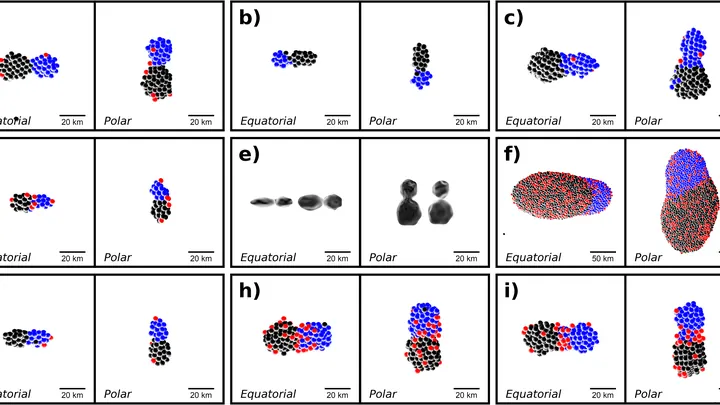
The icy body Arrokoth looks like a snowman: two spheres pressed together. Many such two-headed objects exist beyond Neptune's orbit, in the Kuiper Belt. For a long time, it was thought they formed from the slow collision of two separate bodies.
New simulations show a different path. A cloud of small pebbles around the young Sun collapses under its own gravity.
Saturn's system 300 million years ago resembled a crowded dance floor. The most massive moon, Titan, began to migrate, and this movement threw its neighbors off balance. One moon crashed into Titan; the debris swirled into a vortex, gathering into Hyperion.
Sometimes a fiery streak crosses the night sky. It's a piece of rock from space burning up in the air, and the color of the flash can tell you what elements it contained. Astronomers pointed sensitive cameras at such flashes and, among 180 images, found two rocks that stand out from the majority of shooting stars.
Titan, discovered by Christiaan Huygens in 1655, resembles a canvas that is constantly being repainted. Impacts from cosmic dust and asteroids leave crater marks on it. But an invisible artist, the moon's own forces, time and again covers everything with a fresh layer, erasing old strokes.
Asteroid Didymos slowed its rotation after the DART probe slammed into its moon Dimorphos. The reason: the impact flattened Didymos, making it wider at the waist, like a figure skater spreading their arms. This 'spread' added 0.18 seconds to each rotation — less than an instant, but astronomers noticed it thanks to 20 years of observations.
When countless asteroids pummeled the young Earth, they tore chunks from its mantle. These fragments spiraled in a cosmic disk around the planet and, like a snowball in a blizzard, fused into the Moon.
The Moon harbors a secret that has puzzled planetary scientists for decades: its isotopic composition is almost indistinguishable from Earth's. According to the canonical giant impact model, the Moon should have inherited most of its material from the impactor Theia, a Mars-sized planet that slammed into the young Earth.