The rotation period is the time an astronomical object takes to complete one full spin around its axis. For planets, this determines the length of a day, while for stars, it influences their magnetic activity and stellar wind. Measuring rotation periods is fundamental to understanding the angular momentum distribution, internal structure, and evolutionary state of celestial bodies.
How it works
Rotation periods are typically measured by observing periodic variations in brightness (for stars with spots) or by tracking surface features (for planets). For solid bodies like planets, the period is directly observable; for gas giants, different latitudes may rotate at different speeds, a phenomenon known as differential rotation. Radar ranging and spacecraft flybys provide precise measurements for solar system objects.
In practice
Knowing a planet's rotation period is essential for planning spacecraft missions, interpreting atmospheric weather patterns, and calculating the length of a day for future exploration.
Fun fact
Venus rotates so slowly that its day (243 Earth days) is longer than its year (225 Earth days), and it spins in the opposite direction to most planets.
Units by system: SI: s · CGS: s · Planck: t p · natural: s
The solar wind is a continuous stream of charged particles flowing from the Sun. It has two main components: protons (hydrogen nuclei) and alpha particles (helium nuclei, four times heavier).
At the very heart of the Milky Way, stars whirl around an invisible supermassive black hole. One of them, S301, completes an orbit in just 8.7 years. Its path is a highly squashed ellipse: sometimes it grazes the black hole, sometimes it shoots far away. At closest approach, the distance to the black hole is tiny by cosmic standards.
Two hundred and eighty-nine days: that's how long one rotation of the white dwarf white dwarf WD 1532+129 takes. This is not just a record: on its surface, near the magnetic poles, scars of iron and other metals appear — silent testimony to planets it has devoured.
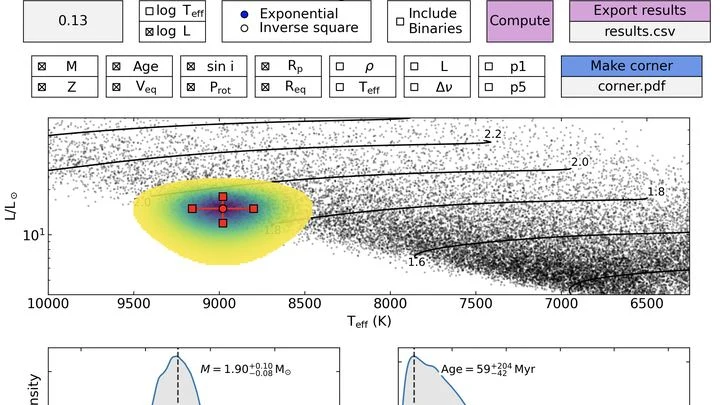
Imagine a person in an old photograph standing in a crowd while spinning — guessing their age would be nearly impossible. That's roughly how astronomers determine the ages and masses of distant stars, and they often get it wrong. For stars slightly heavier than the Sun (from 1.4 to 2.5 solar masses), standard methods like chemical-composition 'clocks' work poorly.
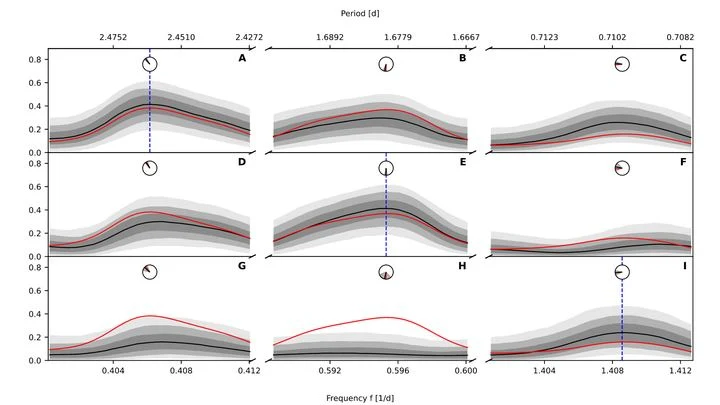
A streetlamp flickers as someone walks past. That's roughly how our nearest star, Proxima Centauri, behaves: it flares in response to the motion of its planets.
Astronomers observed the star with a highly sensitive instrument, the ESPRESSO spectrograph. It captures light and splits it into colors, much like a prism.
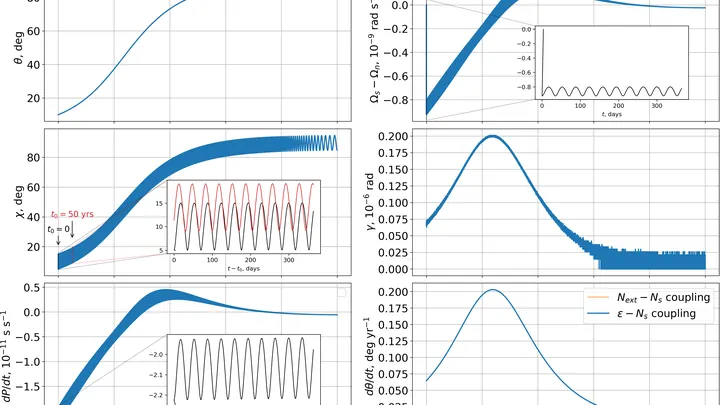
A spinning top that wobbles as it rotates: that's roughly how astronomers picture the neutron star in the binary system Hercules X-1. It completes one full turn on its axis every second, but its axis slowly traces a cone with a period of 35 days.
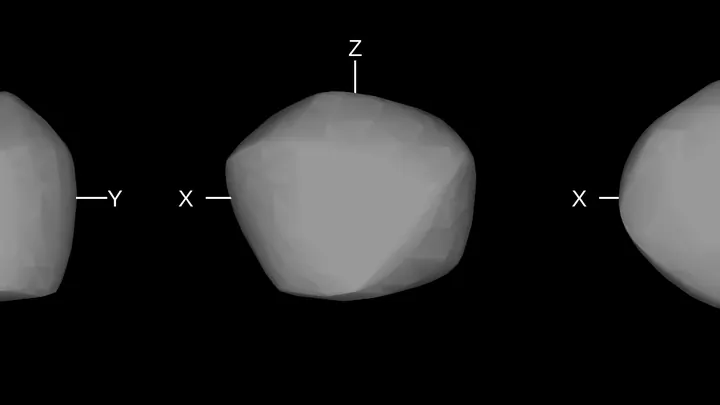
A spinning top launched into weightlessness doesn't just rotate around its axis: it also wobbles, like a drunken sailor. That's exactly how the asteroid Apophis behaves: it doesn't spin neatly but tumbles through space. On April 13, 2029, this celestial wanderer will whiz past at about 38,000 kilometers from Earth — closer than communications satellites.
The carousel spins all the horses in one direction, but one stubbornly gallops against the flow. That's exactly how the planet TOI-1710 b behaves around its star. Using the HARPS-N and GIANO-B instruments, astronomers measured its tilt at 149 degrees. That's nearly a 180-degree flip, meaning the planet orbits "backward" relative to the star's rotation.
The fate of a civilization isn't just a matter of luck or disasters. Scientists simulated a thousand years of history under ten different scenarios, accounting for resource consumption, governance, and random shocks. The key metric turned out to be the 'activity coefficient' – the fraction of time when a civilization is technologically alive. At best, this fraction nears 100%; at worst, it drops to 38%.
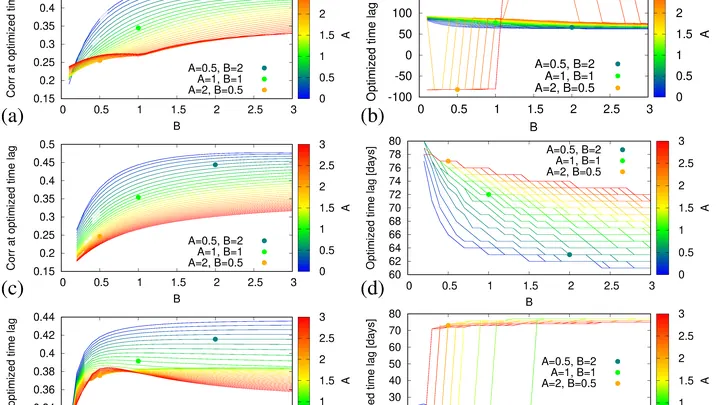
The star GJ 436 is a dim red dwarf, and orbiting it is a Neptune-sized planet on a nearly vertical, tilted orbit. Astronomers spent 18 years taking spectra of this star to track its spots and flares. Suddenly, a rhythm emerged in the data that matched neither the star's rotation nor its 8-year activity cycle. This rhythm exactly followed the planet's orbit.
Neutron stars are the compressed cores of dead stars — city-sized objects with staggering density. Some of these stars become pulsars, cosmic lighthouses emitting strictly periodic radiation pulses.
Radio pulsar J1574+4703 behaves like a finicky lighthouse. Instead of shining steadily, it turns its radio beam on in short flashes and then falls silent for long stretches. Objects like this are called 'rotating radio transients', or RRATs for short.
A neutron star the size of a city spins thirty times per second. Its magnetic field is trillions of times stronger than Earth's. Such conditions could spawn a cloud of axions around the star — light particles that no detector has caught yet, but which neatly explain the hidden mass of the Universe.
A solar flare is like a short circuit in a giant neon sign. Inside the Sun, magnetic fields twist into loops, like rubber bands, and when they reconnect, energy bursts into space. Part of it goes into hard X-rays, produced by particles accelerated to nearly the speed of light.
A star like the Sun hums like a bell: sound waves inside make its surface tremble ever so slightly. From this trembling, astronomers, like doctors reading a pulse, infer the star's temperature, density, and age. But the Kepler telescope spotted an oddity: many stars that spin fast and are covered in spots show no trembling at all. It's as if they've lost their voice.
The Sun is not a calm sphere but a boiling cauldron that follows its own rhythms. Roughly every 11 years, its activity peaks: more dark spots appear on its surface, and streams of charged particles fly into space. But hidden within this grand cycle is a shorter one — about 1.7 years.
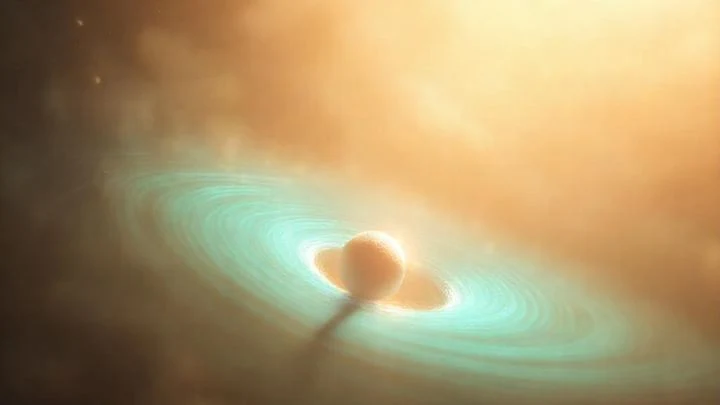
The young star RY Tau is like a finicky spinning top. Around it whirls a flat disk of gas and dust — the leftovers of the cloud from which the star was born. The star pulls some of the disk's matter toward itself like a vacuum cleaner, and flings some back out in a narrow wind cone like a fountain.
The neutron star 1E 161348-5055 in the supernova remnant RCW 103 pulses with a period of 6.67 hours. That's very slow for such a compact object, and astronomers long puzzled over what was going on.
An icy chunk the size of a small town hurtles through space. As it approaches the Sun, the ice starts to vaporize, and jets of gas and dust burst from the comet. These jets act like tiny rocket engines: they push the comet and make it spin. That's exactly what astronomers observed with comet 3I/ATLAS after it rounded the Sun.
Astronomers have discovered a close pair of stars whose orbital dance is speeding up year after year. These are white dwarfs — superdense, cooled remnants of stars, roughly the size of Earth, where matter is compressed to a degenerate state.
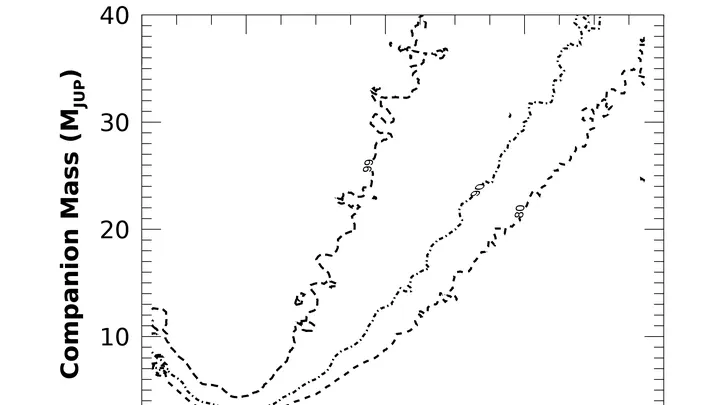
Using the Keck telescope and spectroscopy (light analysis that reveals rotation speed), astronomers measured 32 objects: from giant planets to brown dwarfs — bodies heavier than planets but lighter than stars that never ignited.
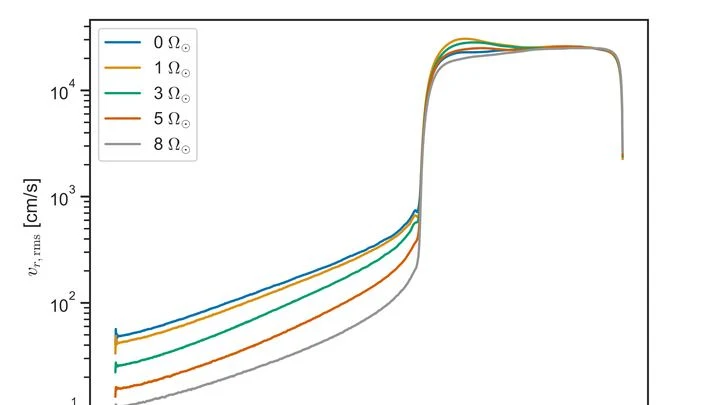
A young star is like a layered spinning top: its outer layers rotate slower, its inner ones faster. The magnetic field here acts like sturdy threads binding these layers together. When the speeds differ, the threads begin to twist and stretch more and more.
Asteroid Didymos slowed its rotation after the DART probe slammed into its moon Dimorphos. The reason: the impact flattened Didymos, making it wider at the waist, like a figure skater spreading their arms. This 'spread' added 0.18 seconds to each rotation — less than an instant, but astronomers noticed it thanks to 20 years of observations.
Two stars, drawing together in a cosmic dance, experience an extra wobble — a consequence of spacetime curvature (an effect predicted by Einstein). A planet orbiting them also wobbles. Sometimes the rhythms align: the gravitational tugs from the stars fall in step with the planet’s orbit, like hands pushing a swing.
Two muons are born in the decay of an eta meson and fly apart, linked by quantum entanglement. One experimenter, Alice, measures the spin of the negative muon, while another, Bob, records the direction of the positron from the decay of the positive muon. It would seem that the order of events should affect the correlations.
A century ago, quantum mechanics gave the world a neat picture: a particle rotating around a point can only have certain discrete amounts of angular momentum, integer multiples of Planck's constant. This rule seemed as solid as the law of gravity, and it followed from simple algebraic arguments.