An asteroid is a rocky boulder racing around the Sun. There are millions of such cosmic cobblestones between Mars and Jupiter in the asteroid belt.
History
After the discovery of Ceres in 1801 by Giuseppe Piazzi as part of the search for a supposed planet between Mars and Jupiter, several more large bodies were quickly found. By the mid-19th century, their number exceeded a hundred. Photographic methods of the 20th century, and later space surveys (LINEAR, Pan-STARRS), increased the catalog to hundreds of thousands. Today, specialized missions study them: NEAR Shoemaker, OSIRIS-REx, Hayabusa.
How it works
The motion of asteroids is described by Kepler's third law and perturbations from planets, especially Jupiter. Their collisional evolution is governed by the conservation laws of angular momentum and energy. The equilibrium temperature is determined by the Stefan–Boltzmann law, taking into account albedo and distance from the Sun. Spectral classification (by absorption lines in the infrared range) relies on Maxwell's equations to interpret radiative properties.
Fun fact
Some asteroids are so small that if you had a car the size of a house, you'd run them over like a pebble on the road.
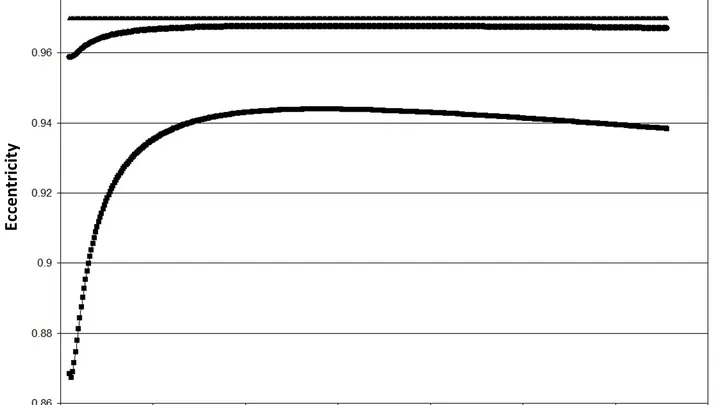
The family album of this stellar pair has been filling up for 45 years, but the pictures were blurry and the captions contradictory. Now astronomers have pulled out the old photographs, taken new sharp shots, and put everyone back in their proper places. Gamma Cephei is a bright star visible to the naked eye, and it has an invisible companion that orbits it every 70 years.
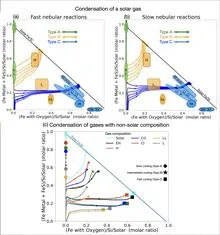
Three cabinets full of rocks. In one, metallic grains and the gray mineral enstatite; in the second, the same grains but with rusty streaks; in the third, layered clays swollen with water. All three sets were pulled from meteorites that fell to Earth: chondrites. They were born in the same gas-and-dust disk around the young Sun, yet somehow turned out so different.
A stone thrown into water quickly loses speed. A meteor entering the atmosphere should behave the same way: air slows it down, and friction burns up its material. But cameras of the Global Fireball Observatory network have captured hundreds of bright fireballs over ten years that streak across the sky with almost no deceleration.
In a single star system, two teams of planets orbit. Some follow neat paths, like figure skaters on an ice rink, avoiding collisions. Others crowd together, their trajectories cross, and sooner or later a cosmic accident occurs — a giant impact.
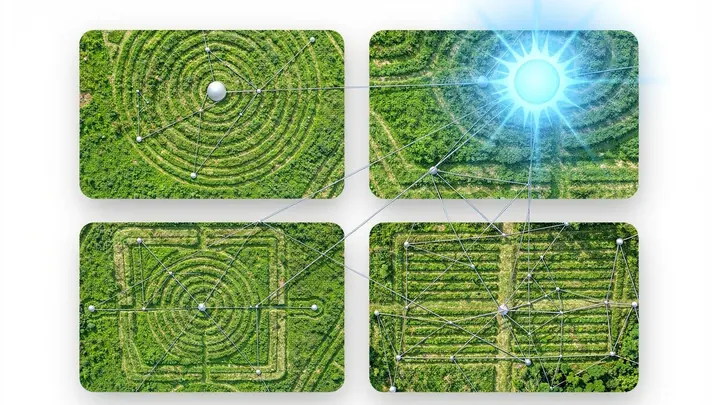
Deep in the Amazon rainforest, beneath a multi-layered canopy of leaves, lie vast earthen figures — squares, rectangles, the occasional rhombus. For decades they teased archaeologists with their silent geometry, until a researcher armed with orbital optics saw them as an astronomical instrument.
An ordinary black hole is surrounded by a thin photon sphere — a place where light can loop around before falling in or escaping. In the new work, this region has puffed up into a whole layer packed with massless particles that zip around at nearly the speed of light and don't press against the walls.
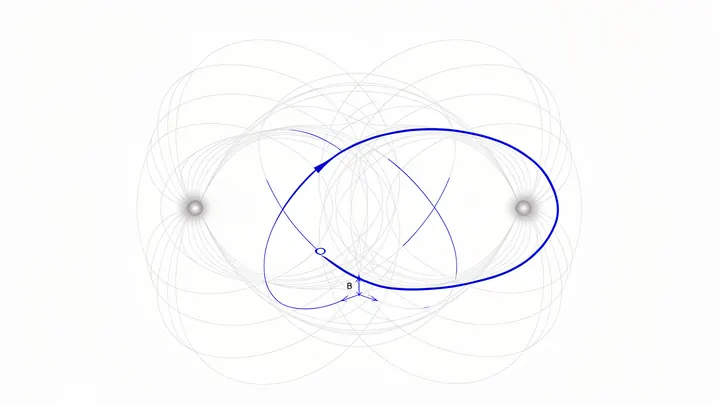
The three-body problem is the eternal stumbling block of celestial mechanics. Even Poincaré realized in the late 19th century that its chaos defies general analytical solutions. In this gravitational madness, islands of regularity appear only rarely — periodic orbits.
In 2019, an unusual visitor, comet 3I/ATLAS, zoomed into the Solar System. It came from another star, and for the first time, astronomers were able to see what its dusty tail is made of.
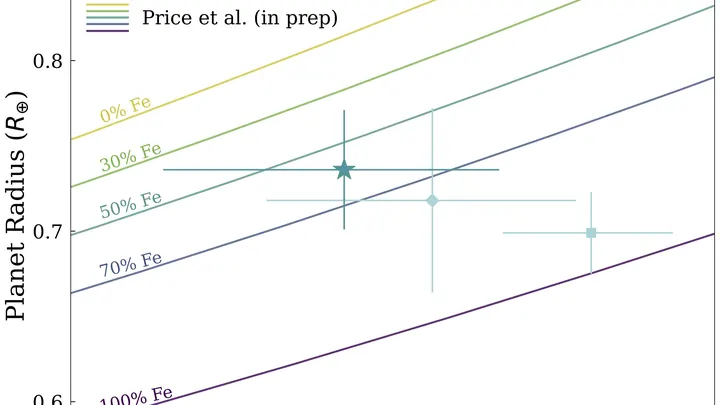
A cosmic sprinter on a short track: that's how you might describe planet GJ 367 b. It whips around its star in just 7.7 hours. This world is slightly smaller than Earth but has a personality: it was once thought to be nearly a solid ball of iron.
Perth residents know: when the daytime heat becomes unbearable, relief arrives from the ocean — a fresh breeze affectionately called the Freo Doctor. The same wind, only on a global scale, decides the fate of cosmic visitors plunging into the atmosphere. A meteorite fall is a two-act spectacle.
Perth residents know: when the daytime heat becomes unbearable, relief arrives from the ocean — a fresh breeze affectionately called the Freo Doctor. The same wind, only on a global scale, decides the fate of cosmic visitors plunging into the atmosphere. A meteorite fall is a two-act spectacle.
On April 1, 2026, satellites recorded a bright fireball blazing in the sky over the South Atlantic. Photometric tracking satellites detected the entry and demise of the object at an altitude of 90.5 km. An ordinary asteroid? No. Astronomers recalculated the velocity vector into the heliocentric system — and gasped: 51.73 km/s.
Eight hundred million years ago, in the main asteroid belt, a giant inkwell shattered. The parent body, over a hundred kilometers in diameter, made of primitive carbonaceous chondrites, suddenly broke apart near the J3:1 resonance with Jupiter.
Among the icy chunks hurtling through the void, there are special travelers — interstellar comets. They were born around distant stars and happened to wander into our neighborhood. One of them, 3I/ATLAS, came under the gaze of telescopes as it approached the Sun. Its material, frozen gases and refractory dust, began to evaporate, leaving a glowing tail behind.
At the edge of the solar system, where the Sun is barely brighter than other stars, icy boulders, trans-Neptunian objects, circle around. Their orbits resemble hoops scattered by someone. But look closer: twelve of these hoops are not just floating in the void.
Recently, astronomers spotted three interstellar comets coming from deep space. One of them, 3I/ATLAS, turned out to be unexpectedly large: its nucleus is several kilometers across.
At the edge of the solar system, far beyond Neptune, hundreds of icy chunks circle the Sun. Some of them move as if an invisible hand had aligned their orbits like compass needles. Ten years ago, this led astronomers to suspect that a massive planet, about ten times heavier than Earth, is hiding there.
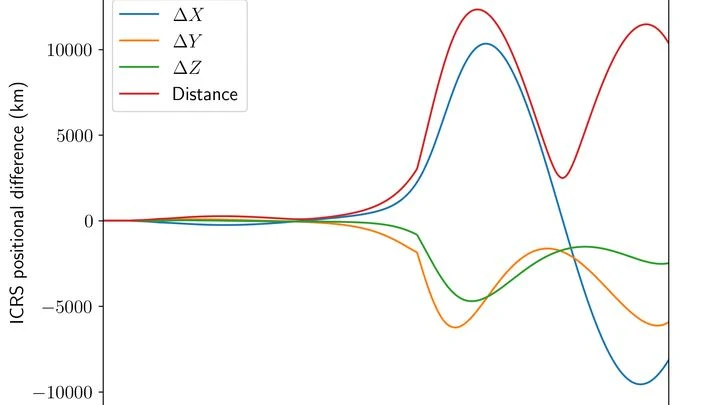
A spinning top launched into weightlessness doesn't just rotate around its axis: it also wobbles, like a drunken sailor. That's exactly how the asteroid Apophis behaves: it doesn't spin neatly but tumbles through space. On April 13, 2029, this celestial wanderer will whiz past at about 38,000 kilometers from Earth — closer than communications satellites.
The Red Planet is surrounded by the rubble of failed worlds — rocky boulders stuffed with metal. Shipping a kilogram of steel from Earth to Mars costs as much as several cars. It's far cheaper to pick up space junk right in orbit.
A sugar cube sits on a saucer next to a cup of hot tea. Drop it in, and it dissolves within minutes. But if you lower it slowly, the sugar melts gradually, releasing its sweetness into the drink. Something similar is happening in two newly discovered stellar pairs, except the sugar is a brown dwarf and the tea is a star.
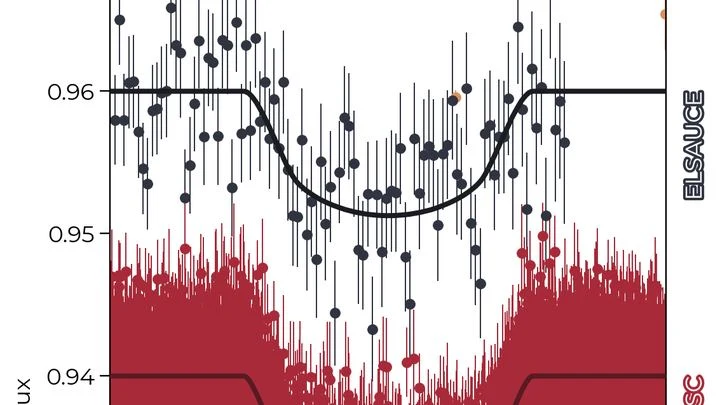
NASA's TESS space telescope monitors thousands of stars, catching the moment when a planet crosses its star's disk — the star's light dims slightly. That's how astronomers spotted two planets orbiting stars similar to our Sun. One, TOI-883 b, completes an orbit in ten days; the other, TOI-899 b, takes nearly thirteen.
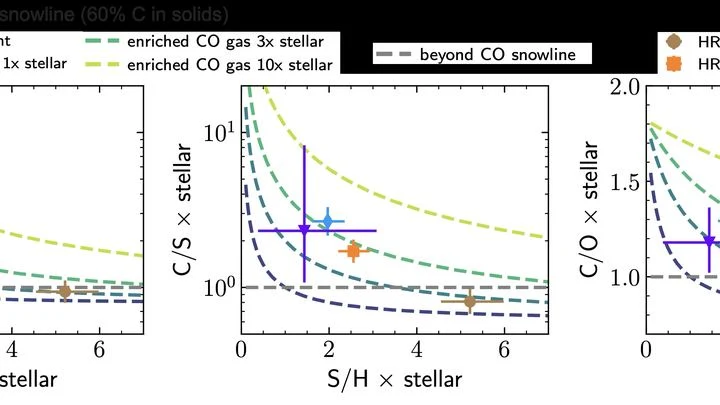
130 light-years away, four giant planets orbit the young star HR 8799—each 5 to 10 times more massive than Jupiter. They lie far from the star, at distances from 15 to 70 astronomical units (one astronomical unit is the distance from Earth to the Sun).
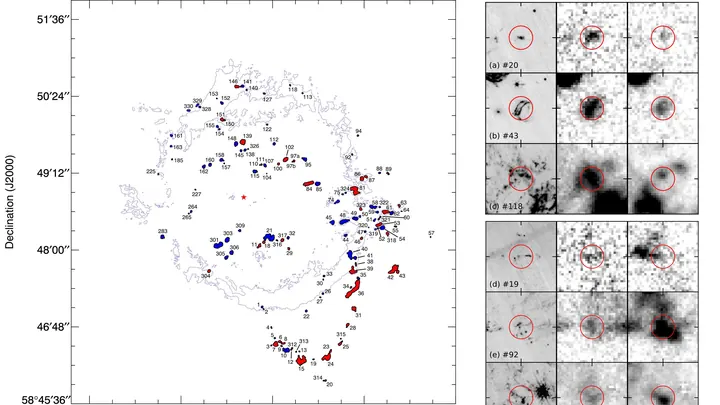
In 2013 and 2020, the same telescope in Hawaii looked at the remnant of an exploded star — Cassiopeia A. The images were taken in the light of glowing iron, as if photographing invisible streams of metal flying through space.
Over seven years, astronomers found 263 dense clumps — debris ejected by the explosion.
Interstellar wanderers are rocks and icy chunks that have broken free from their home planetary systems and now drift through the Galaxy. The first such visitor, 'Oumuamua, zipped past the Sun in 2017, followed by Comet Borisov and the ATLAS object. Where do they come from?
Sometimes a fiery streak crosses the night sky. It's a piece of rock from space burning up in the air, and the color of the flash can tell you what elements it contained. Astronomers pointed sensitive cameras at such flashes and, among 180 images, found two rocks that stand out from the majority of shooting stars.
The TESS telescope's data are like a huge archive of old photographs: it already contains images of thousands of stars, but not every detail has been examined. Standard pipelines only look for the most obvious dips in a star's light when a planet passes in front of it. Fainter signals go unnoticed, like a quiet whisper in a noisy room.
For ten hours, the star HD 137010 dimmed a little, like a lamp with a speck of dust on it. The K2 telescope caught this in 2017, and in all the observing time, it happened only once. Astronomers realized: a planet had passed in front of the star.
This way of finding worlds is called the transit method. When a planet crosses the star's disk, the star briefly fades.
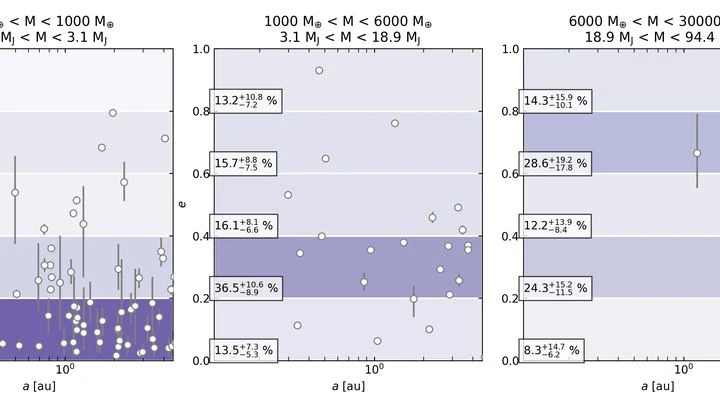
A planet's orbit is its path around its star. If the path is perfectly circular, the planet always stays at the same distance from the star. But many planets have slightly stretched paths, like a running track in a stadium. Astronomers studied hundreds of giant planets around other stars and found a curious pattern.
A family moves into a cramped apartment in the city center. If the move was calm, relatives might have moved in with them. But if the family was evicted from their old home by a storm, they'll end up alone in the new place.
Jupiter is a colossal ball of gas that sits five times farther from the Sun than Earth. Now imagine a similar ball, but around another star, at a distance tens of times greater. These are called cold Jupiters, and they remain a puzzle: how did they get there?
Astronomers studied four such planets around distant stars.
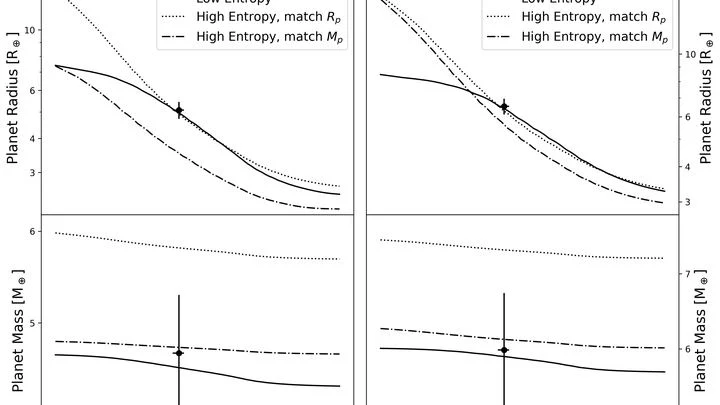
350 light-years away, four planets orbit the star V1298 Tau. They are 5–10 times larger than Earth but lighter than they appear. For nine years, astronomers tracked their motion to understand what they are made of and how they lived in the past.
The planets are lined up in a chain: their orbital periods are nearly in 3:2, 2:1, and 3:1 ratios.
An ordinary lump of coal left under the blazing sun just heats up. But if you take it into space and bring it twenty times closer to the Sun than Earth is, it won't survive for more than a few minutes. That's roughly how dark, carbon-rich asteroids behave. They are rarely found on orbits that dive deep inside Mercury's orbit.
Sun-like stars rarely spin alone. Many of them dance with invisible partners — brown dwarfs: objects bigger than planets but too lightweight for steady stellar burning. In their cores, hydrogen fusion flickers, only to fade fast, never matching the stability of the Sun.
When countless asteroids pummeled the young Earth, they tore chunks from its mantle. These fragments spiraled in a cosmic disk around the planet and, like a snowball in a blizzard, fused into the Moon.
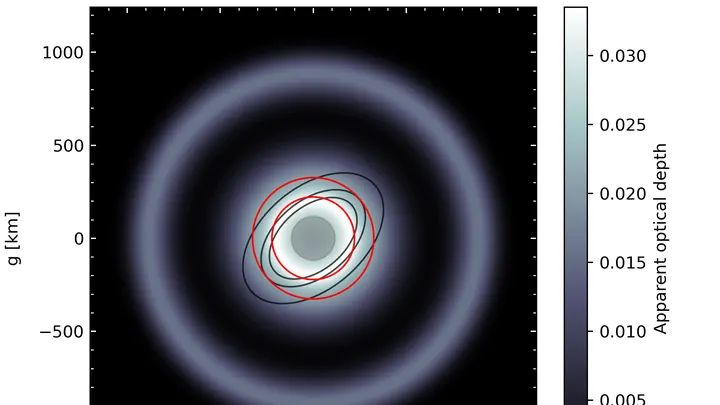
Only by passing in front of a star did Chiron reveal its secret. Three icy hoops encircle the 200-kilometer body — a hybrid of comet and asteroid. Previously, they were only hinted at by spectra of reflected light and brightness fluctuations.
Using the most powerful space telescope, James Webb, astronomers peeked into the cosmic dressing room and saw how the rings of asteroid Chariklo are changing.