Microwave for Quantum Sensors express
Tiny defects in a boron nitride crystal act as ultra-sensitive magnetic sensors. But their signal resembles a radio with a mistuned antenna: instead of a clear note, you get a broad, noisy range. A standard microwave pulse at a single frequency only hits a small fraction of these "radio stations."
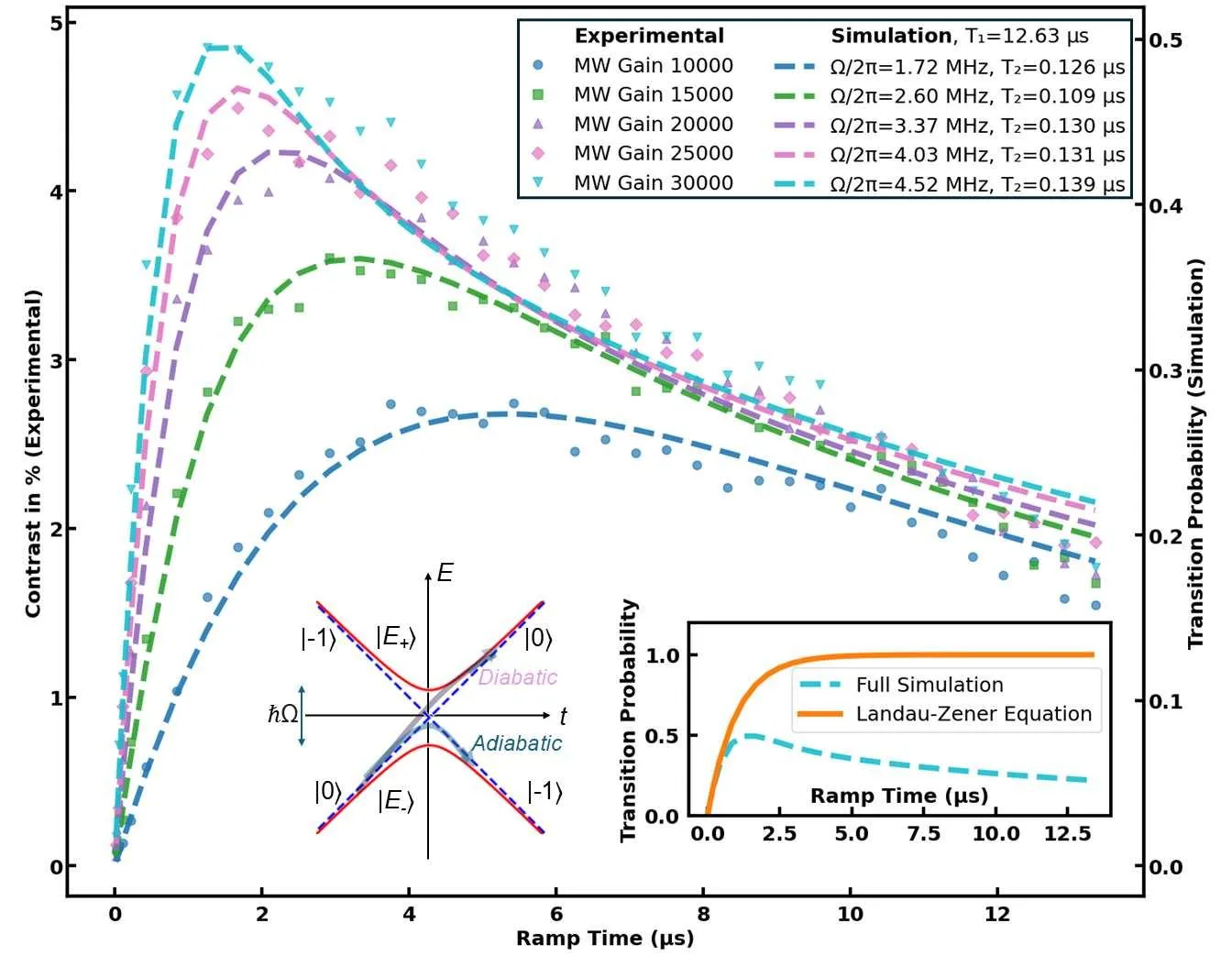
Researchers used frequency modulation: the pulse frequency glides smoothly, like a finger sliding along a guitar string. This trick switched four times more defects into the desired state than a fixed frequency. As a result, measurement time dropped by 16 times.
The method runs on a programmable chip and requires no expensive equipment. It makes quantum sensors based on defects in boron nitride practical for real-world conditions — where electrical and magnetic noise are abundant.
A guitar string that you slide your finger along sounds louder and cleaner than the same string plucked at a single point. Likewise, a sweeping frequency helps pick out a weak quantum signal even amid noise.
Original abstract
as written by the authors arXiv:2601.05013
Negatively charged boron vacancies (V$$_{\text{B}}^{-}$$) in hexagonal boron nitride (hBN) comprise a promising quantum sensing platform, optically addressable at room temperature and transferrable onto samples. However, broad hyperfine-split spin transitions of the ensemble pose challenges for quantum sensing with conventional resonant excitation due to limited spectral coverage. While isotopically enriched hBN using $$^{10}$$B and $$^{15}$$N isotopes (h$$^{10}$$B$$^{15}$$N) exhibits sharper spectral features, significant inhomogeneous broadening persists. We demonstrate that, implemented via frequency modulation on an FPGA, a frequency-ramped microwave pulse achieves around 4-fold greater $$|0\rangle\rightarrow|-1\rangle$$ spin-state population transfer and thus contrast than resonant microwave excitation and thus 16-fold shorter measurement time for spin relaxation based quantum sensing. Quantum dynamics simulations reveal that an effective two-state Landau-Zener model captures the complex relationship between population inversion and pulse length with relaxations incorporated. Our approach is robust and valuable for quantum relaxometry with spin defects in hBN in noisy environments.
Hexagonal boron nitride is sometimes called "white graphene"—it's also layered, but transparent and an insulator.