Signal-to-noise ratio (SNR) is a fundamental measure in any system that transmits, detects, or processes information. It compares the power of the desired signal to the power of background noise, usually expressed in decibels. A higher SNR means the signal is cleaner and easier to distinguish from noise, while a low SNR means the signal is buried and hard to extract. This concept is central to fields as diverse as audio engineering, radio astronomy, medical imaging, and particle physics.
History
The concept emerged with early radio engineering in the 1910s–1920s, where engineers like Ralph Hartley at Bell Labs formalized the idea of signal versus noise in communication channels.
How it works
The ratio is calculated as the power of the signal divided by the power of the noise. In practice, improving SNR involves either boosting the signal, reducing the noise, or both. Techniques include signal averaging (repeating measurements to cancel random noise), filtering (removing frequency bands where noise dominates), and using more sensitive detectors. In the context of the listed articles, SNR improvements come from clever design—like optimizing scintillator materials to emit more light per event, or using feedback algorithms in hearing aids to cancel acoustic feedback while preserving the intended sound.
In practice
SNR is used to evaluate and improve everything from hearing aids and speech recognition systems to radio telescopes and particle detectors, guiding design choices for maximum sensitivity.
Fun fact
In some experiments, increasing the measurement time by a factor of four only doubles the SNR, because noise averages out as the square root of the number of samples.
A smartphone camera captures light with tiny sensors, but by themselves, they can't distinguish colors. So color filters are placed in front of them: red, green, blue, like stained glass in a window. Each sensor sees only its own color, and then software assembles the full picture from these pieces.
The merger of two neutron stars is not just a collision. Even before they touch, they deform each other through tidal forces, and this deformation depends on how 'soft' or 'stiff' the matter inside is. Stiff matter resists more; soft matter changes shape more easily.
A radio transmitter with multiple antennas is like a bathtub with water pouring from several faucets. If the streams splash in different directions or at different pressures, some water goes down the drain — similarly, the signal scatters before reaching the receiver.
Imagine a smart antenna panel, a phased array, that steers radio waves traveling at the speed of light. It works like an orchestra: hundreds of tiny emitters, like musical instruments, shift their phase (the moment they 'join' the overall sound) on command via a variable voltage.
Learning a foreign language is like tuning a musical instrument. The new technology works like a smart tuner: it takes your recording and a native speaker's reference speech, stretches or compresses them in time (like adjusting a string) to align them precisely, and evaluates three key parameters: clarity of sounds, rhythmic precision, and intonation.
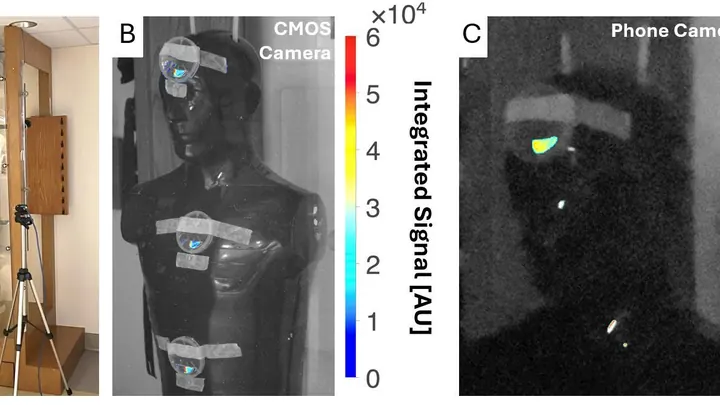
A crystal the size of a matchbox was placed under the beam of a clinical accelerator. Half of its surface was covered with a pattern of nanoscale bumps — tiny, smaller than the wavelength of light. The other half was left smooth. The difference was striking: the coated part produced a signal 4.1 times brighter.