Hexagonal boron nitride (h-BN) is a crystalline compound of boron and nitrogen arranged in a two-dimensional honeycomb lattice, structurally analogous to graphene. Unlike graphene, which is a conductor, h-BN is an excellent electrical insulator with high thermal conductivity and chemical stability. In quantum sensing, h-BN is valuable as a host material for atomic-scaledefects — imperfections in the lattice that can act as quantum sensors, emitting and absorbing light in ways sensitive to magnetic fields, temperature, and strain.
History
Hexagonal boron nitride was first synthesized in the 19th century, but its use as a quantum sensor host emerged in the 2010s, following the discovery of optically active defects in its monolayer form. The specific identification of boron vacancy defects as quantum sensors was reported around 2019.
How it works
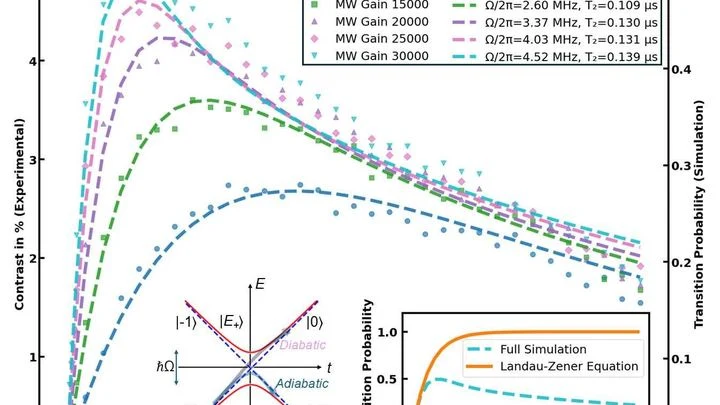
The key to h-BN's role is its wide bandgap, which allows certain defects (such as boronvacancies) to have optically addressable spin states. When a defect absorbs a photon, it transitions to an excited state; the spin of the defect's electron can be manipulated with microwave pulses, and the emitted light intensity depends on the spin state. This spin-photon interface enables readout of the local environment, as external fields alter the spin energy levels and thus the fluorescence. The hexagonal lattice provides a stable, low-noise matrix that preserves the quantum coherence of the defects, even at room temperature.
In practice
h-BN quantum sensors are used in nanoscale magnetometry, thermometry, and electric field imaging, particularly in biological samples or 2D material heterostructures where their atomic thinness and chemical inertness are advantageous.
Fun fact
Hexagonal boron nitride is often called 'white graphene' because it shares graphene's honeycomb structure but is electrically insulating and appears white in bulk form.
On the table lies a layered cake of hexagonal boron nitride flakes, a material similar to graphite but made of boron and nitrogen atoms. One flake is carefully transferred onto another, and at the spot where they overlap, after heating in oxygen, bright single light sources are born.
An aluminum sphere the size of a large globe sits in a neutron beam and answers each hit with a precise note. Inside the sphere there is nothing but nitrogen and eleven tiny steel balls, each the size of a pinhead. When a neutron enters the sphere, it knocks a particle out of a nitrogen atom, and that jolt turns into an electrical signal.
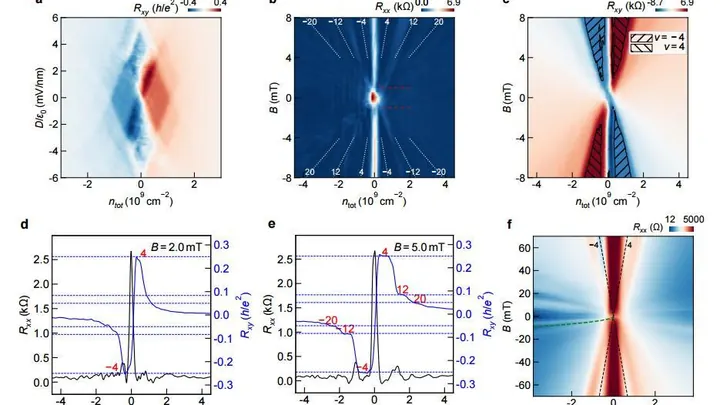
A door lock with two different keys: one turns easily, the other demands noticeable effort. That is how two layers of hexagonal boron nitride behave when twisted relative to each other. This material consists of boron and nitrogen atoms arranged in a hexagonal lattice, and its layers can sit in different registries, like two identical grids shifted by different angles.
In boron neutron capture therapy (BNCT), the patient receives an injection of the isotope boron-10, which selectively accumulates in tumor cells. The tumor area is then irradiated with a beam of thermal neutrons.
A tiny defect in a boron nitride crystal behaves like a microscopic indicator bulb. Shine light on it, and it glows, with the shade shifting with temperature: the warmer it gets, the redder the glow.
A potter uses a sharp stylus to trace a pattern on a still-damp clay tile. One wrong move, and the line blurs, the tile cracks. Physicists work with films of the high-temperature superconductor YBCO (a compound of yttrium, barium, copper, and oxygen) in much the same way.
A stone falls into a pond, and ripples spread across the water. Likewise, light from distant galaxies spreads in all directions — calmly and steadily. But at the center of some galaxies, it's not a stone but a veritable cannon: it fires particles with monstrous force. Astronomers call such objects HSP BL Lac.
In a boron nitride crystal, the perfect atomic lattice is sometimes disrupted: an atom is missing here, or replaced by a foreign one there. Under a powerful microscope, these tiny imperfections appear as traps for electrons: they capture particles and start to emit light, and they also respond to magnetic fields.
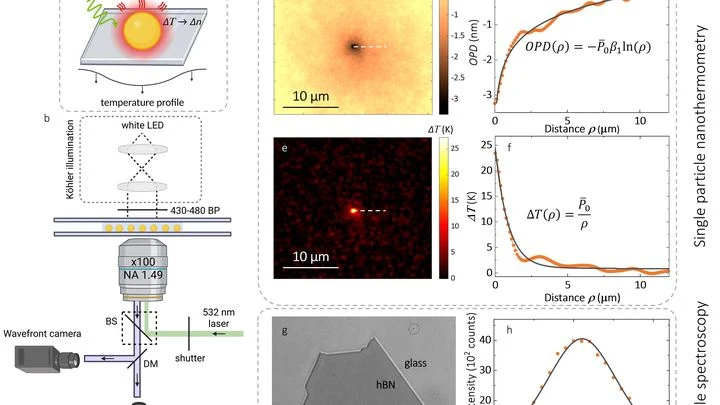
A gold speck the size of a hundred atoms catches a beam of light, and heats up. In everyday life, that's no big deal, but in the world of nanotechnology, this tiny heat can ruin a biosensor or fry a microchip. You can't just put a fan on it: at these scales, heat gets trapped like in a thick winter coat.
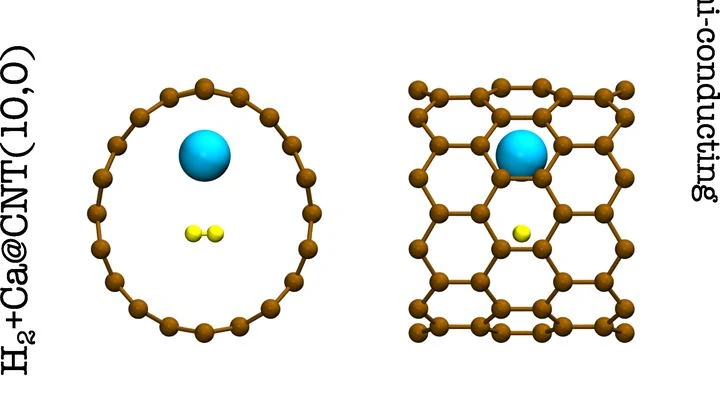
Hydrogen is an ideal fuel: when used, it only produces water, not carbon dioxide. The trouble is that hydrogen is the lightest gas, its molecules leak out of any container. Right now, cars store hydrogen in heavy tanks under extreme pressure, canceling out weight benefits.
Researchers bypassed the problem without high pressure.
A sheet of graphene is a mesh of carbon atoms one atom thick. Even the slightest contamination shows up on it, like dust specks on eyeglass lenses. Ten years ago, researchers learned to hide graphene between layers of boron nitride, like placing a fragile sheet between two pieces of plastic wrap.
A superconductor is a material that conducts electricity without loss, but only at very low temperatures. On such a material, researchers placed a film of magnetic material one atom thick.
A glowing spot on a crystal is like a firefly that you can wake not only with a flashlight but also with the warmth of your palm. Such spots, single-photon sources, can emit light one particle at a time, which is essential for quantum communication and computing.
A handful of modeling clay with one ball stuck far off to the side becomes loose and stretched out. That's roughly how the beryllium-11 nucleus is built: a single neutron dangles at the periphery, forming a "halo" around the dense core.
Physicists used a new method to bypass mathematical hurdles and precisely calculate the shape of this nucleus.
A superconducting strip thinner than a human hair lies on a silicon substrate. Next to it is a tiny waveguide through which a beam travels. When a photon hits the strip, it heats up by a fraction of a degree and immediately changes its resistance.
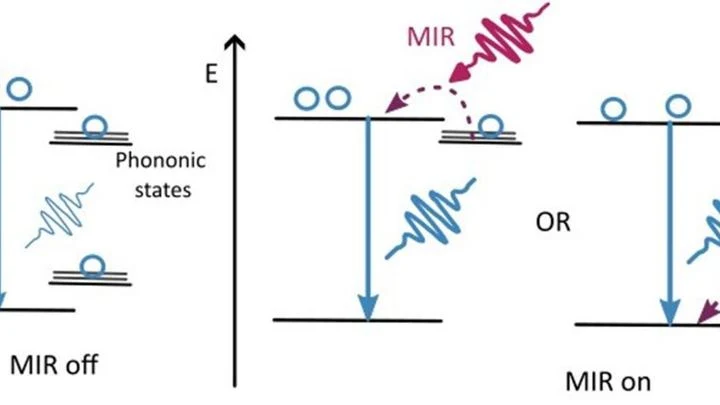
When light hits a semiconductor, it can knock out an electron, leaving behind a hole. The electron and hole attract each other and form a pair — an exciton. This pair can re-emit light, but not immediately: first, it exchanges energy with vibrations of the crystal lattice — phonons.
Inside a boron nitride crystal, defects sometimes occur — places where atoms are knocked out or sit where they shouldn't. One such defect, the B-center, can emit light: it absorbs energy and releases it as a single photon. It's like a tiny light bulb that only lights up when asked, without any stray glow.
A thin crystal of hexagonal boron nitride is a relative of graphite, but transparent and insulating. Occasionally, single defects appear in its lattice: a boron or nitrogen atom is missing, leaving a trap for electrons. Such a trap can absorb light and re-emit it, like a tiny flashlight.
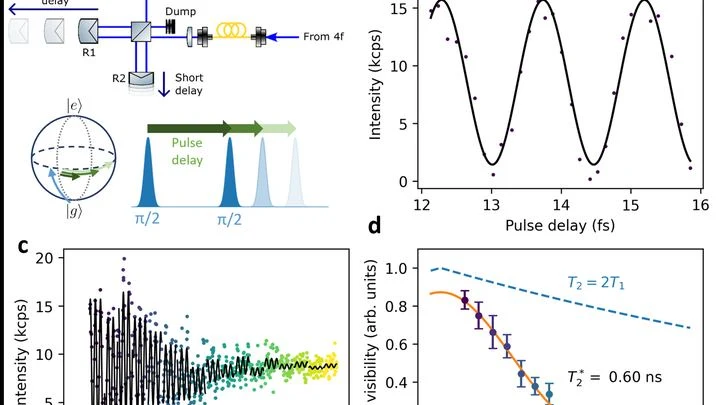
A single light source in a thin layer of boron nitride flashes on and off in a couple of nanoseconds. You can create many such sources in the material, but each one used to work on its own. In the new work, they were made to glow together, like musicians playing in unison.
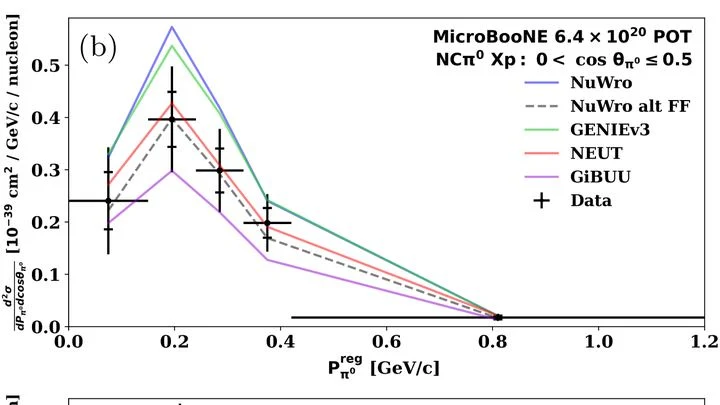
In an underground hall at Fermilab, a huge tank holds liquid argon — a transparent fluid at minus 186 degrees. When an invisible neutrino flies into the tank, it occasionally strikes an argon nucleus, and a short track of charged particles flashes.
Nitinol is a metal with a memory: compressed into a tiny tube, it springs back into shape inside a vessel and keeps it open. But simply inserting a stent isn't enough: it must not clog with clots. To prevent that, a drug is applied, which should be released slowly, like water from a sponge, not all at once.
Graphene is a carbon sheet just one atom thick, a fantastic conductor. But its surface is crinkly, like a wrinkled tablecloth that hasn't been ironed. Scientists built a 'sandwich': two of these sheets pressed together with a non-conductive spacer in between. They iron out each other's folds, like two halves of a sandwich making the surface perfectly even.
When cooled to -272°C, the Fe₄Nb₂O₉ crystal turns into a magnetic pattern where atomic arrows don't line up in a single row but fan out. It's like a crowd frozen in place, but each person looks in their own direction rather than at the back of the neighbor's head.
A piggy bank where coins slip in easily but can only be retrieved by smashing it. Something similar happens with a new material for sodium batteries. It readily accepts sodium ions during charging, but during discharge, it gives back almost nothing.
Graphene is a sheet of carbon one atom thick. If you cut it into narrow strips, you get graphene nanoribbons. Their properties depend on how the strip is cut: just as from a single piece of fabric you can sew both a smooth tablecloth and a pleated skirt.
In the new work, chemists assembled a ribbon of asymmetric shape.
Deep inside an underground laboratory, a room-sized detector waits for an event that might happen once in a hundred million billion years. That event is neutrinoless double beta decay — a process that would break one of physics' fundamental laws. To catch it, you need perfect silence: not a single stray radioactive atom in the detector's materials.
Tiny defects in a boron nitride crystal act as ultra-sensitive magnetic sensors. But their signal resembles a radio with a mistuned antenna: instead of a clear note, you get a broad, noisy range.
In a laboratory at Purdue University, a laser beam strikes a crystal of hexagonal boron nitride, and in response, a single point of light flashes. This is not just luminescence; it is a signal from a spin defect, a pair of electron spins, one of which is coupled to a carbon-13 nuclear spin.
A tuning fork sounds when you strike it. Its prongs vibrate, and you hear the sound until the vibration dies out. The quantum world has its own "tuning forks"—for example, a defect in diamond that responds to magnetic fields, and a carbon tube that can tremble at frequencies billions of times higher than the note A.