Microwave for Quantum Sensors express
Tiny defects in a boron nitride crystal act as ultra-sensitive magnetic sensors. But their signal resembles a radio with a mistuned antenna: instead of a clear note, you get a broad, noisy range. A standard microwave pulse at a single frequency only hits a small fraction of these "radio stations."
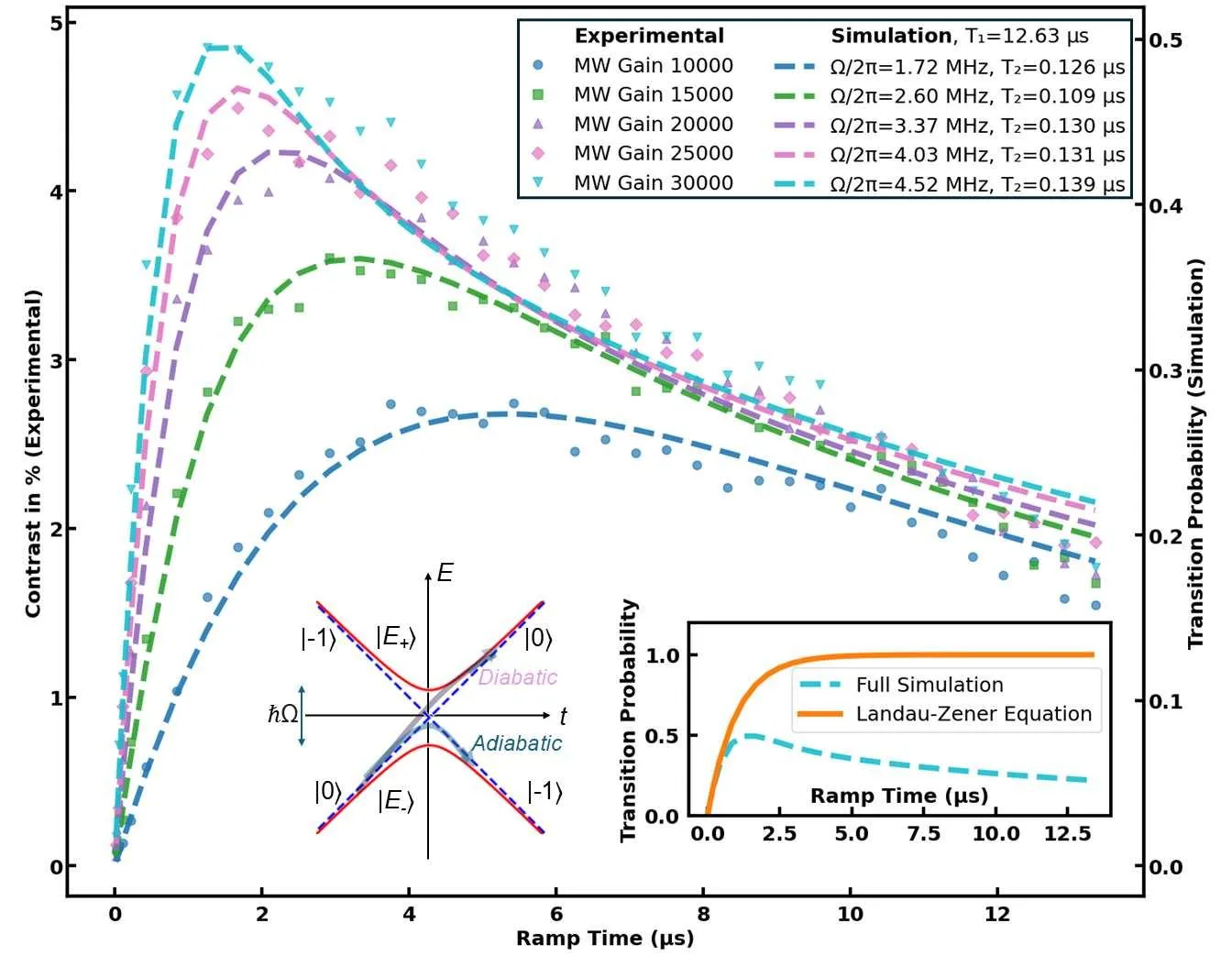
Researchers used frequency modulation: the pulse frequency glides smoothly, like a finger sliding along a guitar string. This trick switched four times more defects into the desired state than a fixed frequency. As a result, measurement time dropped by 16 times.
The method runs on a programmable chip and requires no expensive equipment. It makes quantum sensors based on defects in boron nitride practical for real-world conditions — where electrical and magnetic noise are abundant.
A guitar string that you slide your finger along sounds louder and cleaner than the same string plucked at a single point. Likewise, a sweeping frequency helps pick out a weak quantum signal even amid noise.
Hexagonal boron nitride is sometimes called "white graphene"—it's also layered, but transparent and an insulator.