Boron nitride is a layered crystalline material, similar in structure to graphite, but composed of alternating boron and nitrogen atoms. It is an excellent electrical insulator, chemically inert, and has high thermal conductivity. In the context of quantum technologies, it serves as a host for quantum defects—atomic-scale imperfections that can trap electrons and exhibit quantum behavior, such as spin states that can be entangled.
History
Boron nitride was first synthesized in the 19th century, but its quantum applications were recognized only in the 2010s when researchers discovered that defects in hexagonal boron nitride can emit single photons at room temperature.
How it works
The layered structure of boron nitride allows for the creation of atomically thin sheets, where defects can be introduced and controlled. These defects, often involving vacancies or impurity atoms, create localized electronic states that can be manipulated with light and microwaves. The spins of these trapped electrons can be entangled with each other or with photons, enabling quantum information processing. The material's low nuclear spin background helps preserve quantum coherence.
In practice
Used in quantum sensing, quantum communication, and as a platform for room-temperature quantum entanglement experiments.
Fun fact
Hexagonal boron nitride is sometimes called 'white graphene' because it has a similar layered structure to graphene but is electrically insulating and appears white.
A door lock with two different keys: one turns easily, the other demands noticeable effort. That is how two layers of hexagonal boron nitride behave when twisted relative to each other. This material consists of boron and nitrogen atoms arranged in a hexagonal lattice, and its layers can sit in different registries, like two identical grids shifted by different angles.
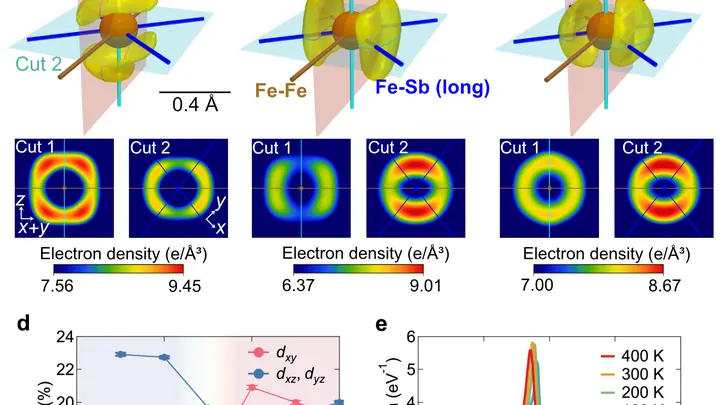
A house with cork walls suddenly gets covered in copper sheets, but only when frost sets in. That's roughly how FeSb₂ behaves when made into a film just a few atomic layers thick. Under normal conditions, it's a narrow-gap insulator: electrons sit tightly in place like spectators in an overcrowded hall.
Usually, light does not turn an insulator into a conductor: that requires powerful laser pulses that break the material's structure. But in twisted bilayer graphene at the magic angle, things are different.
A tiny defect in a boron nitride crystal behaves like a microscopic indicator bulb. Shine light on it, and it glows, with the shade shifting with temperature: the warmer it gets, the redder the glow.
A lone potassium atom enters a dense cloud of sodium atoms cooled to near absolute zero. Such a medium is called a Bose–Einstein condensate — all particles merge into a single quantum wave. One might expect the impurity to simply pick up a single neighbor and form a pair. But the experiment showed something else.
In a boron nitride crystal, the perfect atomic lattice is sometimes disrupted: an atom is missing here, or replaced by a foreign one there. Under a powerful microscope, these tiny imperfections appear as traps for electrons: they capture particles and start to emit light, and they also respond to magnetic fields.
Diamond is the hardest natural material and usually does not conduct electricity. But if you add a few foreign atoms to its crystal lattice, it can become a semiconductor, like silicon in computer chips.
In the crystal Rb1-xV2Te2O, the spins of vanadium atoms arrange in a checkerboard pattern: each spin is surrounded by opposite spins. This pattern is called G-type antiferromagnetism. Neutrons passing through the sample scatter off this pattern and reveal its geometry, like light from a flashlight shining through blinds casting stripes on a wall.
A sheet of graphene is a mesh of carbon atoms one atom thick. Even the slightest contamination shows up on it, like dust specks on eyeglass lenses. Ten years ago, researchers learned to hide graphene between layers of boron nitride, like placing a fragile sheet between two pieces of plastic wrap.
An ordinary nuclear reactor is like a boiler where fuel burns evenly throughout the volume. Here the picture is different: a fission wave, a narrow zone where atoms split and release heat, slowly creeps along a cylindrical rod of uranium carbide. Ahead of the wave, the fuel is untouched; behind, it is already spent. So fire runs along a candle wick, leaving wax behind.
Plain water in a glass is clear and calm. But if you add tiny carbon dots made from sugar and citric acid in an ordinary microwave, the water starts to glow when a charged particle flies through it.
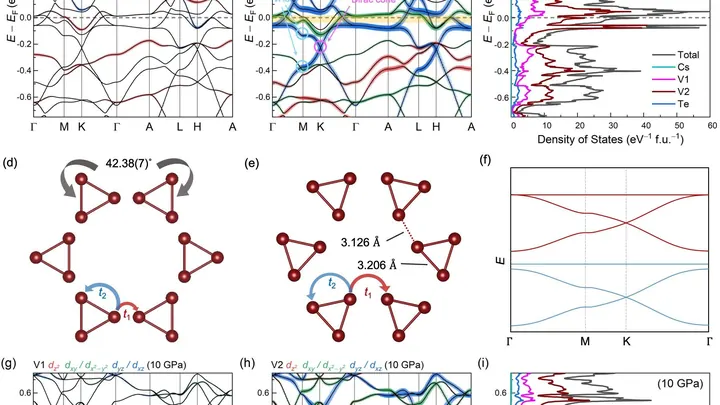
A woven basket made of willow twigs holds its shape thanks to the interweaving. A similar pattern, triangles linked into a flat network, has been found in a new crystal with the formula Cs₃V₉Te₁₃. Here, vanadium atoms form two sets of triangles that pierce each other like threads in fabric.
This pattern is not just pretty: it forces electrons to move along special "flat" energy pathways.
Two-dimensional bismuth on a silicon substrate is a promising material for future electronics. Its edges conduct current without loss, like a highway with no traffic lights. But bismuth itself is delicate: air and moisture quickly degrade its properties.
Inside a boron nitride crystal, defects sometimes occur — places where atoms are knocked out or sit where they shouldn't. One such defect, the B-center, can emit light: it absorbs energy and releases it as a single photon. It's like a tiny light bulb that only lights up when asked, without any stray glow.
A thin crystal of hexagonal boron nitride is a relative of graphite, but transparent and insulating. Occasionally, single defects appear in its lattice: a boron or nitrogen atom is missing, leaving a trap for electrons. Such a trap can absorb light and re-emit it, like a tiny flashlight.
A graphene ribbon nine atoms wide is like a track where electrons race, as water rushes down a narrow trough. Gamma radiation is a stream of particles with enormous energy, capable of punching through metal and plastic.
Graphene is a carbon sheet just one atom thick, a fantastic conductor. But its surface is crinkly, like a wrinkled tablecloth that hasn't been ironed. Scientists built a 'sandwich': two of these sheets pressed together with a non-conductive spacer in between. They iron out each other's folds, like two halves of a sandwich making the surface perfectly even.
The crystal was cooled to minus 228 degrees Celsius, and a pattern emerged on its surface, like frost on a window. But it's not moisture that draws it; it's the magnetic field: tiny iron particles suspended in a liquid settle on magnetized regions, revealing their location. That's the method the researchers used.
The pattern turned out to be two-tiered.
In the air of factory floors and laboratories, invisible solvent molecules drift. One of them, acetonitrile, has a faint smell, but at high concentrations it can harm health. Typical sensors for it are bulky and expensive, but here we have a thin crystalline film that responds on its own to the presence of vapor.
A piggy bank where coins slip in easily but can only be retrieved by smashing it. Something similar happens with a new material for sodium batteries. It readily accepts sodium ions during charging, but during discharge, it gives back almost nothing.
Graphene is a sheet of carbon one atom thick. If you cut it into narrow strips, you get graphene nanoribbons. Their properties depend on how the strip is cut: just as from a single piece of fabric you can sew both a smooth tablecloth and a pleated skirt.
In the new work, chemists assembled a ribbon of asymmetric shape.
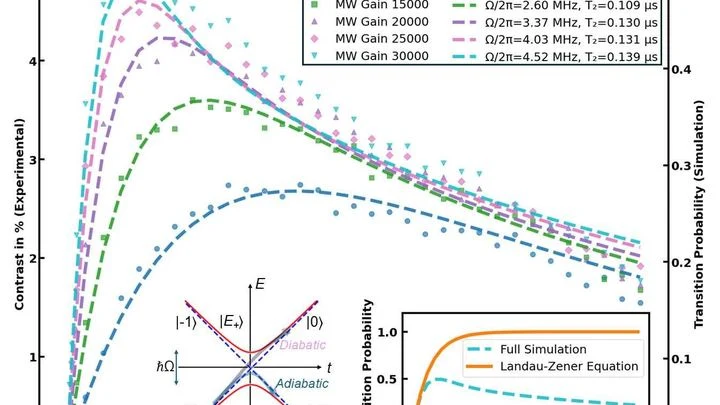
Tiny defects in a boron nitride crystal act as ultra-sensitive magnetic sensors. But their signal resembles a radio with a mistuned antenna: instead of a clear note, you get a broad, noisy range.
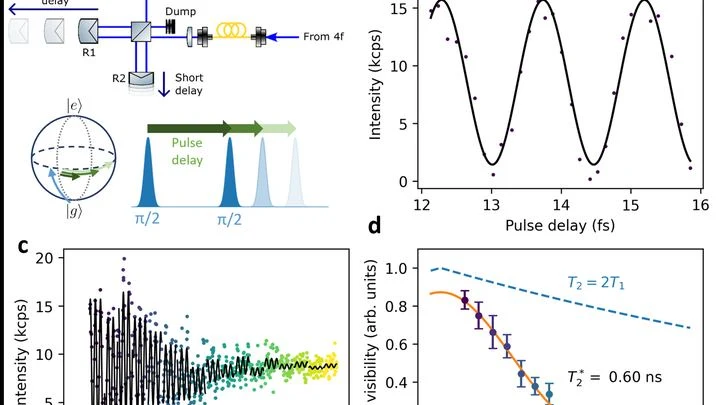
In a laboratory at Purdue University, a laser beam strikes a crystal of hexagonal boron nitride, and in response, a single point of light flashes. This is not just luminescence; it is a signal from a spin defect, a pair of electron spins, one of which is coupled to a carbon-13 nuclear spin.
A tuning fork sounds when you strike it. Its prongs vibrate, and you hear the sound until the vibration dies out. The quantum world has its own "tuning forks"—for example, a defect in diamond that responds to magnetic fields, and a carbon tube that can tremble at frequencies billions of times higher than the note A.