A Robot That Grows Films and Watches Them Get Wet express
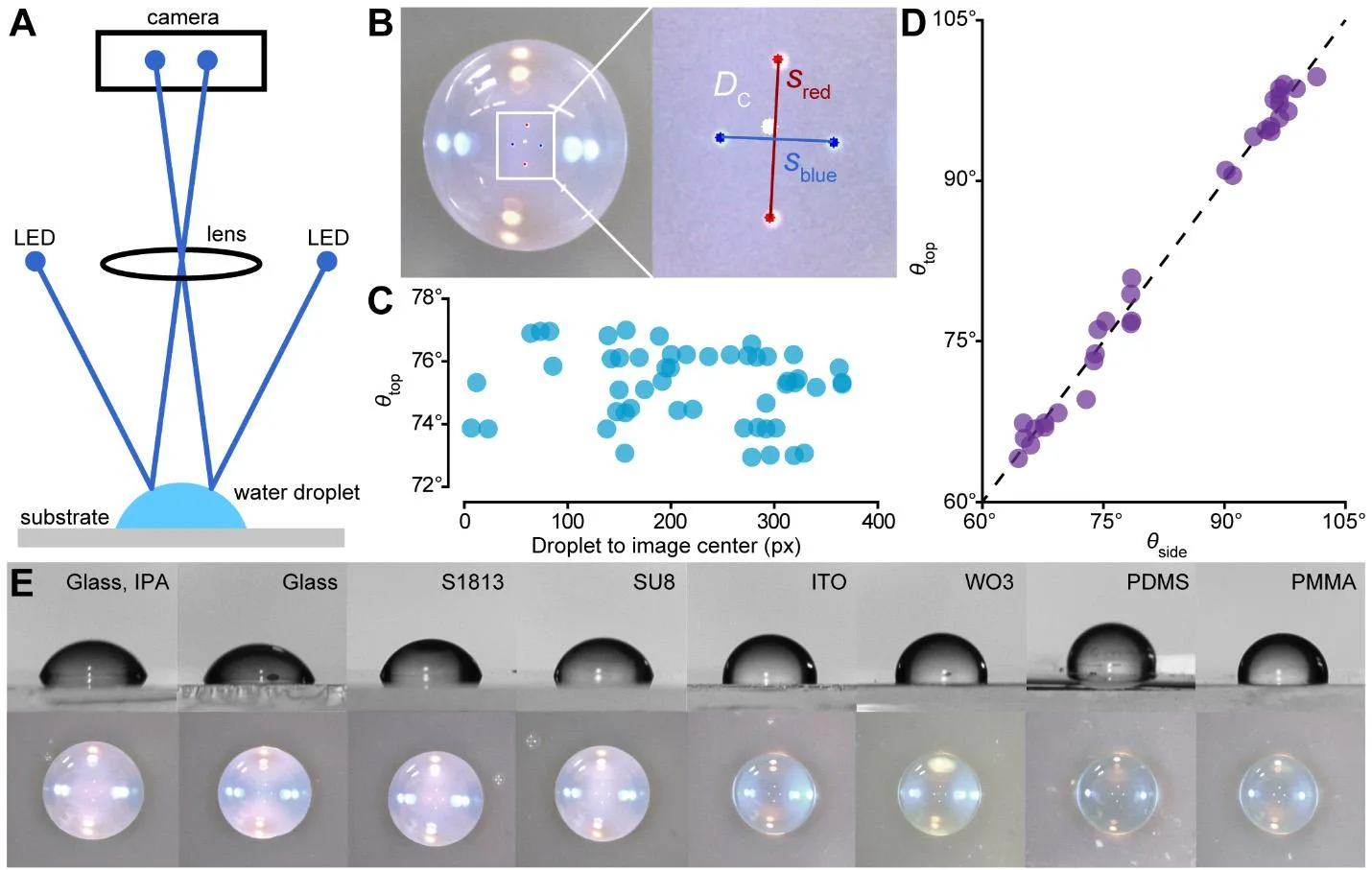
A water droplet on a fresh polymer film behaves like a guest on new furniture: sometimes it spreads out, sometimes it beads up. This behavior tells you how ready the surface is to repel dirt or, conversely, to hold paint. Previously, such tests were done by hand, one film at a time.
Now there's a robot called PANDA-film. It mixes solutions itself, passes a current to deposit a polymer network onto a plate, then drops water on top and watches how it reflects. The whole setup is built on a cheap movable frame like a 3D printer's, so almost any lab can replicate it.
The robot was tested on the polymer PAMA: it applied the film itself, measured the contact angle itself, and produced the result. Such an assistant can run through dozens of formulations overnight and find the best coating composition faster than a human could in a week.
Original abstract
as written by the authors arXiv:2601.07043
Thin polymer films are widely used as functional and protective coatings. However, determining the composition and processing conditions that produce a desired function is a tedious process due to the large number of factors that must be considered and the manual nature of most synthesis and characterization methods. Self-driving labs (SDLs), or robotic systems that prepare and test materials samples, are designed to overcome this bottleneck by enabling the efficient exploration of complex parameter spaces. In this paper, we report the development and testing of the polymer analysis and discovery array (PANDA)-film, a modular SDL for electrochemically synthesizing polymer films and then determining their water contact angle as a measure of surface energy. The system is designed to be highly modular and based upon a lowcost gantry platform to facilitate adoption. In addition to validating fluid handling and electrochemical tasks, we introduce two novel modular capabilities that enable PANDA-film to run sustained campaigns to study the wetting properties of films: (1) an electromagnetic capping/decapping system to mitigate fluid evaporation, and (2) a top-down optical method to determine water contact angle based upon reflectance. These capabilities are validated by depositing and characterizing a poly(allyl methacrylate) (PAMA) film using electrodeposition of polymer networks (EPoN). Comprehensive details for replicating the hardware and software of PANDA-film are included.
The contact angle is the angle between a droplet and the surface. If the droplet is almost flat, the angle is less than 90 degrees — the surface likes water. If the droplet stands up like a ball, the angle is greater than 90—the surface repels water.
In the series 'Westworld', robot hosts create new materials in automated workshops — PANDA-film is taking the first steps toward such factories, but only on the scale of a lab bench for now.