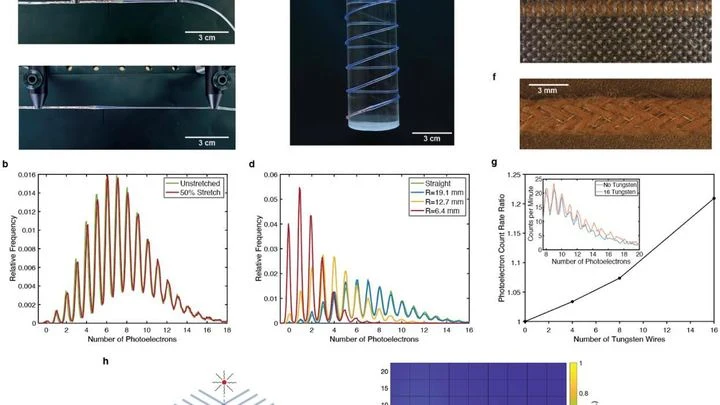
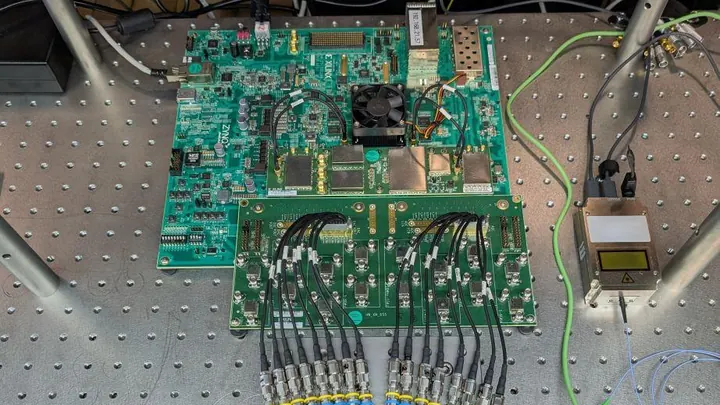
A silicon photomultiplier (SiPM) is a compact, solid-state lightdetector that can count individual photons with high efficiency. It consists of an array of tiny avalanche photodiodes, each operating in Geiger mode, where a single photon triggers a measurable electrical pulse. SiPMs are prized for their high gain, fast response, and insensitivity to magnetic fields, making them versatile tools in modern physics and imaging.
History
Silicon photomultipliers were developed in the late 1990s and early 2000s, building on earlier avalanche photodiode technology. They have since become a standard in high-energy physics and medical imaging.
How it works
Each microcell in a SiPM is a p-n junction biased above its breakdown voltage. When a photon strikes, it creates an electron-hole pair, which accelerates and collides with atoms, generating an avalanche of charge. This avalanche produces a macroscopic current pulse that is counted as one photon. The outputs from all microcells are summed, allowing the detector to measure lightintensity linearly over a wide dynamic range.
In practice
SiPMs are used in particle physics detectors, positron emission tomography (PET) scanners, and LiDAR systems, where their compactness and robustness are advantageous.
Fun fact
SiPMs can operate in strong magnetic fields, making them ideal for use inside MRI scanners combined with PET imaging.
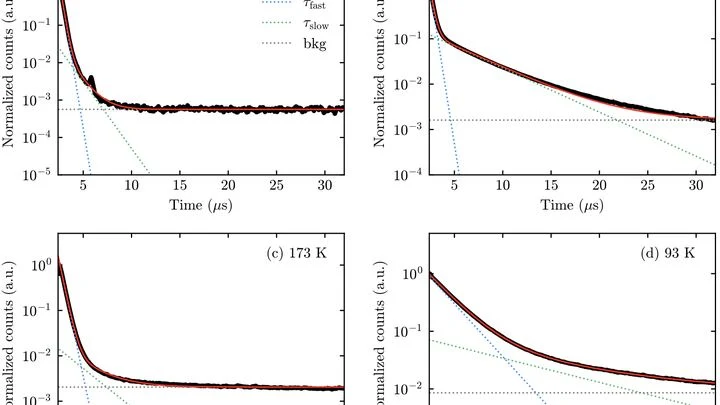
The stage is bathed in icy light, and on it stand silicon spectators. Each is an array of tiny avalanche diodes capable of spotting a single photon, but only if the surrounding temperature drops to 165 K.
The antiproton beam hits the plate, and each impact bursts into a shower of charged particles. In the GBAR experiment at CERN, this picture is captured not by a sophisticated detector but by an ordinary industrial camera without a lens, pressed against the vacuum window from the outside.
A courtroom interpreter must relay every word without being distracted by noise in the room. In the quantum world, a superconducting resonator plays that role, losing photons on schedule without straying into spurious effects.
Light that never reaches the camera still leaves its mark on it. That's how the new imaging method works: you illuminate the object with one color, and the picture is assembled from another. Inside the crystal, light waves mix, and information about the invisible transfers to a visible beam.
In the experiment, they used a silver thiogallate crystal.
Light in an optical fiber is like a stream: it flows inside a glass thread and doesn't spill out. A thick thread carries many streams at once, a thin one only one. Astronomers often need to pour light from a thick fiber into several thin ones to split it into colors.
No one has ever seen dark matter, but it should pass through detectors like wind through leaves. Sometimes, very rarely, a dark matter particle bumps into an atomic nucleus, and then the detector must catch that jolt. The trouble is that light dark matter particles can hardly move heavy nuclei: it's like trying to knock down a bowling pin by throwing a feather at it.
Catching light one particle at a time is like hearing a whisper in a roaring factory. An electron-multiplying camera (EMCCD) can do exactly that: it turns a single photon hitting a pixel into an avalanche of electrons that can be measured. These cameras are mounted on telescopes to spot a barely visible planet next to a dazzling star.
A single photon is like a perfectly smooth brick from which quantum technologies can be built. But to build a house, you need thousands of identical bricks. Rubidium atoms are natural emitters: each atom emits photons of exactly one wavelength, like a tuning fork that always produces a single note.
You can make light turn on command, like water in a hose — if you know where to squeeze. That's what electro-optic circuits do: they change the direction of a beam inside a chip using an electric field. The classic material for such tricks is lithium niobate, a crystal that responds to voltage like a string to a pluck.
In an ordinary room, light vanishes the moment you switch off the lamp. In a tiny silicon nitride cavity, a photon can bounce between the walls 80,000 times before it gets lost. It's like a ball thrown into a room that rebounds off the walls with almost no loss of speed.
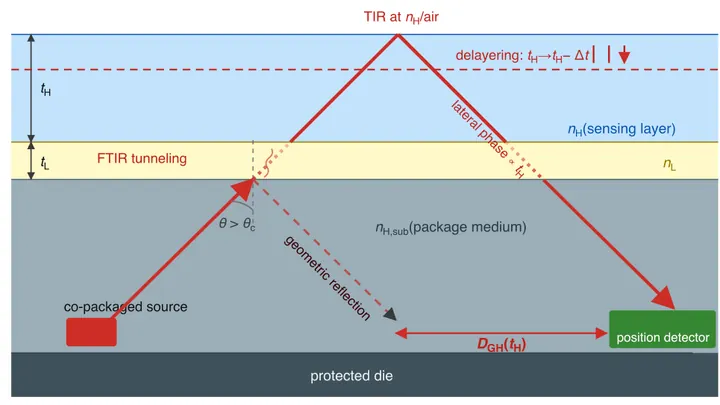
A microchip is like a layered cake: protective layers on top, secrets inside. An attacker can peel off layers one by one to get to the secrets. A new sensor monitors this with a light beam.
The beam hits the chip surface at an angle. Part of the light reflects, but not immediately: it slightly 'dives' into the top layer, like a pebble skipping across water.
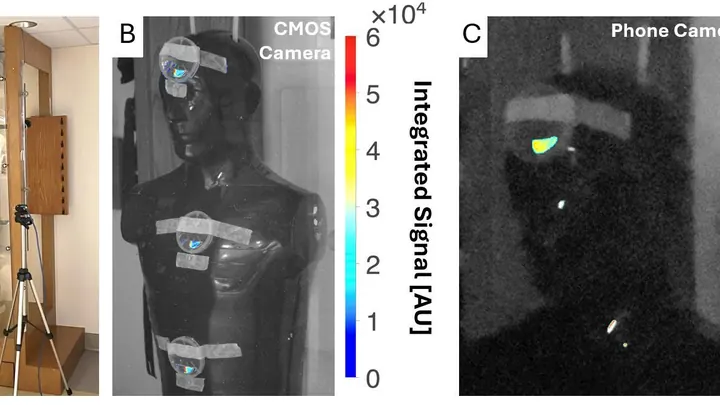
A sodium iodide crystal doped with thallium is like photographic film for invisible particles. When a gamma ray or a hypothetical dark matter particle hits it, it flashes with faint light. Two silicon photomultipliers pressed against the crystal's ends catch the flash from both sides.
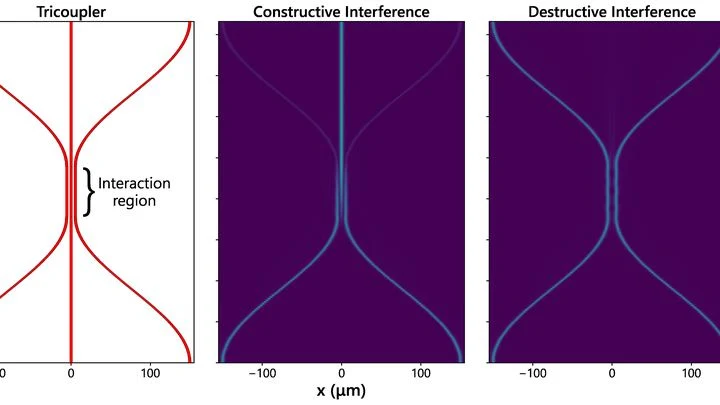
Every night, hundreds of observatories scan the sky, yet planets around other stars remain ghosts. Their light is billions of times fainter than the glare of their parent star — the task seems hopeless. But optics found a way: rather than block the star’s light, cancel it with a counter-wave of the same amplitude, shifted by half a period.
A night river is dotted with tiny sparks. This isn't plankton: it's functional pollen-sensors, millimeter-sized devices that swim on their own and measure the water's chemistry.
Each particle is a tiny lab. Inside, two reagents meet: one triggers a glow upon contact with a pollutant, and the second, a colored filter, blocks out interference.
A regular radar is like a microphone in a buzzing crowd: individual sounds blend into mush. PiVoT works like a conductor who instantly recognizes each instrument in the tuning chaos. Instead of shuffling through hypotheses, the algorithm tightens a loop around the most likely targets — cars, cyclists, pedestrians.
Dozens of copper coils in an MRI scanner pick up the faint response from tissues, like microphones trying to catch a whisper in a noisy hall. Each microphone drags a thick bundle of wires behind it. The wires press on each other, create electrical interference, heat up, and add risk for the patient.
A tiny defect in a boron nitride crystal behaves like a microscopic indicator bulb. Shine light on it, and it glows, with the shade shifting with temperature: the warmer it gets, the redder the glow.
In a small Petri dish sits a droplet of liquid the size of a pinhead. An ordinary scanner wouldn't even notice it: the signal is too weak. But bring a tiny magnetic field sensor close to the droplet, and the picture changes.
A crystal the size of a matchbox was placed under the beam of a clinical accelerator. Half of its surface was covered with a pattern of nanoscale bumps — tiny, smaller than the wavelength of light. The other half was left smooth. The difference was striking: the coated part produced a signal 4.1 times brighter.
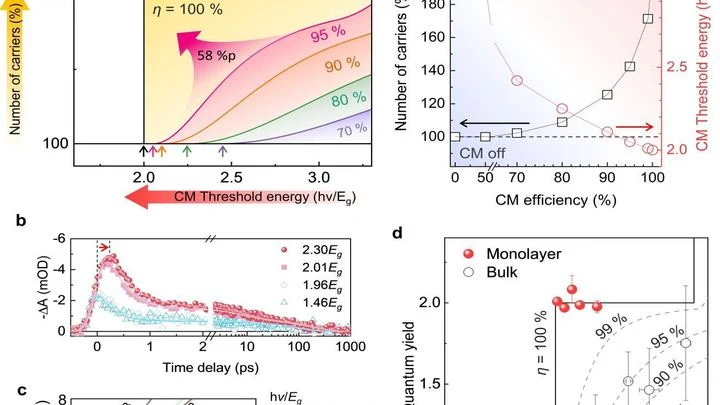
Sunlight hits a material, and each photon knocks out one electron. That's the usual order of things, which is why ordinary solar cells can't convert more than a third of the energy into electricity — the rest is lost as heat. But there's a process akin to a billiard shot where one ball splits into two: carrier multiplication.
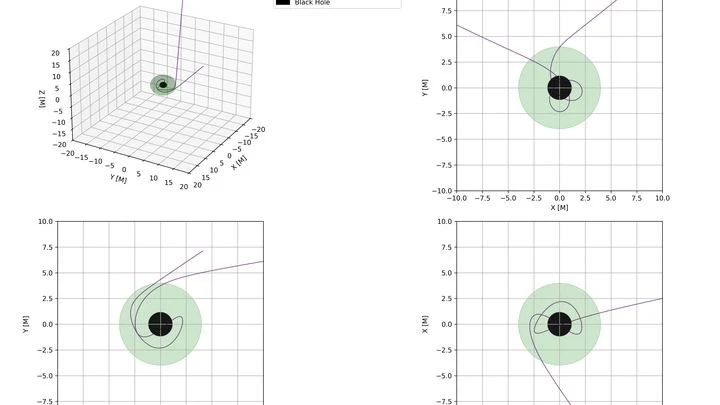
Light passing by a black hole falls into a gravitational trap: its trajectory curves and the particle bounces along a nearly closed orbit, like a pinball.
An ordinary photometry detector can't tell a left photon from a right one. But let it start moving, and everything changes.
Imagine a rower moving between two flutists playing the same note. His ear is perfectly tuned to that note and ignores all others. As he moves, the pitch from the flutist ahead sounds higher, and from the one behind sounds lower.
A flashlight beam aimed through frosted glass turns into a blurry spot with every extra millimeter of thickness. Scintillators, materials that convert X-rays into visible light, behave much the same way. They underpin medical imaging, baggage screening, and detectors at particle accelerators.
Light in an optical fiber runs along the core, barely escaping outside. But if you get very close, you can feel a faint trembling of the field at the surface — the evanescent wave. It is in this 'light fog' above the surface of a tiny silicon ring that physicists have caught a single rubidium atom.
A glass chip, threaded with 128 optical waveguides, has been turned into a kind of quantum pinball machine. The role of balls is played by photons — quanta of light, and instead of mechanical flippers, microheaters control the routes, instantly altering the optical paths.
A musical instrument sounds cleaner when its strings don't touch anything extraneous. Roughly the same principle drives the new optical magnetometer: a glass cuvette the size of a matchbox is filled with rubidium vapor, and its walls are coated with a thin layer of paraffin, like wax on a ski track.
An ordinary rain gauge collects water in a bucket and shows the total volume of precipitation. But the new device is like a sensitive palm that feels every falling drop and keeps count, even when the drops number in the thousands.
That's exactly what physicists have built.
The light bulb turns on only in the room where you need it. That's roughly how photoactivatable drugs work: they 'switch on' only where light is directed, leaving the rest of the body untouched. This is especially important in cancer treatment: conventional chemotherapy hits all dividing cells indiscriminately, causing severe side effects.
Tiny magnets on a lattice, the classic Ising model, are usually described by how neighbors influence each other. But what happens when the system is closely watched? Each measurement of a coupling energy is like a gaze that forces the magnets to 'decide' their state.
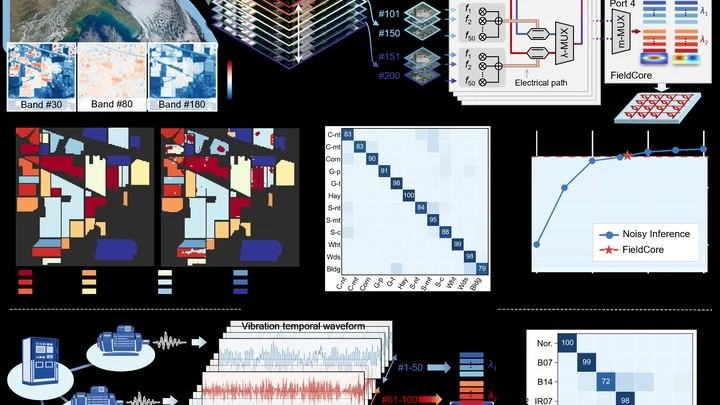
A typical computer shuttles electricity along copper traces, and every operation is a queue: first one thing, then another. Light works differently. In a single beam, you can mix dozens of signals without them interfering, like different voices in a choir, singing at once but each heard distinctly.
The new FieldCore chip uses five such "voices" at once.
When two particles fly at almost the same speed in the same direction, their signals in the detector merge, like two voices in unison. Telling a duet from a soloist is an art in itself.
Light from distant stars travels for millions of years, but X-rays can't be caught with ordinary glass: they pass right through it like a bullet through paper. That's why X-ray telescopes need special lenses: stacks of tiny prisms that gently deflect the rays and focus them to a single point.
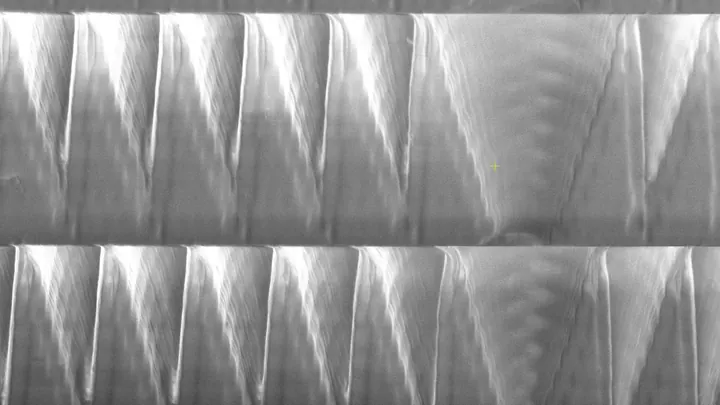
Light in a particle detector behaves like a voice in the mountains. One shout, and the echo repeats several times, growing fainter with each reflection. So it is in a silicon detector: a real flash from a particle gives rise to false ones that confuse measurements.
A security guard needs to check five rooms but can't go inside. He knocks on the door and listens: silence means someone is inside, while an echo means the room is empty.
Inside an ultra-thin polymer thread are microscopic crystals — scintillators. When an invisible radioactive particle hits, they flash for a moment, like fireflies. A sensitive sensor catches each flash, turning the thread into a flexible detector.
A secret key is like a password that two parties need to know, but no one else can peek at. In quantum communication, it's sent using single photons: any attempt to intercept inevitably disturbs them and exposes the spy. Until now, such systems were assembled from many separate components — bulky and expensive.
Infrared light is invisible to the eye, but it's everywhere: from TV remotes to the heat of the human body. Catching it requires special materials. Conventional detectors are bulky, rigid, and not easily tuned to specific wavelengths.
Light in an optical fiber is a stream of photons, and quantum communication requires single photons that can be sent one at a time. But making them emerge quickly while remaining indistinguishable from one another is a tough challenge.
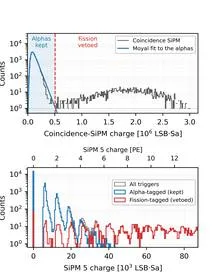
Underground, in a former gold mine, sits a tank of liquid xenon. If a dark matter particle flies through it, the xenon flashes. But it also flashes from ordinary particles, like neutrinos or leftover radioactivity. The task is to tell which flash comes from dark matter and which from noise.
A single electron in a magnetic field is like a tiny top that spins and weakly "squeaks" at its own frequency. Hearing that squeak directly is nearly impossible: it gets lost in the noise. Scientists have devised a resonator: a superconducting microwave strip that works like a tuning fork tuned to the same note.