Smoothed particle hydrodynamics (SPH) is a computational technique for simulating fluids — liquids, gases, and even solids under extreme stress — by treating the fluid as a collection of discrete particles rather than a continuous grid. In traditional fluid dynamics, you divide space into a fixed mesh of cells and track how fluid properties (density, pressure, velocity) change in each cell. SPH instead represents the fluid as a swarm of moving particles, each carrying mass, momentum, and energy. The particles interact with each other through smooth mathematical functions, so the fluid's behavior emerges from the collective motion of these particles.
History
SPH was invented in 1977 by astrophysicists Leon Lucy and Robert Gingold (working independently) to simulate the collision of stars and the formation of galaxies, and it has since spread to many other fields.
How it works
Each SPH particle represents a small parcel of fluid with a given mass, position, velocity, and internal energy. The density at any point is computed by summing contributions from nearby particles using a smoothing kernel — a function that is largest at the particle's location and falls off smoothly to zero at a finite radius. From density, you can compute pressure via an equation of state, and then the pressure gradient and viscous forces are calculated by summing pairwise interactions between neighboring particles. The particles are then moved according to Newton's laws, and the process repeats. Because the method is Lagrangian (following the fluid), it conserves mass exactly and handles advection perfectly.
In practice
SPH is used in astrophysics to model star formation and galaxy evolution, in engineering to simulate fluid-structure interactions like ship hulls hitting waves, and in computer graphics for realistic fluid effects in movies and video games.
Fun fact
SPH is so versatile that it has been used to simulate the formation of the Moon from a giant impact, showing how a disk of debris could coalesce into our natural satellite.
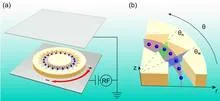
In a ring-shaped channel between two toothed rings, microspheres are suspended: some with a radius of 8 micrometers, others 14. The discharge is switched on, and the particles start moving. The small ones go one way, the large ones the other. It is like a shopping mall where escalators for people of different heights run in opposite directions.
A vacuum cleaner sucks in dust even if there is more of it near the nozzle. The same happens in a tokamak: plasma particles are drawn toward the center, even though their density is higher at the edge. This phenomenon is called particle pinch, and it contradicts the usual rule that everything tends to move from dense regions to sparse ones.
A sphere rolls down a chute. What shape should the chute be to make the descent as quick as possible? Three centuries ago, the answer was the cycloid — a curve resembling the arc of an upside-down bridge. But submerge the chute in a thick liquid, and everything changes: the fluid slows the sphere, and the fastest path becomes something else.
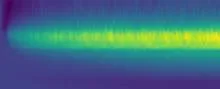
If you push water in a narrow channel too fast, a steep wave forms and breaks into foam. In the world of ultracold atoms, cooled to near absolute zero, quantum laws prevent such a wave from breaking. Physicists took a cloud of rubidium atoms stretched into a thin thread and sharply compressed it from one end with a movable wall of light.
Under an electron microscope, a protein looks like a series of blurry shadows — hundreds of thousands of images of the same molecule, but from different angles and with heavy noise. Previously, from these shadows, one first assembled a volumetric 'haze'—a map of how electric charge is distributed inside the protein.
A cluster of glowing dots drifts through the darkness, now compressing into islands, now spreading out in waves. These are not fish or birds: this is a mathematical model of active matter, where each particle spends its own energy on movement, and also is born, dies, and competes with neighbors for space.
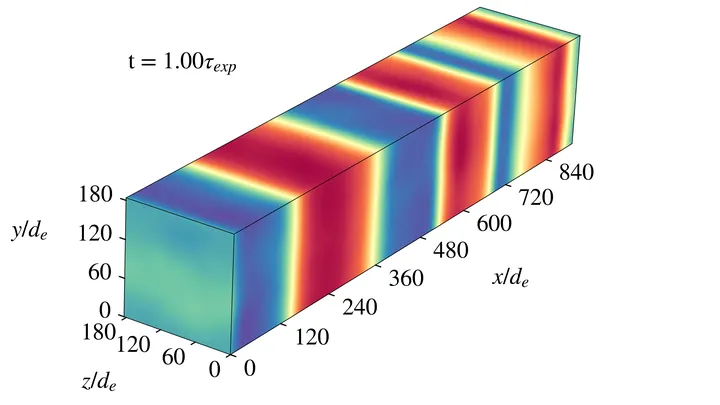
The universe right after the Big Bang was like a boiling cauldron: bubbles of a new state of matter were bursting and growing everywhere. These were first-order phase transitions — exactly like water boiling, only at temperatures reaching trillions of degrees.
The early universe was less like a calm pond and more like a boiling cauldron. Matter flowed, collided, and swirled against the backdrop of rapid spatial expansion. To understand how stars and galaxies emerged from this hot soup, physicists build digital simulations.
This new work is the third part in a series on lattice-based cosmological modeling. The first two focused on fields; this one deals with fluids.
A night river is dotted with tiny sparks. This isn't plankton: it's functional pollen-sensors, millimeter-sized devices that swim on their own and measure the water's chemistry.
Each particle is a tiny lab. Inside, two reagents meet: one triggers a glow upon contact with a pollutant, and the second, a colored filter, blocks out interference.
In a three-dimensional scene, each point is like a candy whose color changes depending on the viewing angle. To describe this play of shades, dozens of numbers are stored for each point — a special mathematical function invented by Joseph Fourier. Memory fills up instantly.
Many natural processes are described by differential equations, but scientists often have only fragmentary data — a sort of torn map. The new computational method works like a cartographer who reconstructs a complete map of the terrain from a few landmarks.
Hybrid perovskites are the rising stars of photovoltaics: their efficiency is growing so fast it feels like we're on the brink of a solar revolution. But these materials, like intricate atomic mosaics, are extremely vulnerable — moisture, heat, and light quickly turn them to dust.
When physicists drive electrons through an ultrapure gallium arsenide channel at helium temperatures, they expect to see a well-behaved, almost ideal fluid.
Picture a pot of boiling soup, but every grain in it is not just a point but a tiny top spinning around its own axis. That's the world of spin-1 particles. For example, some short-lived mesons born in accelerator collisions.
The paradox of the young solar wind has long puzzled heliophysicists. Measurements showed that near the Sun, proton beams aren’t smeared out but sharply compressed, as if someone had neatly hammered them into the shape of a hammerhead.
Many chemical transformations resemble assembling furniture in complete darkness: you see the starting parts and the finished cabinet, but the assembly itself remains a mystery. The intermediate states, like awkward positions of the craftsman's hands, vanish too quickly to be discerned.
Mountain river water doesn't flow smoothly: it churns, swirls into eddies, and suddenly accelerates. This chaotic motion is called turbulence. But even within it, there are hidden rhythms — rare and intense bursts that briefly alter the entire flow pattern.
A lump of plasticine, when kneaded, behaves like an amorphous solid — not a crystal, but not a liquid either. Inside such a material, avalanches can occur: one tiny rearrangement triggers neighboring ones, and a wave sweeps through the entire sample.
A stellar river winds around the center of a distant galaxy like a glowing ribbon on an invisible frame. That frame is the dark halo: a vast cloud of invisible dark matter whose gravity holds stars and gas in place. If the halo is squashed like a pumpkin or stretched like a melon, the stellar stream will bend differently.
A boiling pot, a gust of wind, a wisp of smoke from a campfire — all obey equations that mathematicians call 'nonlinear and dissipative.' In plain terms, energy is lost to friction, and parts of the flow influence each other so strongly that predicting the motion ahead of time is a task on the edge of feasibility.
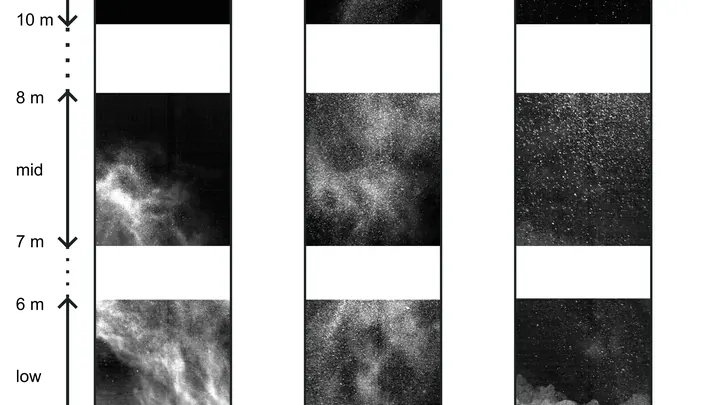
A powder avalanche isn't just a pile of snow sliding down a mountain. It's a cloud racing downhill at car speed. Inside, snow doesn't lie still: it flies: thousands of tiny particles are caught up in air vortices. Until now, no one had seen what actually happens to each snowflake in this chaos. Now scientists have the first footage.
A drop of oil in water, coated with soap molecules, behaves differently from a bare drop. Soap molecules are tiny rods: one end loves water, the other loves oil. In a quiescent fluid, they stand on the surface like a picket fence, lowering the surface tension — the force that pulls the drop into a sphere.
E. coli is a tiny swimmer in a world where water is as thick as jelly. Inside our gut, it doesn't glide freely but fights through mucus — a tangled web of long molecules, like a ball of knotted threads.
When servers in a data center run at full tilt, they get as hot as a forgotten iron. That heat goes to waste, and cooling them eats up even more energy. Engineers in Germany have proposed putting that heat to work: let it drive liquid through thin tubes all by itself, with no motors or pumps.
Their device looks like a flat box with an asymmetric bottom.
The boundary between two liquids is like an invisible skin: it's there, but you can't touch it with your finger. Scientists have found a way to measure its elasticity without touching it. They made a tiny probe oscillate above the surface, and between the probe and the interface lay a thin film of liquid.
Water deep within the Earth is compressed more than a thousandfold compared to the surface. Even there, it continues to flow, but its internal structure changes. Researchers measured how water resists flow and compression as pressure rises from zero to 1.6 gigapascals — equivalent to placing a 16-ton weight on every square centimeter.
Strike a tuning fork, and it rings with a single pure note. But if the fork is trembling and people are chattering nearby, the sound won't be perfect. Same with molecules: each one absorbs light of a specific color, but due to its own vibrations and the jostling of neighbors, that color gets smeared out.
The authors of the paper figured out how to show this to students without complex formulas.
In a protoplanetary disk, a cloud of gas and dust around a young star, dust grains don't just fly in circles. They are carried by the gas flow, like sand by the wind, and in turn alter that flow. Layers emerge, sliding past each other, and at their boundaries an instability arises — waves and vortices.
Hydrogen is a champion in energy per kilogram, but storing it is a hassle. As a gas, it takes up a huge volume, and if you compress it or cool it to a liquid, you need heavy tanks and lots of energy. There's a third way: some solid materials absorb hydrogen like a sponge soaks up water and hold it within. Heat it up, hydrogen comes out; cool it down, it gets absorbed back.
A laser beam holds a single ion in a vacuum, and that ion behaves like a ball trapped between two cups. The cups aren't pits in the ground but regions where the ion energetically prefers to be. In the classical world, a ball would roll into one cup and stay there.
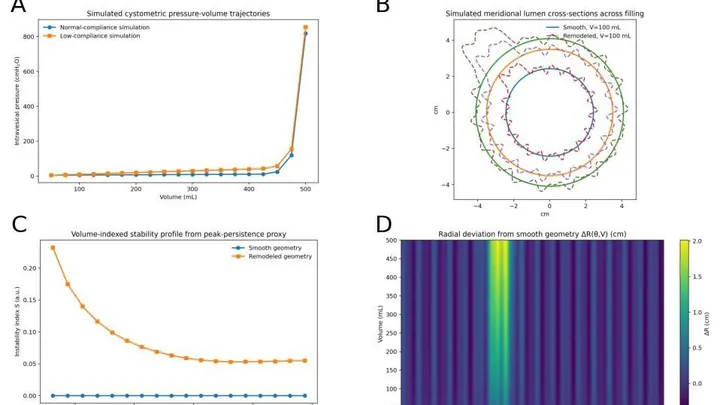
The bladder is like a balloon: as it fills, the wall stretches and the shape changes. Doctors usually monitor the pressure inside and how much fluid has entered, but they rarely look at the geometry itself — how the surface curves. Yet irregularities can appear before the usual metrics deteriorate.
In the desert, the sun sucks water out of the ground. But a layer of water-repellent sand just 5–10 mm thick works like a lid: air passes through, but water is blocked. Evaporation drops by 63–83%.
Under such a lid, sand behavior flips upside down. Normally, fine sand loses moisture 37% faster than coarse sand because it heats up more.
The lymphatic system is like a city's network of canals, through which water slowly moves, carrying away waste from tissues. But it has no single pump-heart. Instead, along the vessels are placed small station-locks — lymphangions. Each such lock squeezes itself like a fist and pushes fluid onward. How they coordinate their work has long remained a mystery.
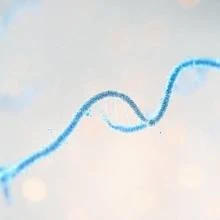
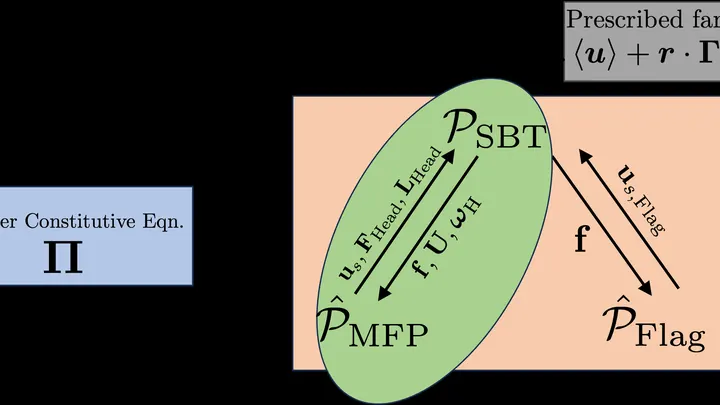
A microbe with flagella rows through water the way a person rows with their arms. But if a person swims breaststroke, they go forward, while a microbe goes in a spiral. The reason is that a microbe has no single direction: each part of its surface pushes water in its own direction, and the body twists like a corkscrew.
Plasma is a gas in which electrons are stripped from atoms, and it conducts electricity. In space, such gas is often so rarefied that particles rarely collide, and its behavior is described by the equations of motion for each particle. The computer method Particle-in-Cell (PIC) does exactly that: it tracks millions of particles and the electric fields they create.
Hot plasma is like a swarm of frantic fireflies darting around in a jar. Keeping it confined in an open magnetic trap is like trying to keep those fireflies from touching the glass. A new computer model shows how to do it more precisely.
Ions and electrons in plasma constantly collide, exchanging energy.
Salt in a glass of water is a crowd of charged particles. When there's plenty of water, each particle floats on its own, wrapped in a thick fur coat of water molecules. But as you keep adding salt, the water runs out for everyone, and the particles start seeking each other out. First, they stick together in pairs, then in larger clumps.
At the Large Hadron Collider, protons smash into each other like two trucks full of confetti. The debris, dozens of new particles, scatters in all directions. The detector records their tracks, and then the real work begins: piecing together a complete picture of the collision from those tracks.
Previously, this was done by a set of rules devised by physicists.
A sheet of paper released from a window flutters, tumbles, and sometimes pauses flat for a second. Until now, to honestly predict such behavior, you had to run millions of equations on supercomputers for every drop of air. That's like simulating every atom of a cash register to count change at a store.
The new approach is smarter.
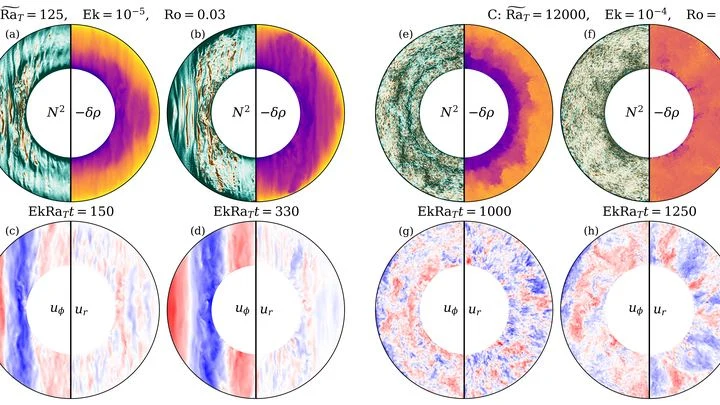
Inside giant planets like Jupiter and Saturn, heat doesn't always rise freely. Heavy elements, which are more abundant in some layers than others, prevent hot fluid from floating up. This creates semiconvection — a type of mixing where heat and composition spread at different rates.