Electric current is the flow of electric charge, typically electrons, through a conductor such as a metal wire or a thin film. It is measured in amperes (A), where one ampere equals one coulomb of charge passing a point per second. In materials science, passing a current through a film is a standard way to probe its electrical properties, revealing how conductive it is, how it responds to temperature, or how it interacts with magnetic fields.
History
The concept was formalized by André-Marie Ampère in the 1820s, who studied the magnetic effects of current, and the unit is named after him. The electron's role was identified later, by J.J. Thomson in 1897.
How it works
Current arises when an electric field pushes free charge carriers—usually electrons—through a material. The rate of flow depends on the material's resistance, the applied voltage, and the density of charge carriers. By measuring the current and voltage, one can derive properties like resistivity, and by varying conditions (e.g., temperature or light), one can study phase transitions or electronic behavior.
In practice
Current is fundamental to all electronics, from household wiring to semiconductor devices, and in research it is used to characterize thin films, superconductors, and other materials in experiments like those probing quantum effects.
Fun fact
In a typical copper wire, electrons drift at only about 0.1 millimeters per second, yet the electrical signal propagates near the speed of light because it is carried by the electric field, not the electrons themselves.
Units by system: SI: ampere · CGS: statampere · Planck: planck current
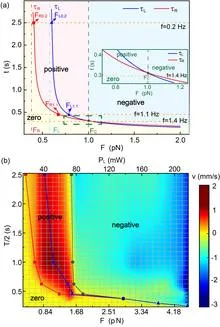
A swing that rocks on a sawtooth hill behaves strangely: without kicks, it gets stuck in the first dip, but with rhythmic pushes it can move uphill, downhill, or stay frozen in place. That is exactly what physicists saw when they placed a single dust grain in a trap with a sawtooth bottom and started pushing it alternately with laser beams.
In 1994–1995, the LEP accelerator collided electrons and positrons, producing Z bosons that promptly decayed into showers of particles. The DELPHI detector recorded these events, and now, decades later, a new pattern has been found in that data: the electric charge within particle jets is not distributed randomly but follows a simple sine curve.
An electron beam is a stream of tiny particles carrying an electric charge. When such a beam hits a material, it doesn't just heat it or knock out atoms: it also gives the surface a slight push, like a jet of water pushing against your palm.
Crystals glued to the outside and inside of a metal wall act as an invisible channel. One, receiving current, starts to tremble, and these vibrations, like ripples on water, spread out in all directions through the metal. The inner crystal catches this tremor and generates electricity again.
An electron flying through a gas is like a swimmer trying to cross a crowded pool. Each collision with an atom changes its course and speed. In dense argon gas, there are so many collisions that a simple description no longer works.
Physicists measured electron mobility — how easily electrons drift under an electric field.
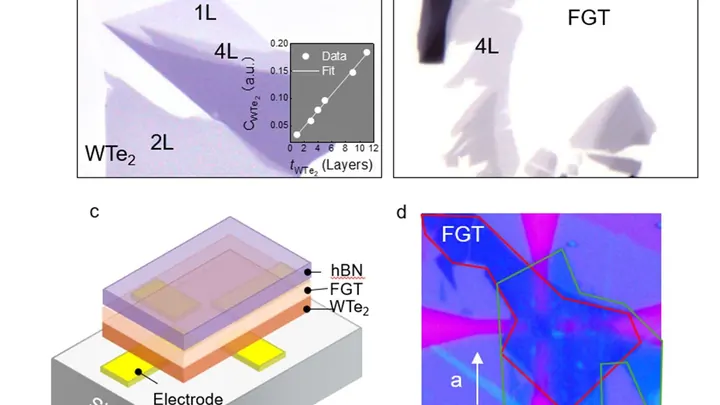
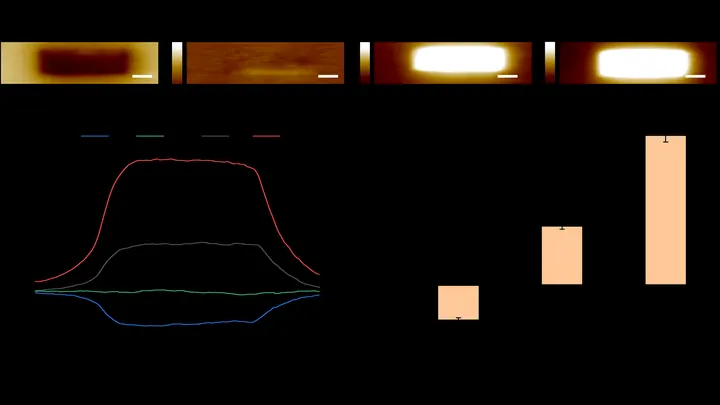
Usually, current in a metal acts like boiling water on ice: it heats the material and destroys magnetic order. But in a layered structure of tungsten ditelluride and the ferromagnet Fe3GeTe2, current behaves differently.
A thin film of nickel oxide, tens of nanometers thick, is like a sheet of paper folded hundreds of times thinner. At room temperature, it conducts electricity, but cool it slightly and it becomes an insulator.
Neutrinos are tiny particles that zip through Earth, barely noticing it. In the MicroBooNE experiment, they are caught in a tank of liquid argon. When a neutrino strikes an argon nucleus, it produces an electron and protons, like splashes from a stone thrown into water.
A sheet of paper hundreds of times thinner than a human hair: that's roughly the thickness of the vanadium oxide film scientists grew. Inside this film, electrons, the tiny carriers of electric current, move almost without collisions. Like cars on an empty night highway, they accelerate and don't lose speed.
A flexible screen as thin as a human hair is glass you can bend. But this marvel has a quirk: touch it, and an invisible electric charge lingers on the surface. Like dust on polished furniture, it builds up and interferes with operation.
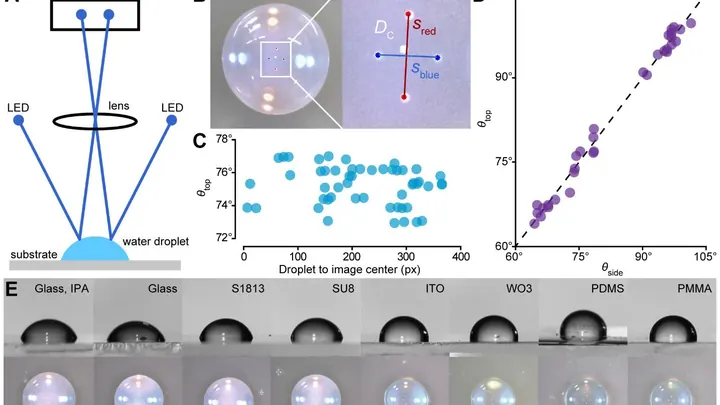
A water droplet on a fresh polymer film behaves like a guest on new furniture: sometimes it spreads out, sometimes it beads up. This behavior tells you how ready the surface is to repel dirt or, conversely, to hold paint. Previously, such tests were done by hand, one film at a time.
Now there's a robot called PANDA-film.
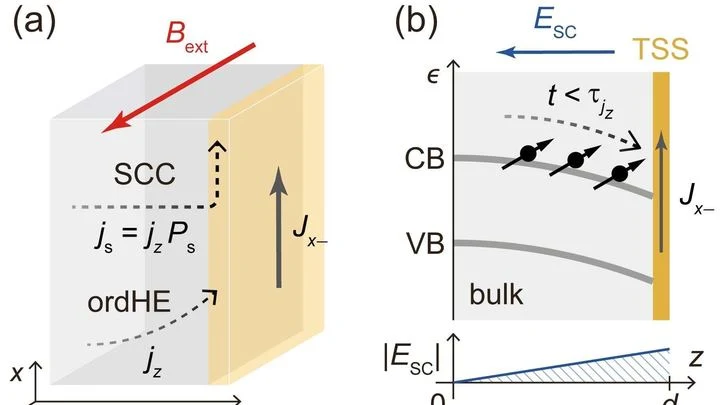
A thin film of a bismuth-selenium compound sits on a substrate. A laser pulse lasting a millionth of a billionth of a second strikes it. Nearby, a magnet is switched on, with a field weaker than that of a fridge magnet.
After an injection under the skin, a drug doesn't just spread out like ink in water. Antibody molecules carry an electric charge, and that charge makes them interact with surrounding tissues — much like a magnet attracts or repels iron filings.
Gravity works like an invisible photographer. When a piece of metal falls, inside it, according to Albert Einstein and the electromagnetism of James Clerk Maxwell, an electric field is born — that's how spacetime curvature…