Thin-film topological insulators are ultra-thin layers of materials, often just a few atoms thick, that exhibit topological insulator properties: they are insulating in their interior but conduct electricity on their surfaces or edges without dissipation. These edge states are protected by time-reversal symmetry, making them robust against defects and impurities. Thin films are particularly interesting because they allow precise control over the material's electronic structure and can be integrated into devices.
History
The theoretical prediction of topological insulators in 2D (quantum spin Hall effect) was made by Charles Kane and Eugene Mele in 2005, and the first experimental realization in mercury telluride quantum wells followed in 2007. Thin-film topological insulators were later fabricated from materials like bismuth selenide and bismuth telluride.
How it works
Topological insulators have a band structure where the bulk has an energy gap, but the surface states cross the gap, forming a Dirac cone. In thin films, quantum confinement alters the band structure, and when the film thickness is reduced, the top and bottom surface states can hybridize, opening a gap in the surface states. However, if the film is thin enough and the material has strong spin-orbit coupling, the edge states remain conducting. The topological protection arises from the material's symmetry, not from the details of the film's geometry, so the conducting edge states persist even with impurities or bends.
In practice
Thin-film topological insulators are being explored for spintronic devices, where the spin of electrons carries information, and for topological quantum computing, where the protected edge states could host Majorana fermions for fault-tolerant qubits.
Fun fact
The edge states in a topological insulator conduct electricity without generating heat, even when the edges are bent or have defects, because the electrons' spin is locked to their direction of motion.
On the table lies a layered cake of hexagonal boron nitride flakes, a material similar to graphite but made of boron and nitrogen atoms. One flake is carefully transferred onto another, and at the spot where they overlap, after heating in oxygen, bright single light sources are born.
A microchip the size of a fingernail gives off as much heat as a small light bulb. Getting rid of that heat is like trying to cool a cup of hot tea with a teaspoon: the insulating material around transistors is usually a poor heat conductor.
A stack of playing cards lies still. You can slide the top card with your finger: that's crude intervention. Or you can blow so that the whole stack momentarily changes shape, but the cards don't scatter. That's roughly how light, in a new experiment, rearranges a crystal of tin selenide (SnSe).
Usually, to change the structure of a solid, you heat it or pass a current through it.
A highway where opposing flows are separated not just onto different sides, but onto two independent roads: each with its own entrance and exit. Something similar happens to electrons in a new type of topological insulator described by the authors of the study.
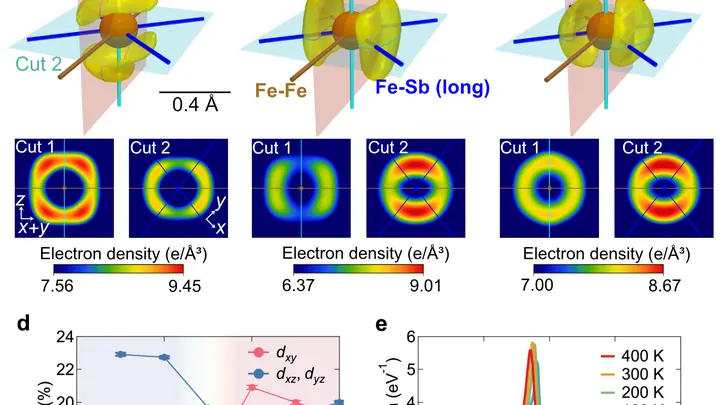
A house with cork walls suddenly gets covered in copper sheets, but only when frost sets in. That's roughly how FeSb₂ behaves when made into a film just a few atomic layers thick. Under normal conditions, it's a narrow-gap insulator: electrons sit tightly in place like spectators in an overcrowded hall.
Hidden within thin layers of tantalum selenide (TaSe₂) is a property that defies conventional physics. When guest atoms were added between the layers of this material, the structure lost its center of symmetry, and inside, superconductivity with armor emerged.
Blood vessel cells were seeded onto a transparent film just 700 nanometers thick — a hundred times thinner than a human hair. Flat electrodes are hidden beneath the film. They send a weak alternating current and listen as the resistance changes.
Usually, light does not turn an insulator into a conductor: that requires powerful laser pulses that break the material's structure. But in twisted bilayer graphene at the magic angle, things are different.
The book is open to the middle. Current runs along the spine, while the pages remain cool. That's roughly how a two-dimensional topological insulator works — a material where electricity flows only along the edges, while the interior stays still.
In the new model, each active particle has an internal rhythm: it spins either left or right. Chirality is key: some twirl clockwise, others counterclockwise. But when such a particle bumps into an obstacle or a neighbor, it flips its spin, like a figure skater who, after touching the board, explodes into a reverse pirouette.
Imagine a multilayered shell where metal and insulator layers alternate like pages in a book. Such a structure can make an object hidden inside invisible to an observer. Light bends around it as water smoothly flows around a smooth stone: no ripple, no splash — no reflection, no shadow.
A neat stack of atomic layers lies on a substrate. An invisible beam of terahertz light shines down on it, with a magnetic field applied from the side. After reflection, the beam's polarization rotates slightly.
Two white sheets lie in the sun — one rough, one smooth. Which one heats up less? The rough one scatters light more strongly, so it seems it would stay cooler. But if the coating is made of many transparent glass beads, the logic changes. Light wanders through it like in a thick fog, and at some point it stops noticing individual droplets.
Two thin layers of a semiconductor were twisted relative to each other by 2.29 degrees, like two sheets of transparent paper with printed grids. Where the lines nearly align, a large pattern of dark and bright spots emerges. Electrons in this pattern behave very differently from those in a regular crystal.
A film of aluminum nitride, as thin as a soap bubble, hangs above a mirror with a micrometer-sized air gap between them. When invisible infrared light with a wavelength of about 15 micrometers hits it, the film starts to vibrate in sync with the light, like a string that responds only to its own note.
A single-atom-thick sheet of tungsten telluride is like thin foil: electrons can't pass through because there's a band gap between their possible states, like a moat you can't jump across. Add two more layers, and the moat disappears; the material becomes a metal, and current flows. Add more layers, and the properties change again, as if someone is flipping modes with a single button.
A sheet of paper weighs almost nothing, but stack a hundred sheets and you get a noticeable pile. That's roughly what scientists did with a material that excels at converting one color of light into another, but only when it's just one atom thick. A single layer is like a single sheet: it works beautifully, but it's too thin to produce much light.
A mosaic floor made of many small tiles, each turned in a different direction. It seems that any pattern trying to cross such a floor would get scrambled and vanish. That's how people usually think about disorder in crystals: if atoms aren't arranged in a perfect lattice, delicate quantum effects should fall apart.
A crowd on a narrow street moves slowly because people bump into each other. In silicon, heat is carried by similar 'shoves'—atomic vibrations called phonons. If you cut tiny holes in a silicon film, phonons will bump into them like pedestrians into lampposts, and heat will flow worse.
An ordinary transistor in a phone is made in a vacuum chamber, where atoms are deposited layer by layer. Expensive and slow. But indium oxide can be printed like ink — from a drop of liquid metal that, in air, coats itself with a thin oxide film.
The authors took indium, melted it, and rolled it over a substrate at 250 degrees.
A gas bubble in water sings loudly — this is Minnaert resonance: the heavy liquid prevents the bubble from compressing quickly, forcing it to vibrate. In air, there's no such effect: air is too light. But if you dress the bubble in a soft silicone shell, like rubber, it plays the role of the water mass. You get an 'elasto-bubble'.
A glowing spot in a crystal is like a lighthouse in fog: the longer it shines, the more reliable the signal. In quantum devices, ions of rare-earth metals embedded in a transparent lattice play the role of such a lighthouse. They absorb energy and release it as a flash of light. But if there are atoms with magnetic moments nearby, the flash quickly dies out.
A thin film is like a taut sheet: the thinner it is, the harder it is to push through. Scientists have noticed that films made of very different materials (graphene, graphene oxide, polymers) resist projectile penetration surprisingly well under high-speed impact. And the thinner the film, the more energy it absorbs per unit mass.
A green flashlight beam dives into a pool and reaches the bottom with barely any loss. Water is transparent to green light, which is why it's used for underwater communication. But to send video or sensor data, the light needs to be switched on and off very quickly — billions of times per second. Ordinary lasers are too slow and unstable for this.
The microchips inside smartphones and computers are getting denser: billions of transistors are packed onto a sliver of silicon the size of a fingernail. When they work, they give off heat like tiny stoves. If that heat isn't drawn away, the chip overheats, starts glitching, or fails outright.
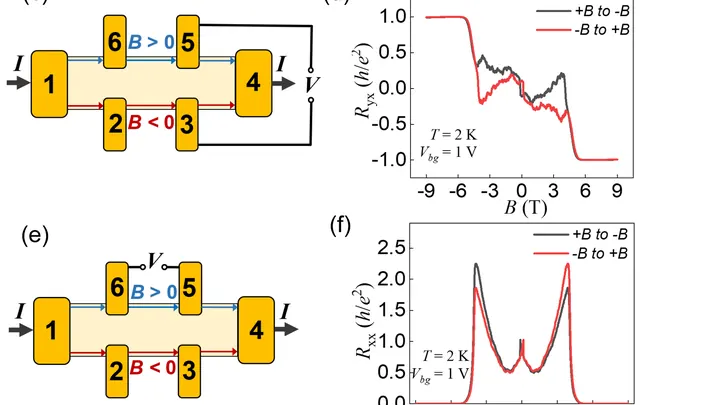
Certain materials, when placed in a strong magnetic field at low temperatures, exhibit a surprising property: their interior stops conducting, becoming an insulator, while along the very edge of the sample electricity runs like a river along a channel, always in one direction.
In a metal crystal, atoms line up in neat rows like bricks in a wall. Knock out a single brick, and you're left with a void — what scientists call a vacancy. Under irradiation, these voids multiply and start merging into large holes, sapping the metal's strength. It's like holes in a brick wall joining up into a gaping breach.
A thin film of indium arsenide on an insulating substrate behaves like a double-walled thermos: the electrons inside barely give off heat to the surrounding crystal. In an ordinary metal, electrons quickly exchange energy with atomic vibrations, so their temperature is always close to that of the sample.
Two-dimensional bismuth on a silicon substrate is a promising material for future electronics. Its edges conduct current without loss, like a highway with no traffic lights. But bismuth itself is delicate: air and moisture quickly degrade its properties.
A quantum computer is like a musical instrument: even a tiny scratch on a string ruins the sound. Instead of strings, we have superconducting resonators — thin traces of titanium nitride on a silicon wafer.
An ordinary piece of semiconductor weakly changes the color of light passing through it. For decades, physicists worked around this limitation by placing the crystal in clever surroundings, but the material itself remained the same.
Now researchers have assembled a "sandwich" of alternating thin layers of gallium arsenide and aluminum gallium arsenide.
A blazing furnace in a workshop or the hot exhaust of a turbine is not just heat: it's light, invisible to the human eye. Regular solar panels catch visible light, but here you need a receiver for invisible thermal radiation.
A crystal is like a perfectly laid mosaic of atoms. But growing such a mosaic is a tricky task: if the order slips even slightly, 'seams' appear — boundaries where rows of atoms don't align. For ordinary electronics, that's a minor issue, but for a quantum computer, it's a disaster.
Light usually travels straight, like a flashlight beam. But it can be twisted, like water in a funnel, creating a vortex in the beam. Such twisted light can carry more data: different vortices don't interfere with each other, just like different radio channels. The challenge was to make a source of such light small enough for a chip.
Electronics get hot. The more powerful the processor, the more heat you need to get rid of, or it will fail. One bottleneck is the boundary between two materials: heat hits it like a seam between tiles and slows down.
Terahertz radiation sits between microwaves and infrared light. It passes through clothing, paper, and plastic, but not through metal or water. That's why it's used in security scanners and medical imaging. To see the polarization of such radiation, you need a detector.
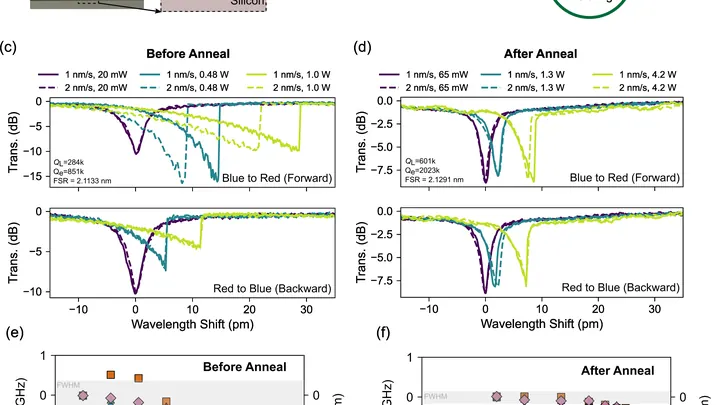
Light in a tiny ring is like water in a closed channel: if you push the flow too hard, the walls start to shake and the channel changes shape. In optical microrings, the water is played by a laser beam, and the walls are a crystalline track thinner than a hair.
An ordinary laser amplifies light into a bright beam. Run the process in reverse, and you get an anti-laser — a device that sucks in light without a trace. But such a machine is finicky: even a slight disorder can ruin the absorption.
Physicists have found a way to make the anti-laser invulnerable.
A heated floor in a room always vibrates slightly — molecules in it are moving. The same happens to mirrors in gravitational wave detectors: heat makes their surfaces tremble finely, which hinders picking up faint signals from space.
To calm the jitter, thin layers of different materials are applied to the mirror, like a layered cake.
Light passing through a window pane refracts the same in all directions. But in thin layered crystals, it's a different story: light traveling along the layers sees the material differently than light traveling across them. It's as if a sheet of paper were transparent but transmitted light differently along and across its fibers.