Particle detection methods are experimental techniques used to identify and study subatomic particles produced in high-energy collisions or cosmic rays. These methods rely on measuring the particles' energy, momentum, charge, and mass through their interactions with matter. Modern detectors combine multiple technologies—silicon trackers, calorimeters, and muon chambers—to reconstruct the full event topology.
History
Early techniques included cloud chambers (Charles Wilson, 1911) and bubble chambers (Donald Glaser, 1952). Modern electronic detectors evolved in the 1960s–70s with the development of multiwire proportional chambers by Georges Charpak.
How it works
When a charged particle passes through a medium, it ionizes atoms, leaving a trail of free electrons. Detectors amplify this signal using electric fields (as in wire chambers) or convert it to light (as in scintillators). Calorimeters absorb particles entirely, measuring their energy via the resulting shower of secondary particles. Time-of-flight and curvature in magnetic fields provide momentum and mass information, allowing particle identification.
In practice
These methods are essential for experiments at particle accelerators like the LHC, as well as for medical imaging (PET scans), radiation monitoring, and astrophysical observations of cosmic rays.
Fun fact
The invention of the multiwire proportional chamber earned Georges Charpak the 1992 Nobel Prize in Physics, and its principles are still used in modern particle detectors.
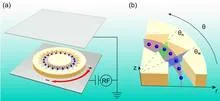
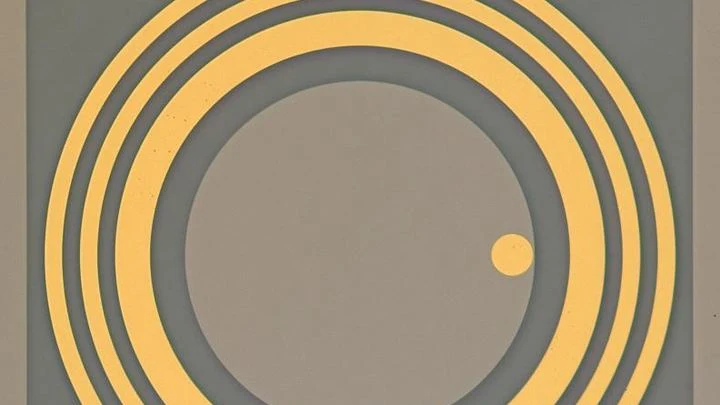
In a ring-shaped channel between two toothed rings, microspheres are suspended: some with a radius of 8 micrometers, others 14. The discharge is switched on, and the particles start moving. The small ones go one way, the large ones the other. It is like a shopping mall where escalators for people of different heights run in opposite directions.
Dark matter — the invisible architect of the universe, holding galaxies from flying apart. Thanks to the pioneering work of Fritz Zwicky and Vera Rubin we know: ordinary matter in the cosmos is just a negligible impurity. But what lies behind this dark matter?
A photographer shoots a night forest, trying to catch fireflies in the frame. The flashes are rare and faint, while around there's the noise of wind and distant lights.
A charged particle streaks through a silicon sensor, leaving behind a trail of free electrons. The time it takes for this charge to be collected at the electrode depends on how deep in the crystal it was born. A particle entering head-on carves identical paths through neighboring pixels: their signals arrive almost simultaneously.
An alpha particle is a helium nucleus that flies out when heavy atoms decay. When it hits a gallium nitride crystal, it deposits its energy and creates an electrical pulse. The pulse height tells you how much energy the particle had.
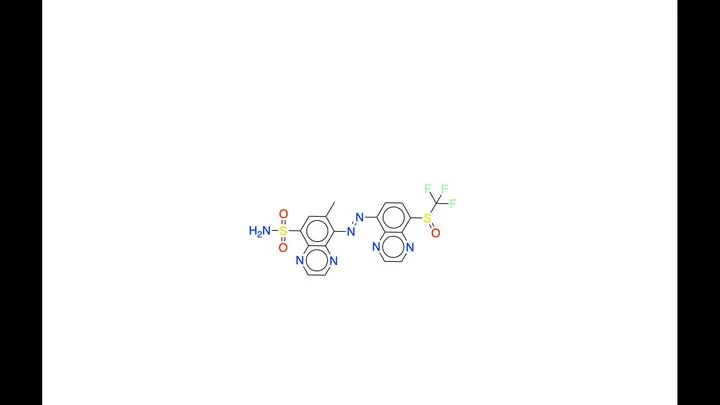
The light bulb turns on only in the room where you need it. That's roughly how photoactivatable drugs work: they 'switch on' only where light is directed, leaving the rest of the body untouched. This is especially important in cancer treatment: conventional chemotherapy hits all dividing cells indiscriminately, causing severe side effects.
A tiny glass bead hangs in a laser beam like a speck of dust in sunlight. Around it is a rarefied gas: atoms of krypton, xenon, and heavy molecules of sulfur hexafluoride. They collide with the bead, and each hit transfers a tiny impulse, like a pea thrown at a taut sheet makes it tremble.
Impulse is a measure of motion: mass times velocity.
When two particles fly at almost the same speed in the same direction, their signals in the detector merge, like two voices in unison. Telling a duet from a soloist is an art in itself.
In giant accelerators, particles zip through detectors in billionths of a second, and telling one from another requires a stopwatch of incredible precision. The new µRWELL-PICOSEC detector acts as such a stopwatch: it captures the moment a particle passes with a precision of 48 picoseconds: that's 48 trillionths of a second.
When heavy nuclei collide in accelerators, a multitude of particles is produced, and physicists want to understand how electric charge moves through this chaos. Two trains crash into each other: the passengers (quarks) scatter, but their luggage (charge) may end up far from the crash site.
In turbulent air, droplets don't fly in straight lines: they get tossed around like dust motes in a beam of light. Physicists have built a setup that tracks each droplet, which is about a tenth of the thickness of a human hair. A camera captures their motion, and a computer reconstructs their trajectories.
In collisions of heavy nuclei, a fireball of thousands of particles is born. Among them are pions and kaons, two kinds of light particles that look very much alike. To understand what happens in this fireball, physicists need to know exactly how many of each particle flew out.
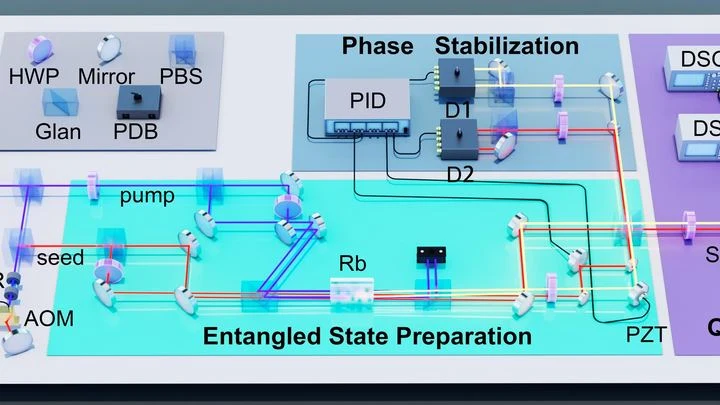
A single antiproton, trapped and cooled to near absolute zero, behaves like a tuning fork that needs a very precise strike to produce a clean note. Catching that 'note' directly is nearly impossible — the signal is too weak.
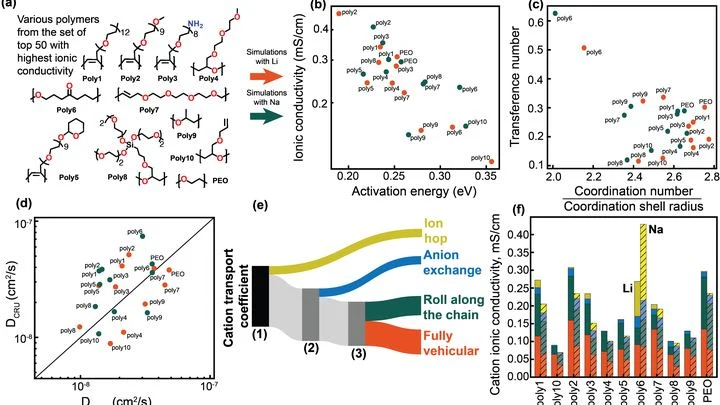
Modern batteries with liquid electrolytes can leak or catch fire. Polymer electrolytes (solid, plastic-like materials) solve that problem, but ions move through them more slowly, so the battery loses power.
Researchers set up a virtual assembly line: a computer program generated new polymer structures the way a chef experiments with new dough recipes.
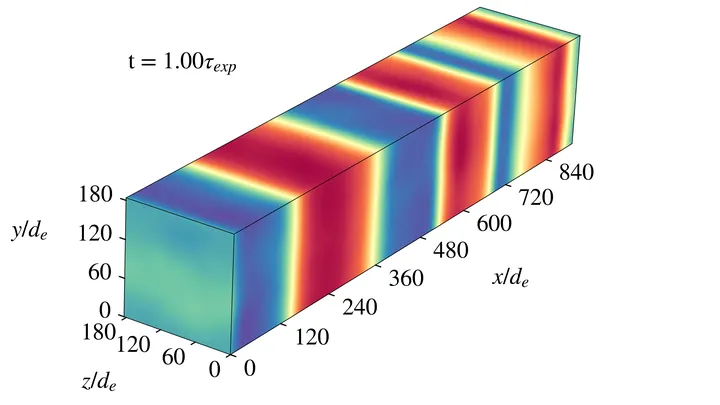
Plasma is a gas in which electrons are stripped from atoms, and it conducts electricity. In space, such gas is often so rarefied that particles rarely collide, and its behavior is described by the equations of motion for each particle. The computer method Particle-in-Cell (PIC) does exactly that: it tracks millions of particles and the electric fields they create.
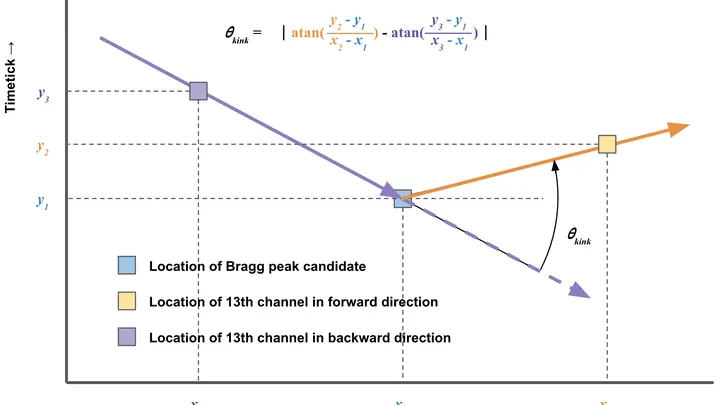
The MicroBooNE detector is a large tank of liquid argon that catches particles flying through it. When a particle passes, it leaves a trail of charge and a flash of light. These trails combine into a three-dimensional picture of the event, as if the particle were drawing its path in a transparent cube.
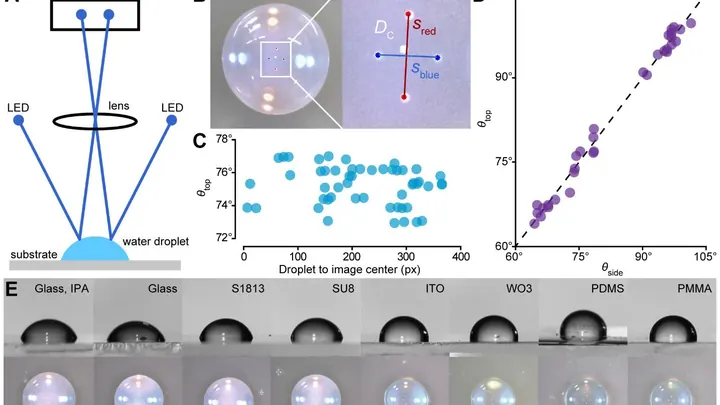
A water droplet on a fresh polymer film behaves like a guest on new furniture: sometimes it spreads out, sometimes it beads up. This behavior tells you how ready the surface is to repel dirt or, conversely, to hold paint. Previously, such tests were done by hand, one film at a time.
Now there's a robot called PANDA-film.
A pulsar is a dead star that spins and emits radio pulses like a lighthouse. If a pulsar has a companion, they whirl around a common center of gravity.
Many molecules, like amino acids, are like musical notes: their left and right versions sound almost identical, yet the difference is critical. One heals, the other is poison. Picking up this difference is hindered by inescapable noise, like in a room where a fan is loudly running. Regular spectroscopy misses the nuances.