Weak Light, Long Acceleration express
If you hit an atom with a strong laser, the electron flies out like a ball off a racket and then comes back. When it returns, it releases the accumulated energy as a flash of light. Usually, the energy of such a flash is limited: the electron only has time to accelerate a little.
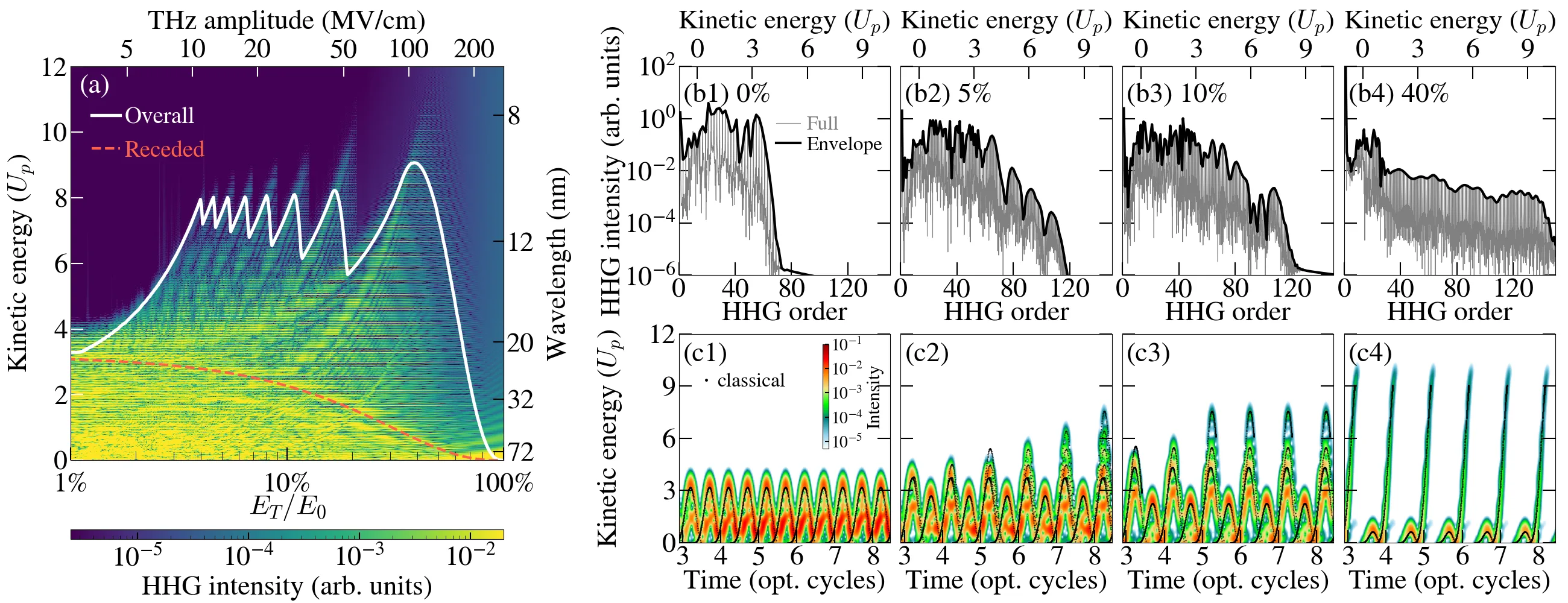
Now physicists have added a weak terahertz field to the laser, like a gentle tailwind. It turns out that even a weak wind can make the electron orbit the atom for several cycles before returning. During that time, it gains much more energy, and the flash becomes shorter and brighter. On a graph, this looks like a fish fin: a long tail of energies that was previously unattainable.
This mechanism works for different atoms and does not depend on precise laser tuning. That means we can build compact tabletop sources of ultraviolet and soft X-rays, which could be useful in medicine, microelectronics, and for observing ultrafast processes.
Original abstract
as written by the authors arXiv:2601.16747
Extending the high-harmonic cutoff with experimentally accessible fields is essential for advancing tabletop coherent extreme ultraviolet (EUV) and soft X-ray sources. Although terahertz (THz) assistance offers a promising route, cutoff extension at weak, laboratory-accessible THz strengths remain poorly understood. In this report, we comprehensively investigate THz-assisted high-order harmonic generation (HHG) using time-dependent Schr\"odinger equation simulations supported by classical trajectory analysis and Bohmian-based quantum dynamics. By mapping the plateau evolution versus THz strength, we show that even weak THz fields can extend the cutoff, producing a pronounced ``fish-fin'' structure whose prominent rays saturate near $$I_p + 8 U_p$$. We trace this extension to long electron excursions spanning several optical cycles before recombination, and provide a fully consistent explanation using both classical analysis and Bohmian trajectories flow. Our findings reveal that this cutoff-extension mechanism is remarkably robust, persisting across different atomic species and remaining insensitive to variations in the driving parameters. These results demonstrate that cutoff control is achievable with laboratory-scale THz fields, offering practical guidelines for engineering coherent high-energy HHG, and providing a robust pathway for tracking ultrafast electron motion in real time.
In such a process, the electron can fly away from the atom to a distance thousands of times larger than the atom itself, but it still comes back.
In Stanisław Lem's novel "Solaris," the planet's ocean creates strange structures that cannot be explained, just like the behavior of an electron in a strong field, which at first glance defies intuition.