Second-harmonic generation (SHG) is a nonlinear optical effect where two photons of the same frequency combine inside a crystal to produce one photon at twice the frequency — effectively doubling the light's energy. It is the simplest and most common nonlinear optical process, and it underpins many laser technologies. SHG is also a powerful microscopy tool: it occurs only in non-centrosymmetric materials, so it can image collagen fibers, muscle tissue, or cell membranes with remarkable specificity, without any fluorescent dye.
History
SHG was first observed in 1961 by Peter Franken and colleagues at the University of Michigan, just a year after the invention of the laser. The experiment was so ahead of its time that the editor of Physical Review Letters mistook the faint spot on the photographic plate for a defect and cropped it out of the published figure.
How it works
In a nonlinear crystal (like beta-barium borate or lithium niobate), an intense laser field distorts the electron cloud so strongly that the material's response becomes nonlinear. The oscillating electrons emit light not only at the driving frequency but also at its harmonics. For SHG to be efficient, the crystal must be 'phase-matched' — the refractive indices at the fundamental and doubled frequencies must be equal, so the generated light adds coherently as it travels. This is often achieved by tilting the crystal or using temperature tuning.
In practice
SHG is used to convert infrared laserlight into visible or ultraviolet light for spectroscopy, to create green laser pointers (from infrared diodes), and in nonlinear microscopy to image biological tissues without staining.
Fun fact
The original SHG paper's published figure had the crucial spectral line removed by an editor who thought it was a dust spot — the first and only time a discovery was accidentally edited out of a scientific record.
A laser pulse slams into a crystal of Ca0.4Sr0.6CuO2, and inside the chains of copper and oxygen atoms a dance begins that lasts less than one millionth of a nanosecond. In an ordinary conductor, electrons run freely through the material, but here strong Coulomb repulsion pins them in place like passengers in a packed bus.
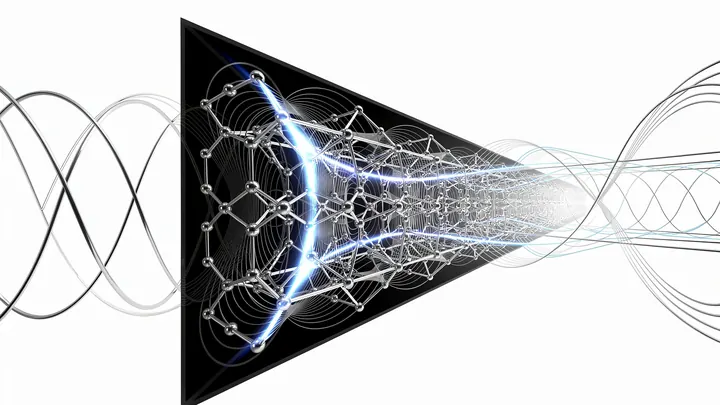
A gas target is like a funnel: the steeper its walls, the stronger the flow. But in this funnel, it is not water that flows, but ultraviolet light, born when a powerful laser pulse passes through a cloud of argon. The efficiency of this conversion is usually minuscule, about 0.001%: out of a thousand laser photons, only one turns into useful ultraviolet.
In a dark room, a spark jumps between two wires, and for an instant, there is light. Physicists have done something similar, but a million times smaller: at the boundary of two transparent crystals, they drew a conducting path and left a break just a few atoms wide. When a direct voltage was applied across this tiny gap, it began to glow.
Collagen is the rope from which our tendons, skin, and bones are woven. Each "rope" is a bundle of molecules twisted into a triple helix, like three strands in a cable. Until now, no one had seen what happens to these strands when we pull on the cable.
In an ordinary room, light vanishes the moment you switch off the lamp. In a tiny silicon nitride cavity, a photon can bounce between the walls 80,000 times before it gets lost. It's like a ball thrown into a room that rebounds off the walls with almost no loss of speed.
A light beam usually travels in a straight line, but you can make it spin around its axis, like water swirling into a vortex as it drains. This 'twisted' light carries more information and is needed for ultra-fast communication and quantum computing.
A copper oxide crystal looks like a dark red pebble. But when a short laser pulse hits it, pairs are born inside: an electron and a 'hole'—a place where an electron is missing. Such a pair is called an exciton and behaves almost like a hydrogen atom: the particles circle each other, bound by electric attraction.
A stack of playing cards lies still. You can slide the top card with your finger: that's crude intervention. Or you can blow so that the whole stack momentarily changes shape, but the cards don't scatter. That's roughly how light, in a new experiment, rearranges a crystal of tin selenide (SnSe).
Usually, to change the structure of a solid, you heat it or pass a current through it.
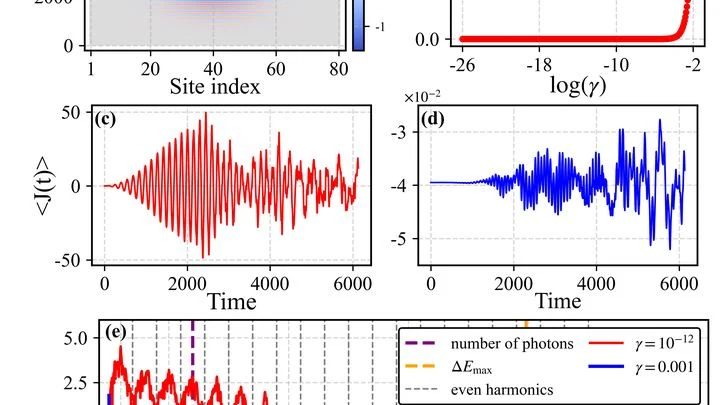
A guitar string plucked exactly at its middle produces only odd overtones. The same prohibition holds in symmetric crystals: when light knocks out electrons, their re-emitted radiation contains only odd harmonics. But physicists have found a way to bypass this rule — without shifting a single atom.
The secret is electric current.
The Universe is humming, but our ears catch only the bass. LIGO hears the rumble of black hole mergers — the infrasound of space. Higher up, in the gigahertz range, the flutes and violins of primordial gravity ring out.
In very dim light, photons arrive one by one, like drops from a leaky faucet — never in pairs. This effect, predicted by Roy Glauber and confirmed by Leonard Mandel, directly proves that light is made of particles.
Imagine a carousel with two types of seats: some spin clockwise, others counterclockwise. If you push all of them at once, the carousel jerks but stays in place. That's how a Weyl semimetal crystal works: electrons are born in pairs—'left' and 'right'—and their contributions to current cancel each other, like two identical motors running in opposite directions.
Two tiny mirrors in a vacuum are like figure skaters in a pairs routine. Their oscillations are synchronized by an invisible gravitational thread. When cooled to millionths of a degree above zero, this thread turns them into a single quantum link — the motion of one instantly echoes in the other.
Two ultra-thin sheets, each just one atom thick, are placed on top of each other and slightly rotated. Like two sheets of colored tracing paper: while they lie flat, the picture is one thing, but give them a twist and a moiré pattern appears. Here, though, the pattern isn't visible to the eye, but it completely changes how the material handles light.
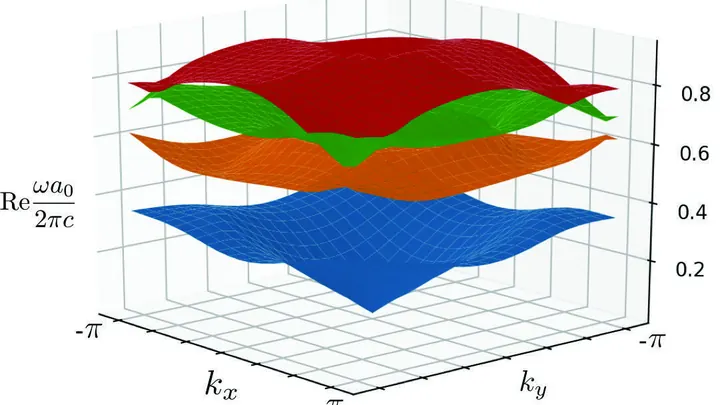
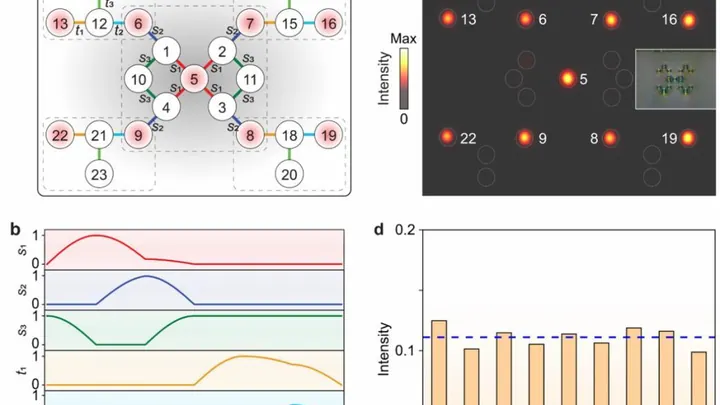
Light, discovered by Maxwell, behaves differently in different media. In a new study, researchers simulated a two-dimensional crystal that absorbs light and has magnetic properties. In it, light waves behave like passengers on a one-way escalator: they relentlessly move toward edges and corners, where they accumulate.
An ordinary camera flash lasts thousandths of a second. An attosecond pulse is a trillion times shorter — in the time it takes, light travels a distance smaller than the size of an atom. Such flashes act as an ultra-high-speed shutter: they freeze the motion of electrons, letting us see them jump between orbitals or take part in a chemical reaction.
Light from a bulb or even a regular laser resembles a crowd at a subway exit: people move haphazardly, sometimes dense, sometimes sparse. Physicists call this behavior shot noise — random fluctuations in the number of particles arriving per second.
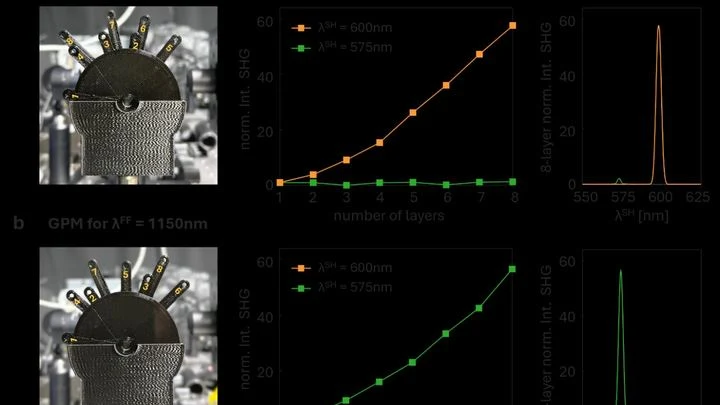
A sheet of paper weighs almost nothing, but stack a hundred sheets and you get a noticeable pile. That's roughly what scientists did with a material that excels at converting one color of light into another, but only when it's just one atom thick. A single layer is like a single sheet: it works beautifully, but it's too thin to produce much light.
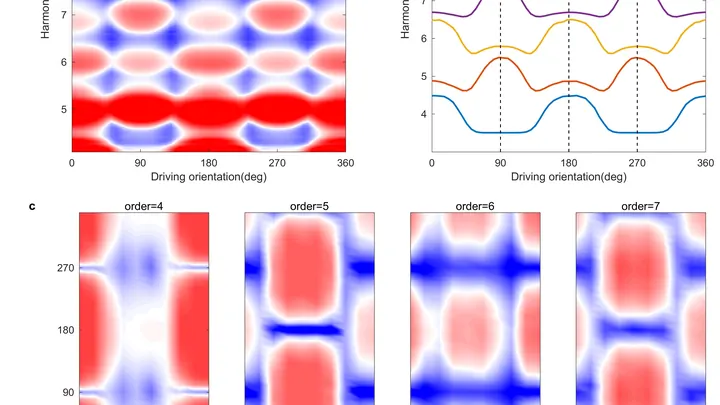
A laser beam hits an atom, and an electron is knocked loose. It accelerates, returns, and, crashing into the atom, emits a flash of light — a harmonic. If there are two light beams and they are crossed like an intersection, the electron can choose different routes. In the new experiment, the two beams had comparable strength and were directed at right angles.
A laser strikes the crystal, and it responds with flashes of light, like a bell ringing after a blow. But if the bell is warm, its sound wavers and fades. Same here: the crystal's atoms constantly jitter from heat, and this jitter disrupts the electrons' smooth flight, making the light dim and blurry.
Light in an optical fiber is a stream of photons, and quantum communication requires single photons that can be sent one at a time. But making them emerge quickly while remaining indistinguishable from one another is a tough challenge.
A laser beam inside a special crystal spontaneously turns into a “Schrödinger’s cat”—a mixture of two states. Erwin Schrödinger dreamed up this paradox for an atom, but now physicists see it happen with an entire stream of photons.
Light is like a company of soldiers on a parade ground.
Ordinary light is like a crowd in a square: each photon moves on its own, bumping into others and scattering. But in some media, photons start running together like a pack of dogs: they bunch up. Scientists have built a random fiber laser where light particles gather into especially dense clusters.
A tiny diamond bridge vibrates so strongly that it starts to 'sing' at many frequencies at once. Previously, such vibrations would dampen themselves: the harder the resonator swung, the harder it was to add energy. Physicists found a loophole in this rule.
They used light to drive the diamond. Light pushes on the bridge, making it tremble.
The edge of a magnet works like a guitar fret: a string pressed near the edge sounds different, with a richer set of overtones. Magnetic waves in a thin strip of nickel and iron behave in much the same way.
A laser beam hits a transparent crystal, and the crystal answers with a whole rainbow — from infrared to invisible ultraviolet. This isn't a trick with mirrors; it's the work of a nonlinear crystal, which can add light frequencies the way a musician plays not just the fundamental note on a string but also its overtones.
An ordinary lamp scatters light in all directions, and it is impossible to predict when the next photon will fly out. Quantum technologies, however, need a completely different kind of light — single photons that appear strictly one at a time, like letters slipping through a mail slot.
A sharp tug on a twisted cord sends a spiral wave along it. Similarly, an ultrashort laser flash in a RhSi crystal gives birth to light instantly twisted into a three-dimensional corkscrew.
Light hits a thin film, and an electric current instantly appears in it. This is how a pair of two materials works: molybdenum disulfide and cobalt. The first is a semiconductor, the second is a magnet. Between them, as it turns out, an invisible intermediary layer is born.
Light passing through a thin crystal can change color and the direction of its oscillations. In a molybdenum disulfide flake just hundreds of atoms thick, an infrared beam turns green, and its polarization, the way the light wave oscillates, obeys the crystal's geometry.
An ordinary piece of semiconductor weakly changes the color of light passing through it. For decades, physicists worked around this limitation by placing the crystal in clever surroundings, but the material itself remained the same.
Now researchers have assembled a "sandwich" of alternating thin layers of gallium arsenide and aluminum gallium arsenide.
When two light beams meet in a crystal, they can generate a third beam with a different frequency. For this process to be efficient, the waves need to stay in step, like two people walking side by side without breaking stride. Previously, two old tricks were used: either picking a crystal with the right properties, or slicing it into thin layers.
An ordinary free-electron laser is like a musical instrument with a single string: it can play only one note until you change its design. To get a different wavelength, you have to retune magnets or accelerate electrons harder. That's expensive and bulky.
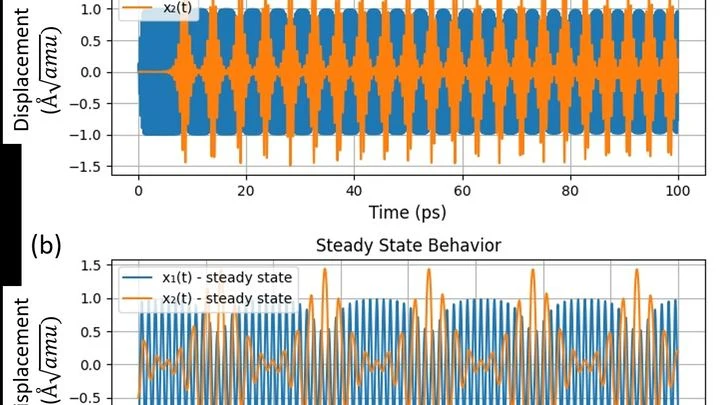
A short laser pulse hits a crystal, and instead of a single sound, the crystal responds with a whole ladder of frequencies, each separated by the same interval. This is how a phononic frequency comb is born, a phenomenon that physicists are exploring in a material with an unusual internal structure.
Light from a single bulb usually spreads in all directions, and catching it in equal portions across several channels is quite a puzzle. In the new work, light is split into nine identical beams without a single lens or mirror. Instead, there's a glass plate with etched waveguide paths, along which light naturally flows in the desired way.
Light from an ordinary bulb is a stream of individual photons, like drops from a faucet. But there is also light where photons come in pairs, like twins walking together. Such grouped light has long been desired for measuring distances and imaging objects hidden around corners. But sources of this light were either too dim, or their flashes too short for ordinary detectors to catch.
Imagine blinds that don't just block or let through light but change its color. Light hits the slanted stripes, and some rays come out a different shade, as if a white beam, passing through the slits, turned green. That's exactly how this new surface works: on a thin film of lithium niobate (a material that can transform light), there are slanted stripes of titanium dioxide.
When you pluck a guitar string hard, it doesn't sound a single note but several at once — the fundamental tone and overtones. Physicists have pulled a similar trick with light: they aimed an infrared laser at a crystal, and the crystal lit up with sixteen colors at once, from invisible heat to hard ultraviolet.
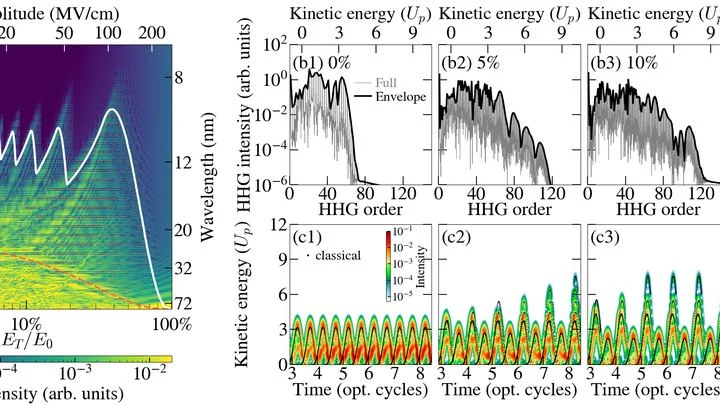
If you hit an atom with a strong laser, the electron flies out like a ball off a racket and then comes back. When it returns, it releases the accumulated energy as a flash of light. Usually, the energy of such a flash is limited: the electron only has time to accelerate a little.
Now physicists have added a weak terahertz field to the laser, like a gentle tailwind.
A flashlight beam in fog draws a cone, but it can't carve a figure out of a cloud. A hologram, though, is like a stencil for light: it knows in advance where to gather into bright points and where to remain shadow. Now such a stencil makes liquid resin solidify throughout the entire volume at once, without layer-by-layer printing.